When Banks Shut Out Jewish Immigrants, They Built Their Own Financial System
In Credit to the Nation, Rebecca Kobrin chronicles East European Jewish immigrants who came to New York and, by lending to fellow Jews, became a crucial part of the city’s history.
What are immigrants to do when business opportunities abound in their new home, but banks refuse essential financial support? How can they make the journey in the first place without help?
In Credit to the Nation: Eastern European Jewish Immigrant Bankers and the Shaping of American Finance, 1873–1930, Rebecca Kobrin, Russell and Bettina Knapp Associate Professor of American Jewish History, chronicles turn-of-the-20th-century Jewish immigrants who stepped up by doing the lending themselves. Arriving from the Russian Empire and settling primarily in New York, they made livelihoods by assisting fellow Jews so they could purchase passage to the United States and, after arriving, obtain credit that other lenders would not dare provide.
The book traces the novel practices of bankers who not only enabled the flourishing of American Jewry, but also revolutionized the U.S. financial industry. Drawing on previously unexamined archival materials in Russian, Yiddish, German, and English, Kobrin tells a story that is also crucial to the history of New York, as immigrant bankers’ financing of real estate transformed wide swathes of the city. Lenders drove a boom in the prices of tenement buildings, but heavy speculation eventually precipitated the downfall of immigrant banking. Kobrin notes in particular the case of the Bank of United States—a private lender catering primarily to Jewish businessmen—which the Federal Reserve refused to bail out from bankruptcy in 1930.
Immigrants’ grasping for credit, and the rise and fall of immigrant banks, gave way to a contemporary banking industry that, ironically, refuses credit to today’s immigrants. Kobrin emphasizes that now, as before, the denial of credit pushes entrepreneurial Americans into unregulated money-lending and the trap of endless debt.
Tell us about your book.
What if the story of Jews and American banking wasn’t really about Wall Street titans like Jacob Schiff, Felix Warburg, or the Lehman brothers, but about immigrant families who arrived with little, and built commercial banking businesses that helped others thrive?
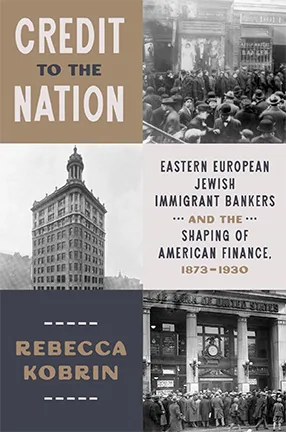
Credit to the Nation restores a lost chapter in the story of Jews and American banking. Through telling the tale of a dense network of Yiddish-speaking immigrant brokers, the book expands our understanding of Jews’ engagement with the world of banking beyond investment banking. For millions of East European Jewish immigrants, banking was far more personal—and urgent. They arrived with just a few dollars and needed to find a place to set up an account so they could save, bring over relatives, perhaps open a small business, or buy a first home. Traditional banks shut them out. Banks like Chase Manhattan operated only in English, and would open accounts for clients with larger sums. Moreover, these banks would not loan to individuals without collateral.
So immigrant communities built their own financial system. While every immigrant group created its own banks, in New York City, East European Jews dominated the world of immigrant banking, as the city was the East European Jewish immigrant capital of the world.
My book opens in Eastern Europe, and lays out the distinctive culture of credit that dominated in Jewish Eastern Europe. I then follow how Jews borrowed to buy ship tickets, enabling them to traverse Europe to get to port cities, and make their way to the United States. As East European Jews boarded ships with their candlesticks and featherbeds, they also migrated with their ideas about credit, risk, failure, and debt. The book brings to life the forgotten network of Yiddish-speaking immigrant brokers who made this all possible, transforming not only American Jewish life, but also American commercial banking from the bottom up.
These East European Jewish immigrant ship-ticket salesmen called their businesses banks in the United States, despite not being state-chartered banks, and remade three overlapping businesses—the business of migration, which sold ship tickets on installment; the business of banking, which offered financial services to those with only a few dollars; and the dynamic enterprise of real estate development, as they provided mortgages to immigrants with dreams and ambition, but no collateral.
Credit to the Nation brings to life men like Sender Jarmulowsky, born in Tsarist Russia, who went on to become a rabbi before going to Hamburg to sell ship tickets, and then venture to New York City to found a bank there. Jarmulowsky succeeded because he traded in small sums, offering his customers banking services in Yiddish, Russian, or Polish, accepting small deposits, granting loans, translating and writing letters, and transferring amounts as minuscule as $1 overseas—all services larger banks like Chase refused to do. Moreover, as a Senate Commission reported, Jarmulowsky “fixed his bank hours to suit the convenience of his patrons”—with Sunday being his longest day of business, when every other bank in New York was closed.
The world of finance was always suspicious of immigrant bankers. Although Jarmulowsky’s bank ultimately failed in 1914—like those of some other bankers I discuss such as Max Kobre—their banks form a critical, yet still untold chapter in the overlapping histories of American finance and American Jewish immigration. By offering credit, these East European Jewish immigrant bankers linked together the businesses of migration, banking, and real estate, and helped millions of immigrant strivers with just a few dollars achieve the American dream.
How did you come to this project?
Indeed, it was not an interest in banking, but rather my love of walking New York City’s streets and learning from the built environment. For years, I have taken my classes to the Lower East Side. A few blocks down from our first stop, the Tenement Museum on Orchard Street, one finds a 12-story building located at the corner of Orchard and Canal streets, which still towers over the surrounding tenements. Emblazoned over its door is: S. Jarmulowsky’s Bank. The questions this building would elicit from my groups, and my attempts to answer them, led me to this book project.
Aside from erecting his bank tower—called the Temple of Capitalism—Jarmulowsky also helped build the Eldridge Street Synagogue, demonstrating his concern for both the spiritual and economic lives of those who lived on the Lower East Side. Buildings have great stories to tell. My narration of their stories highlights a time when New York City served as both the financial capital of the United States and the East European Jewish immigrant capital of the world.
What are your sources for this story?
This sweeping story of migration and adaptation forced me to delve into archives in cities as diverse as Moscow, Warsaw, Rotterdam, Hamburg, New York, and Jerusalem. Drawing on documents written in Yiddish, Russian, Polish, German, and Dutch, the book reveals how immigrant bankers created institutions that served communities ignored by mainstream finance—keeping their banks open all day on Sundays when no other banks were open, translating documents for their clients, and tying together migration, credit, and real estate into a powerful engine of mobility.
What are the lessons for today?
Credit to the Nation is not just a story about the past. The last chapter looks at Chinese immigrant banks in Lower Manhattan in the last few decades, located in buildings just steps away from Sender Jarmulowsky’s bank, which is now the upscale Nine Orchard Hotel. The book explores the enduring links between immigration, inequality, ethnic entrepreneurship, and financial access. I show how America’s financial system was shaped, then and now, not only in corporate boardrooms, but also in crowded immigrant neighborhoods where no one spoke English.
These forgotten East European Jewish immigrant bankers were a twofold credit to the nation: Through their offers of credit, they made it possible for thousands to make it to America, and then make it in America by offering uncollateralized loans. These bankers were a credit to the Jewish nation by providing loans to those who other banks would not serve, and by pushing mainstream commercial American banks to think in new ways of how to address the growing number of unbanked foreign workers who were transforming America.
Through the stories of these colorful Jewish immigrant entrepreneurs, we can gain new insight into long-standing debates in America over credit access, banking regulation, and immigration. Far from being strictly academic, these debates continue to this day. Eastern European Jewish immigrant bankers working in Yiddish on the periphery transformed not only the Jewish immigrant world, but also New York’s larger political and economic infrastructure.
What are you teaching this year?
Immigrant New York, Jews and the City, and American Jewish History.
What have you read lately that you would recommend, and why?
I am currently reading The Personal Librarian, a work of historical fiction about a topic that fascinates me--book collecting--which beautifully captures the dynamics of race in Gilded Age New York. I love how the book brings to life a remarkable, but little-known woman of the Gilded Age, Belle da Costa Greene, who was the personal librarian to J.P. Morgan, and later became the first director of the Morgan Library and Museum in New York. Moreover, I enjoyed the smooth narrative, which is astounding considering that the book is a collaboration between Marie Benedict and Victoria Christopher Murray.
Do you have a favorite spot on campus?
I love the pedestrian bridge over Amsterdam Avenue looking north, where you can appreciate the bluff on which Columbia sits.
Through the Institute for Israel and Jewish Studies, Rebecca Kobrin will discuss Credit to the Nation with Kim Philips-Fein, and how entrepreneurial Jewish immigrants transformed commercial banking and enabled the economic and social advancement of Jews in America, on Thursday, September 24, at 1 pm, in 617 Kent Hall.