A Professor of Indo-Tibetan Buddhism Focuses on Buddhist Cultural Production
Dominique Townsend recounts how, as a high school senior, a 12th-century wooden statue of a Buddha in a museum helped set her on her path.
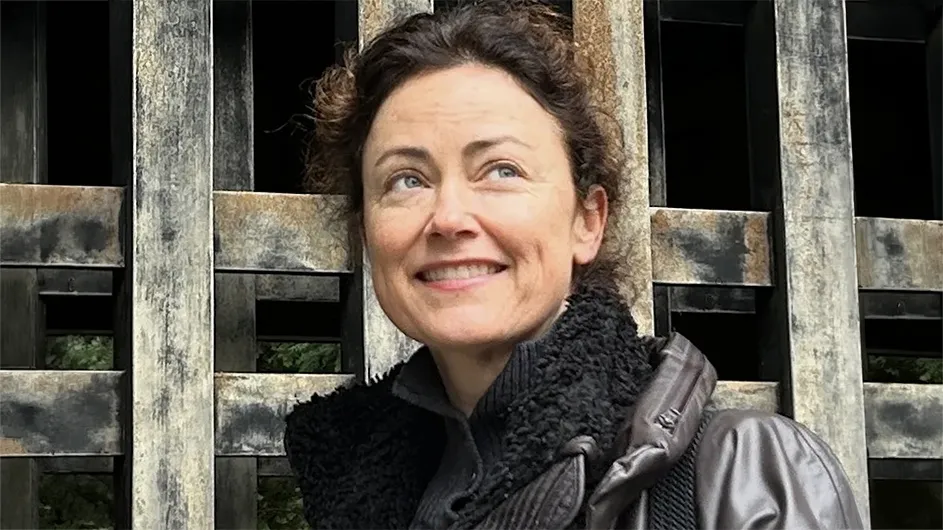
During an event that she moderated at the Lenfest Center for the Arts a few months ago, Dominique Townsend, Jey Tsong Khapa Associate Professor of Indo-Tibetan Buddhism, recounted asking the acclaimed writer Ocean Vuong and multimedia performer Laurie Anderson, in an early meeting how their Buddhist practice interacted with their creative practice. “They looked at each other and then at me,” she said, “and answered identically: ‘They are the same.’”
Since long before she helped organize that transcendent evening, Townsend has been exploring issues such as Buddhist practice as creative practice. As a scholar of Tibetan Buddhism whose research combines historical and literary methods, Townsend’s interests include Tibetan Buddhist cultural production, poetry, aesthetics, dreams, gender, and translation. Her research is rooted primarily in Classical Tibetan texts, with an emphasis on the 17th through the 20th centuries. She teaches courses on Tibetan Buddhism and history, Asian humanities, poetics, new media, dreaming, and Buddhist approaches to death and dying.
What is the single unifying thread that runs through your body of work?
The unifying theme in my work is the resonance between Buddhist practice, creativity, and cultural history. I’ve written a lot about Buddhist aesthetics as a connective force between being in the world on the one hand and renunciation on the other. I’ve also focused on Buddhist poetics and translation, and currently I’m writing a book about the work of dreams in Tibetan Buddhist cultural expression and experience.
What attracted you to the study of Tibetan Buddhism, and what was your path to becoming a professor?
When I was a teenager trying to make sense of the world, Japanese and Vietnamese poetry in translation, Buddhist sculpture in museums, and the writings of teachers like Thich Nhat Hahn, Suzuki Roshi, and Pema Chödrön drew me to Buddhism. I was curious about the potential for Buddhist art forms to help people manage difficult experiences. As a high school senior in Providence, Rhode Island, I liked to visit a 12th-century wooden statue of Mahavairocana Buddha in the RISD Museum after school. I would often just rest there in the gallery, appreciating the statue’s calm presence. When I was deciding where to go to college, I was sitting with the statue when it occurred to me that I could study this. At the time, my sense of Buddhist studies and the study of religion in general was vague. Even so, I had a feeling that’s what I wanted to do, and my resolve was clear.
I went to Barnard, where I majored in religion and concentrated on Buddhist studies with the late Professor Robert Thurman. The faculty members were brilliant and nurturing, and while I also studied French literature seriously and did a lot of poetry and sculpture in workshops, the study of religion was the container that held all my other interests. I had studied the modern political history of Tibet in high school as well, so Tibetan Buddhism felt like a natural focus for me in the diverse field of Buddhist studies. (At Columbia, there’s a robust history of excellent scholarship in South Asian and East Asian religious traditions, along with Tibetan Buddhism.) The course catalog was a treasure chest for me, and I took philosophy courses about phenomenology and existentialism. I also engaged deeply with 20th-century European thinkers, and, at the same time, began to study Classical Tibetan language. I found wonderful cross-pollination in my courses, and tended to take multiple classes with the faculty members who inspired me most.
When I graduated, I had the sense that I knew a lot about Buddhist theories, but not enough about Buddhist practice as it’s lived, so I went to India to reside in a community of Tibetan Buddhist nuns. I taught English, studied Tibetan language, and observed the nuns’ daily practices of memorization, recitation, ritual, and debate. There were nuns who were learning to create sand mandalas, nuns who were working toward the equivalent of a PhD in philosophy, and those who were more focused on ritual or meditation. I learned from all of them, not just as scholars, artists, and practitioners, but also as friends.
After a year at the nunnery, I went to live in Kathmandu, Nepal, where I worked for a few different university programs that enabled me to travel regularly to Tibet and India. I was studying Tibetan language and doing Buddhist studies with tutors. I was learning so much, but eventually, I felt the need for a more disciplined course of study than I could manage on my own. I enrolled in the Masters of Theological Studies program at Harvard Divinity School. I studied there with some wonderful Tibetan Buddhist scholars, especially Janet Gyatso and Leonard van der Kuijp.
Browsing through Tibetan language books in the stacks at Harvard, I started my research on Buddhist aesthetics and cultural history, and decided to continue that work as a PhD student in Columbia’s Department of East Asian Languages and Cultures, with Gray Tuttle as my doctoral advisor. I came to see the cultivation of the senses in Buddhist education as a connective force between Buddhist theories of transcendence and renunciation with practical approaches to being a person in the world. A Tibetan monastery called Mindröling, which is famous for literary arts in particular, was the focus of my dissertation. After I finished my PhD at Columbia, I taught at Barnard for a year, and then worked as the head of interpretation at the Rubin Museum in New York. (Sadly, the museum is now closed, although the curators still develop exhibitions from its marvelous collection to show elsewhere).
In 2016, I began teaching Buddhist studies in a tenure-track position at Bard College. Bard is a gem of liberal arts education; while there, I learned so much about pedagogy and student-focused teaching and advising. In 2024, I became a professor at Columbia. I’m in the position one of my undergraduate mentors, Bob Thurman, held before me—an immense honor. Over the years, the relationships I’ve had with mentors and peers alike have shaped the way I approach scholarship and teaching. I’ve come to see the study of Buddhism as a wonderfully rich field for studying humanities, which, in its most basic sense, concerns understanding what it means to be human.
How does Buddhism manifest as a creative practice?
In so many ways! This is such a rich area of humanities research, I hesitate to reduce the question to a single answer. I’m continually thrilled by how Buddhist practitioners throughout history and today have engaged poetry, translation, song, visual arts, theater, and dance as expressions of Buddhist insight and experience. Creative and imaginative practices offer means to cultivate and record perception.
Take poetry, for example: Composing poems can inspire, bear witness to, and movingly communicate Buddhist insights, emotions, and experiences. Poetic forms can embody meditative experience, compassion, and insight in ways that are not as accessible through discursive uses of language. When I was in high school, I found a volume of Buddhist haiku edited by the poet Robert Hass in a used bookstore. Those little poems often convey remarkable instants of experience, which are ordinary until they are captured in the container of the lines, and then they become something bright and clear, a moment of wakeful attention.
Poetic traditions in early Indian Buddhism, such as the Therigatha, translated by Charles Hallisey, or the tantric Buddhist verses in Tantric Treasures, translated by Roger Jackson, all offer the reader access to instants of alertness and attention, which is a profound aspect of Buddhist experience. Poetry is just one example of many art forms that demonstrate the mutuality of Buddhist practices and creative practice. At root, it’s about paying attention and finding the means to train and share that attention.
And as an ethical system of social justice?
Buddhist ethics are based on a commitment to recognizing cause and effect. This demands self-reflection, honesty, and disciplined efforts to reduce selfish habits, while also developing habits of caring for and prioritizing the well-being of others. Buddhist traditions are very diverse from each other in many ways, but every tradition of Buddhism is consistent in the commitment to benefiting others, and to being accountable for self-serving attitudes and actions. The actions a person takes physically, verbally, mentally, and emotionally, and the impulses that spark those actions, are the bases for future experience, according to Buddhist theories. Being ethical means to cultivate a deep sense of one’s own biases, neuroses, and blind spots, as well as one’s values and virtues, so as to be able to slow down the processes of acting and reacting, moving toward more compassionate action and less self-centeredness. This approach involves a lot of contemplation and patient looking inward to understand and reckon with one’s own behavior.
Buddhist ethics is also focused on the subtle intentions that spark actions, and the frequent occurrence of unintended consequences. This approach to ethics is often associated with solitude and renunciation, but it certainly can also translate into social justice work. That’s been especially evident in the life and legacy of Vietnamese Buddhist monk and activist Thich Nhat Hahn, for instance. Fragrant Palm Leaves is a recent publication from his edited journals, some of which recount the time he spent in the Columbia neighborhood.
Summer plans?
During the summer, I conduct fieldwork in Tibetan Buddhist regions in Nepal. Even though my work is primarily historical and literary, I spend as much time as I can in Buddhist communities where the art forms and practices I study are very much alive. I value the expertise of Buddhist practitioners and native speakers of Tibetan language immensely, and I rely on their guidance in my own research and writing. I aim for my work to be meaningful to Buddhist practitioners, as well as to students and scholars of Buddhist studies and the humanities in general.
This summer, I’ll be in Upper Mustang and the Kathmandu valley. There’s a conference for the International Association of Tibetan Studies in August, and I’m excited to learn about the research of my colleagues, especially junior colleagues, and those who are based in East Asia and South Asia.
What are you working on now?
I’m writing a book about dreams in Tibetan Buddhist experience. I’ll be on leave from teaching next year so I can finish the book.
Advice for students interested in pursuing a trajectory similar to yours?
Start studying Buddhist languages right away. It’s time-consuming, so it’s important to start early. Whether the research is ethnographic, historical, literary, or otherwise, having a deep knowledge of the relevant languages is essential. I also recommend reading widely across genres, including poetry and fiction, to develop a sense of the language as it’s lived. I urge students to go into libraries and browse the stacks. Titles will catch your eye and lead you to make connections that won’t emerge virtually. Seek out mentors, both in the academy and beyond. If you’re inspired or moved by the work of a scholar, translator, practitioner, or critic, reach out and tell them briefly and specifically what moves you about their writing. Don’t worry if you don’t hear back; just keep seeking those connections, and some of them will spark. Keep journals and notebooks where you track your own questions and observations.
These are lifelong pursuits, and students might return to research questions decades after they first arise. My research on dreams traces back decades, but only now am I fully turning my attention to those sources in Tibetan literature. It’s amazing to go back to old notebooks, and recall what inspired and intrigued me all those years ago. Now I have the experience and perspective to make sense of the literary, biographical, yogic, medical, and psychological aspects of dreams in Tibetan literature, and I’m so glad to have those fragments of ideas and theories that started germinating when I was a student.
Lastly, it’s vital for students to connect with peers who share their interests and methodological commitments, especially across disciplines. Start reading and writing groups where you can share ideas, questions, drafts, and feedback. Scholarship is about communicating and growing our shared capacity to see clearly and understand, and we need each other.
What is the best thing about teaching at Columbia?
The libraries are a marvel; in particular, the resources we have in Tibetan Buddhist studies are unparalleled. We have dedicated Tibetan studies librarians who can expertly advise students on the collections. In general, the staff and faculty inspire me every day. But the best thing about Columbia is the students. In these terribly trying times, when there are so many threats to expression and dialogue, the students give me hope.