Maria Victoria Murillo Is the New Chair of Political Science
The field “provides essential tools for understanding how power operates across society,” she says.
Columbia’s Political Science Department was the first of its kind in the country, founded in 1880. Today the department is one of the largest at Columbia, serving one of the biggest undergraduate majors on campus, and annually attracting a stellar group of graduate students. Among the faculty are leaders and prize winners in every subfield of the discipline; and graduates of the department are leaders in global and domestic public and private sector organizations, as well as professors at colleges and universities in the United States and abroad.
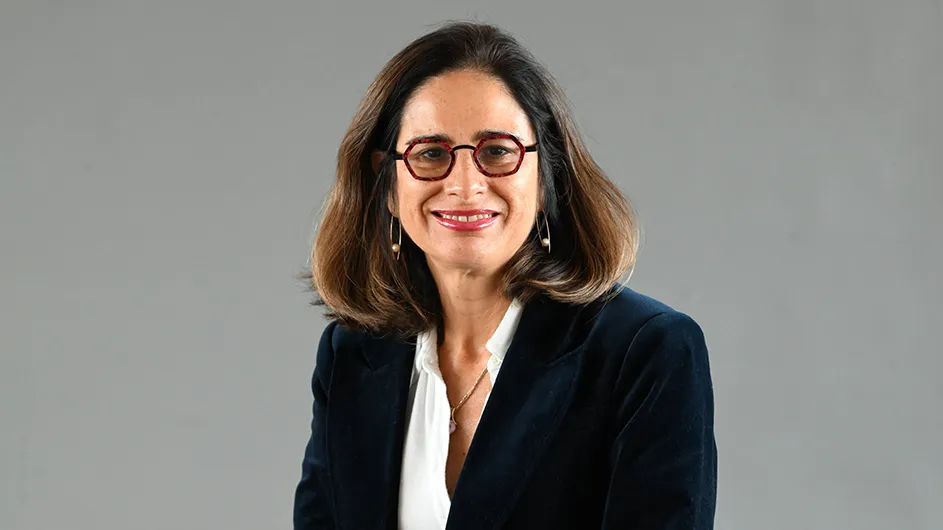
Maria Victoria Murillo, the new chair of the department, talks about her plans for Political Science with Columbia News.
As the new chair of Political Science, what are your plans for the department?
As one of Columbia’s larger majors, I want to build a stronger sense of community among our undergraduate students, including programming that facilitates their interaction with faculty and alumni. I also want us to make greater use of social media to communicate with students and strengthen their connection to the department.
Academically, we are developing new experiential learning courses to be offered this spring, and we are discussing broader curriculum reform to ensure that our teaching responds to a rapidly changing technological and political environment.
Finally, as chair during our academic review, I want to work with my colleagues to think strategically about where we want the department to be over the next decade, particularly given the crucial role of political science in understanding the political and societal transformations we are experiencing.
While chair, will you continue to teach? If so, what are you teaching this semester, and in the spring?
Yes. I will be teaching Latin American Politics, a large lecture course that brings multiple perspectives to the study of the region and its relationship with the U.S., while also introducing students to core concepts and methods in comparative politics.
What sort of programming is planned for the department this year?
We expect to organize events around the midterm elections this fall, and to collaborate with the Political Science Students Association on a welcome event for our undergraduate students. More broadly, we hope to create additional opportunities for students to engage with faculty, alumni, and one another outside the classroom.
Why is the study of political science so important?
Political science provides essential tools for understanding how power operates across society. This field develops critical thinking, writing, and research skills, while exposing students to multiple perspectives on fundamental political questions and values. In the age of AI, these broad and flexible analytical skills are more important than ever. Political science prepares students not only to adapt to a changing world, but also to understand and shape it.
What was your path to a career as an educator and writer?
I was a student activist in high school in Argentina during the transition to democracy, which sparked my interest in politics. I studied political science at the University of Buenos Aires, where the major had only recently been created following democratization. I was part of only the second graduating cohort. As one of the more advanced students in the new program, I received a research fellowship that allowed me to conduct independent research with a faculty mentor.
I discovered that I loved research and decided to pursue graduate studies, which at the time required leaving Argentina. I came to the U.S. on a fellowship to pursue my PhD at Harvard: This was before the internet, so I still remember learning about PhD programs from a guidebook! My dissertation examined labor unions and market reforms in Argentina, Mexico, and Venezuela, and involved extensive fieldwork in all three countries. I loved doing comparative research. After graduating, I joined the faculty at Yale, where I continued working on the political economy of Latin America. This research has led me to publish academic books and articles in both English and Spanish, as well as occasional pieces for broader audiences.
Since moving to Columbia in 2003, I have continued teaching Latin American politics in lectures and seminars for undergraduate students. I also teach comparative politics to graduate students and a course on political and economic development at Columbia’s School of International and Public Affairs.
Teaching has been part of my academic life from the beginning. I started teaching as an undergraduate in Argentina, where there were no graduate students to serve as teaching assistants, continued teaching throughout graduate school, and then later at Yale and Columbia. I enjoy teaching because of the immediate engagement with students: I learn from them, find their energy contagious, and have remained in touch with many after graduation, and followed their careers with great interest. Mentoring graduate students has been equally rewarding. I remain closely connected with many of my former PhD students, see them regularly at professional conferences, and continue to collaborate and coauthor with some of them.
What are you working on now?
I have just completed two book projects that will be published soon. The first is a short book coauthored with my former PhD student Jorge Mangonnet, Shocks, Democracy, and Rural Unrest. The second is an edited volume with Argentine sociologist Gabriel Kessler, The Social Underpinnings of Political Discontent in Latin America.
I am currently working on the political economy of land conservation in Latin America. This is a collaborative project with my former PhD students Ella Bayi and Elena Barham, as well as colleagues in Peru and Argentina.
Advice for anyone interested in pursuing a trajectory similar to yours?
I would encourage students to remain curious and open to opportunities they may not initially have imagined. My own career was not something I planned from the beginning. Political processes in Latin America have guided my search for opportunities to do research, work with mentors, conduct fieldwork, and collaborate with colleagues, gradually shaping the questions I wanted to pursue. I would also tell students to follow questions they genuinely care about: Research is a long process, and intellectual curiosity is what sustains it.
What’s special about teaching at Columbia and in New York?
Teaching at Columbia is special because of the extraordinary diversity of our undergraduate classrooms, which bring together students from Columbia College, the School of General Studies, and Barnard College. Their different experiences and perspectives enrich classroom discussions and create an environment in which we all learn from one another. Few of our peer institutions have comparable diversity in their classrooms.
There is also something distinctive about students who choose to study at Columbia. They want to be in New York, and tend to be curious about the vast complexity of the city—its cultures, communities, and people. That openness and curiosity carries into the classroom, and makes Columbia a particularly exciting place to teach.
Anything you want to add?
I think this is a particularly important moment to study political science. We often emphasize the critical thinking, writing, and analytical skills that our discipline provides, and those skills will become even more valuable in a job market transformed by AI. But political science also gives students the tools to understand and engage with the political world around them.
At a time when democratic institutions and civil liberties are under pressure in many parts of the world, and when new technologies create unprecedented possibilities for surveillance and the concentration of power, understanding how institutions work, how power is exercised, and how rights are protected is increasingly important. Political science prepares students not only for a changing job market, but also to be informed citizens capable of critically evaluating—and helping shape—the societies in which they live.