Madeleine Dobie Is the New Chair of the French Department
Her plans include helping her colleagues flourish and encouraging undergrads to broaden their thinking about French.
The modern history of French at Columbia began with the establishment of the Department of Romance Languages and Literatures in 1890. As the emphasis gradually shifted from philology to literature, the link between French, Spanish, and Italian became increasingly tenuous, and the Department of Romance Languages and Literatures was divided into three sections in 1929. The section of Romance Philology and French was later renamed the Department of French and Romance Philology.
Fast-forward to the mid-1960s, when new ideas from France began to have a major impact on American academics. A small number of French departments were early adopters, including Columbia’s, where some professors were important advocates of French theory, a wave of post-war philosophy and structuralist thought.
Sylvère Lotringer joined the Columbia faculty in 1972. Under the banner of Semiotext(e), the journal he founded in 1974, Lotringer brought together academics, fiction writers, musicians, and visual artists, and played a pioneering role in the dissemination of the work of Michel Foucault and Gilles Deleuze in the United States.
With the recruitment of Antoine Compagnon in 1985 and Maryse Condé a decade later, the French Department moved toward a reassessment of historical approaches to the study of literature and culture, and committed itself to the study of francophone literature. Following a wave of retirements in the early- and mid-2000s, the department was rebuilt.
The current faculty has a strong interdisciplinary orientation, and includes several members trained in fields other than literature. The department’s longstanding investment in the teaching of history and literature was reinforced by the recruitment of several faculty members who are historians, and by the establishment of the MA program in History and Literature, which is offered at Reid Hall, Columbia’s campus in Paris.
Columbia’s French Department is now a leader in francophone studies and the study of French literature and culture in a global and multilingual context. Other important directions have included French cinema, as well as gender and sexuality studies. The interdisciplinary research and teaching of the faculty has led to close working relationships with several other departments and institutes, such as History, Philosophy, Sociology, Anthropology, the Institute for the Study of Sexuality and Gender, and the Institute for Comparative Literature and Society.
Yet this cross-disciplinary research, particularly conversations between literature and history, has not signaled the abandonment of close reading and the study of literary form. Other links with the department’s history include the publication of Romanic Review, founded in 1910, and a close relationship with Maison Française.
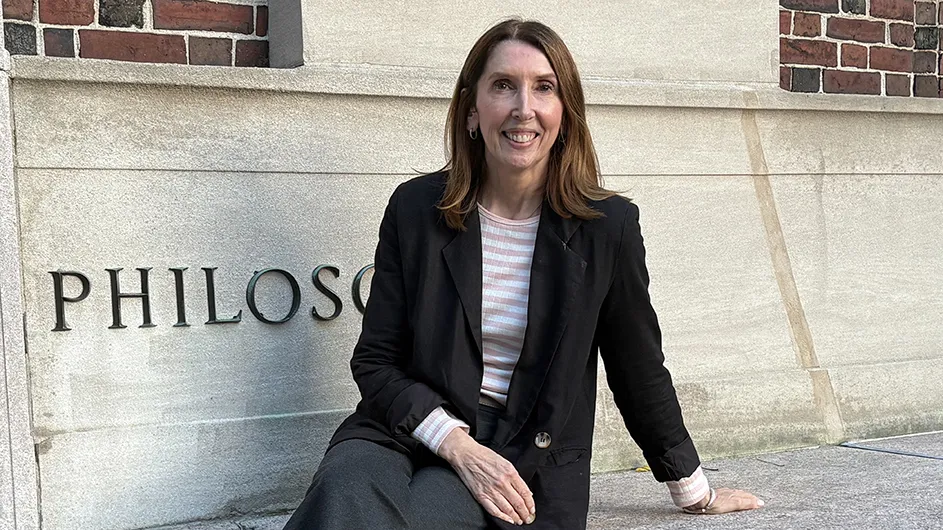
Madeleine Dobie, the new French chair, shares her plans for the department with Columbia News.
As the new chair of French, what are your plans for the department?
My main goal as chair is to foster an environment in which my colleagues can flourish as teachers and scholars. This is made easier by the fact that I work with a very talented and dedicated group of faculty, staff, and graduate students. It’s also facilitated by the hard work and vision of my predecessor, Emmanuelle Saada. Over the past few years, we’ve revised the French major, created a new minor, and overhauled our graduate programs.
The next step will be to encourage undergraduates to think of the French major or minor not as a side interest that they’re pursuing alongside a “bankable” major, but as a building block for their intended careers. For example, many humanities majors ultimately go to law school. With this in mind, we offer a course oriented toward students who are pre-law, or who envisage working for human rights organizations. On October 27, we’re hosting a panel discussion and Q&A with professionals in the field of business law who draw on their college French studies in their professional lives. Later in the year, we’ll curate other events tailored to the career objectives of our majors and minors and the members of the very active Columbia French Cultural Society.
In addition, we will continue to partner with our colleagues at Columbia’s home away from home in Paris, Reid Hall, to provide rich study abroad opportunities both during the academic year and in the summer session. Study abroad in general was hit hard by COVID, but it is making a comeback; our Paris programs are attracting students who want an immersive French learning experience, as well as those who don’t speak French (yet), but who are drawn to studying in Paris for other reasons.
Will you continue to teach? If so, what are you teaching this semester, and in the spring?
I’m serving this year as chair and director of graduate studies, so my teaching will be limited to one course a semester. I’m currently co-teaching the course I just mentioned, an experiential learning class in which students gain knowledge about the concept and practice of asylum. My co-instructor is a practicing attorney—and Columbia College grad—who leads an association that provides legal services and other support to vulnerable immigrants. Our students learn U.S. case law on asylum, and are trained to work with asylum seekers as they write their declarations, the centerpiece of every asylum case. The clients we work with are from francophone West Africa. They write their declarations, in collaboration with their student advocates, in French, and the students translate these documents into English.
It’s a very meaningful human connection and a great opportunity for students who are learning French, and who are also interested in law and/or human rights. The class is offered in the fall. In the spring, students can apply for an internship with the association that we work with. This asylum class is one of two experiential learning courses that we offer in the French Department. The other one focuses on art galleries and curation, and it also has an internship component.
In the spring, I’ll be teaching Francophone Romance: Love, Sex, and Intimacy in the French Colonial World, a global core course that approaches colonialism and its legacies from the perspective of intimate relationships conducted in contexts that involve exploitation, racial hierarchy, and violence. For example, we explore family relationships during slavery, the concept of metissage (the blending of different ethnic, cultural, or biological origins), and ideas about gender and nationhood in the era of decolonization.
What sort of programming is planned for the department this year?
The French Department works closely with the dynamic team at Maison Française, which means that we host events several times a week, often for an audience from Morningside Heights and other parts of New York City, as well as the Columbia community. Given this, it’s hard to single out a few events as highlights, but since you ask, we launched our fall programming with a great panel discussion of my colleague Emmanuelle Saada’s magnificent and sweeping new book, Histoires et colonisations. The room was packed, showing that interest in history and historiography remains very much alive.
We’re now in the midst of our annual fall film festival. This year’s theme is History on Trial. We’re showing films about trials that divided the societies of their time, and left a mark on history. The selections include films about the trial of Joan of Arc, the Nuremberg Trials, and a fictional trial of the World Bank and the International Monetary Fund held in a backyard in Bamako, Mali. In addition to the festival, we have upcoming talks or panel discussions on the future of the Paris climate accords, 17th-century court spectacle, representations of the Sahara, and the French-Canadian roots of Jack Kerouac. There’s truly something for everyone!
Why is the study of languages and literature/history/humanities so important?
How long do we have for this answer?! We exist in language: It’s the medium of thinking, of knowledge, and it’s our main mode of communication. To study anything, we need to pay attention to the shaping role of language. But to say language is to say languages, since the world is multilingual and translational. Our lives are enriched by recognition of this diversity, whether we’re in New York City, one of the most multilingual environments on earth, a place where French is spoken by French, Haitian, West African, and Canadian expatriates and immigrants—to say nothing of Columbia students—or travel to distant places.
Those who claim that in the age of translation apps language learning has become obsolete are wrong for all kinds of reasons, the main one being that human-to-human communication—the gesture we make to others when we speak their language—is irreplaceable as a way of establishing connection and building trust. Literature is language turned back on itself and outwards toward the world. It’s a process of self-exploration, the immemorial product of human imagination. Every society has had storytellers. Discovering the narratives of other times and places is a magical window onto the ways in which other people are similar and different to us. I happen to think that French-language literature, from troubadour love poetry to Enlightenment philosophy and contemporary novels by writers from France, Algeria, or the Democratic Republic of the Congo, is particularly rich!
What was your path to a career as an educator and writer?
I wasn’t set on becoming an academic until I reached the end of my undergraduate degree and realized that I wasn’t ready for my studies to end there. Wanting to read and think more led me to graduate school and, ultimately, to becoming a professor. But there were some twists and turns along the way. I began my undergraduate degree at Oxford focusing on Arabic and Islamic history, but eventually graduated with a BA in Philosophy and Modern Languages, then completed a PhD in French. I never left Arabic behind, however, and now much of my work focuses on France and North Africa. I think that having a background in several fields broadens your perspective in valuable ways—which is why economics and psychology majors at Columbia should all consider a French minor.
What are you working on now?
My main research project is a book about memoirs or other forms of testimony about the Algerian War of Independence (the most emblematic struggle of the age of decolonization in Africa) written decades after the events. I’m interested in how, toward the end of their lives, people look back on a revolutionary youth. It’s a project about how relationships to political events change over time, about the fortunes of revolutionary politics in Africa, about gender and genres of writing, and about memory and the effects of aging.
Advice for anyone interested in pursuing a trajectory similar to yours?
Jobs in the humanities are unfortunately scarce; this shouldn’t hold someone back if they are passionate about research and teaching, but it’s wise to imagine the PhD as a pathway to an academic career or another field, whether it’s one that’s in or adjacent to academia, or in a completely different walk of life. In many other countries, people pursue doctorates knowing that they won’t become academics because they love the field, understand that the knowledge and skills they acquire will benefit them in the long term, and believe that advanced education benefits society as a whole. I would like it to be a lot easier for young scholars to secure an academic job—but it wouldn’t be a bad thing if there were more humanities PhDs in government, business, and medicine.
What’s special about teaching at Columbia and in New York?
Columbia and New York go hand in glove. It’s a huge privilege to work at Columbia University in the City of New York, and to have at one’s fingertips everything a big city can offer in terms of museums, theater, art, parks, food, and, above all, people. Columbia has been a place of deep learning, scientific innovation, and political activism. These are proud traditions, but they must be defended at this time when academic freedom, scientific independence, and free speech—from all quarters—are under attack.
Anything you want to add?
Thank you for your questions and your interest in the Department of French. Please check out our courses and programming!