First Discussion in The Columbia Colloquium Is One for the Books
President Mnookin moderated a lively interdisciplinary panel of Columbia faculty members talking about why universities matter.
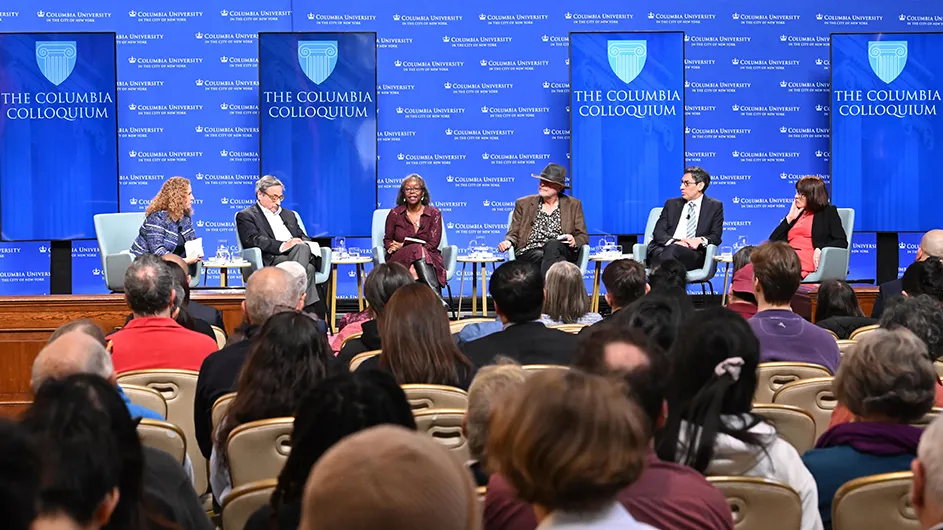
This week, more than 100 faculty, staff, and students gathered in Low Rotunda—while another 100 watched online—to participate in President Jennifer L. Mnookin’s first discussion in The Columbia Colloquium, a series of interdisciplinary conversations that will showcase faculty scholarship and reflect on the University’s shared intellectual objectives. This first discussion focused on the role of universities in providing knowledge, democracy, and research.
Mnookin opened the proceedings by introducing the four panelists: Andrew Delbanco, Alexander Hamilton Professor of American Studies; University Professor Farah Jasmine Griffin; Christos Papadimitriou, Donovan Family Professor of Computer Science; Miguel Urquiola, senior vice provost for academic initiatives and dean of social sciences; and University Professor Gordana Vunjak-Novakovic. She then moved quickly to the day’s topic.
“We’re focusing on a big question that’s of significant importance to Columbia, to higher education, and to the broader world,” Mnookin said. “Why do universities matter? What’s important about them? What are their purposes? What do they do well? Where might there be opportunities for them to do differently or do better?”
Papadimitriou was firm in his response. “I believe that humanity has built few things better than the university,” he said. “It helps each generation accumulate knowledge, together with the means and the mandate to question it and to go beyond it.”
Griffin, who specializes in African American literature, emphasized that the university is “a space that engages with a broad world, with a world outside of the walls of the university,” she said. “Not only in terms of ... knowledge we produce, and how that knowledge impacts that world, but how the university acts as an institutional citizen.”
Vunjak-Novakovic, who is Mikati Foundation Professor of Biomedical Engineering, spoke about the importance of communication with others and establishing trust with “our local community” and by doing so “it will be much easier to have a dialogue.”
The University’s Role in Sustaining Democracy
Delbanco, who has written about higher education, addressed the role of the university in sustaining democracy and producing democratic citizens. “We’re in the business of trying to foster the qualities in young people so that they can become informed and responsible democratic citizens,” he said. “If we can do that, we’re making a contribution to our democracy, a big one.”
To that end, Urquiola, professor of economics and international and public affairs who has also written about higher education, suggested that universities have to look within themselves and ask whether everyone feels represented and how we can do better.
Delbanco also emphasized the mission to teach students how to think and how to choose. “Not what to think or what to choose ... but to think analytically, how to make ethical choices about how to live one’s life.”
AI and Higher Education
When the conversation turned toward artificial intelligence and whether the university will still exist in 50 years, Papadimitriou said that AI will supplant the university. Urquiola countered that the university has been declared dead many times but that it was still very much alive. AI, he said, “will change us. It is a substantial challenge, absolutely. But there are other things going on, other things people are paying for and buying here, and those will remain.”
Griffin was even stronger in her counter argument. “I believe in the power of the classroom, and I believe in the human-to-human contact that happens in the classroom ... there’s something about what happens in a classroom with students doing something together with a teacher that is transformative.”
Pride in Columbia and New York City
Throughout the conversation, pride in Columbia and a sense of gratefulness in being able to teach at a university in New York City was also on display.
Delbanco spoke about intellectual freedom at Columbia and the “opportunity to grow intellectually, to fulfill my own curiosity.” He talked about the “distinctive” Columbia students and how they “have a certain aliveness, a mobility of mind and imagination.”
Griffin mentioned how “the City of New York” and “the neighboring community of Harlem” helped shape her research.
And Vunjak-Novakovic talked about the banner that reads “Amazing Things Are Happening Here,” which she sees every day when she goes to work at the medical center campus. “I think this is very true for all 17 schools that we have under our roof.”
Mnookin wrapped up the discussion by inviting everyone to keep an eye out for the next event in The Columbia Colloquium series, which is scheduled for Tuesday, November 17, at 6 p.m.
For the full discussion, watch “Why Universities Matter.”