University Senate Sees Upswing in Participation, Lively Debate at Last Two Plenaries of 2018
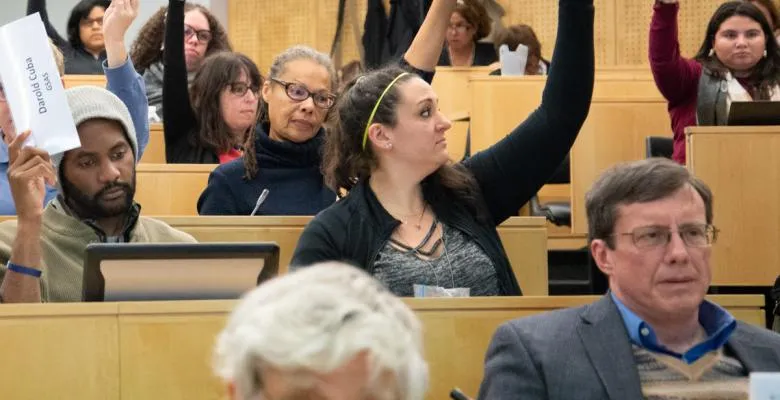
On November 16, a current of participatory energy that has been growing for months pushed the University Senate beyond its routine agenda and down some unaccustomed procedural by-ways.
Senate membership is up, and so is plenary attendance. In November the Arts and Sciences faculty elected 10 new senators, filling an 18-member delegation that had long gone half-empty, and leaving only two of 108 voting seats empty—the highest occupancy rate since the Senate’s early years. Twenty years ago the legislature routinely fell short of quorum (a simple majority of the full membership) at two or three of its eight meetings each year; two years ago it took three consecutive plenaries and a lot of flailing to muster the super majority (three-fifths of the membership) needed to amend the University Statutes. But the Senate hasn’t missed a quorum in three years, and all four meetings so far this year have had super majorities present, despite lackluster agendas.
This new energy upended Senate procedure on an academic program proposal (normally a rubber-stamping exercise), this time a certificate program in comparative media in the Graduate School of Arts & Sciences, designed to supplement the curriculum of Ph. D. students with half a dozen courses, some of which could be counted toward other requirements. Journalism School senator June Cross (Ten.) presented an unexpected statement of protest from her colleague Andrea Tucher, director of the J-School’s Ph.D. program in communications, who objected that the certificate proclaimed as new an approach that was developed over the past 20 years by her own program. Tucher also noted that students in the certificate program would enjoy the standard five-year package of full financial aid for GSAS Ph.D. candidates, further undermining the J School’s doctorate, which offers only three years of stipend support.
These reservations soon took the form of a motion to remand the proposal to the Senate’s Education Committee for further consideration. No fewer than 18 senators, more than half of them speaking in the plenary for the first time, joined a lively debate, focusing on whether a supplementary GSAS certificate would affect future applicants’ choice of a doctoral program.
After 40 minutes of discussion the Senate voted 36-21 to remand the proposal, perhaps swayed by the observation from Sen. Daniel Savin (Research Officers) that the body normally proceeds by consensus, which was clearly eluding it this time.
The next surprise came as Executive Committee chair Sharyn O’Halloran prepared to adjourn the meeting 70 minutes in. Agreeing to take a final question from Sen. David Cheng (Stu., SW), she found herself fielding a half-hour of student criticism from him and a half-dozen others that Senate leadership mishandled the final stages of consultation on a policy banning romantic and sexual relationships between faculty or staff and undergraduate students, which the Senate adopted at its final meeting of the 2017-18 academic year.
In the weeks after that Senate vote, as many left campus for the summer, a number of revisions were added to the new policy—some by University lawyers, others by senators—with an expectation of final approval from the Executive Committee, as well as the three committees that had done most of the drafting. Exec saw these changes early in the summer, but did not act on them, and the changes were not shared with the membership of two of the three committees.
In the following months, even after the Senate resumed its regular work in September, there was no further plenary discussion of the policy. So there was consternation among student senators when the provost’s office posted a document online on November 14 incorporating the late-spring changes as the final policy.
On the cusp of adjournment at the November 16th meeting, they wanted to know why Student Affairs was not consulted about the last changes: whether administration offices could change Senate documents without Senate approval; why an urgently needed undergraduate policy wasn’t approved sooner; and why the Senate used summer powers when it could have proceeded with regular consultations during the fall.
Three weeks later, on December 7, the plenary turnout was no less robust, but the energy was different. The GSAS certificate in comparative media was back, but this time all of the principals, including Tucher, expressed enthusiasm about the proposal, which was unchanged, and the enacting resolution, which included adjustments to three whereas clauses recognizing the value of current programs, such as the Journalism School’s Ph.D. in communications. The vote to establish the certificate was 63-0, leaving some to wonder what the fuss had been about in November.
No one said a word about relationships between undergraduates and Columbia officers. But by that point the Executive Committee had appointed a small group representing student and faculty committees, as well as the Office of Equal Opportunity and Affirmative Action, to work together on another final version of the policy. It will be presented to the Senate in the spring.
Also on December 7, the Student Affairs Committee presented a statement condemning a recent act of anti-Semitic vandalism in a professor’s office at Teachers College and affirming the University’s commitment to diversity and tolerance. After 23 minutes, the Senate dispersed for finals and intersession.
The Senate's next meeting is on February 8, 2019. Anyone with CUID is welcome. Plenary documents are available at senate.columbia.edu.
This column is editorially independent of Columbia News.