University Senate Discusses CUIMC Lab Woes, Calls for By-Laws in All Academic Units
At its penultimate meeting of the academic year, the University Senate discussed how to support research in aging facilities.
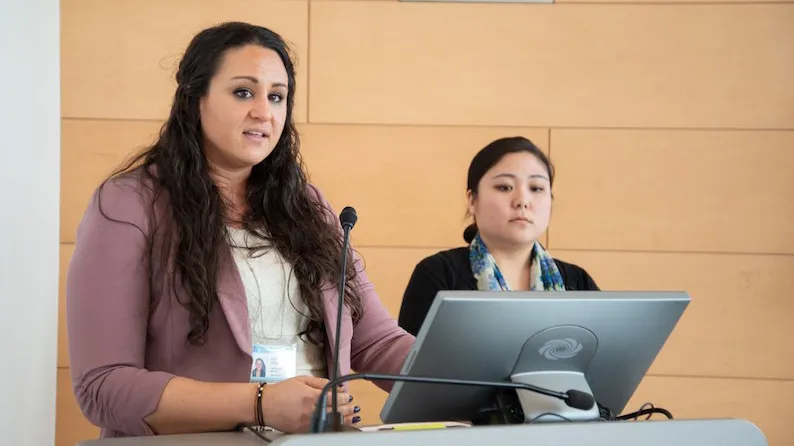
At the April 5 plenary held at the Nursing School, the University Senate focused on the struggle to support federally funded research in aging facilities at the Medical Center. It also resolved to strengthen governance by requiring up-to-date by-laws for all academic units, and heard student reports on food insecurity and disability services.
The facilities discussion followed a substantial report from the Campus Planning and Physical Development Committee organized by chairman John Donaldson (Ten., Bus.). Associate Research Scientist Regina Martuscello began by summarizing the detailed study she presented last fall to the committee listing problems that have bedeviled researchers on the medical campus and jeopardized their grants.
These include erratic electrical service, deficient freezers and temperature controls that wrecked samples, pervasive construction noise disrupting the lives of animal subjects, and confusion between the Columbia Medical Center and New York Presbyterian Hospital over who is responsible for maintaining research spaces, particularly the Brain Bank.
Sen. Julie Yoshimachi (Stu., Nursing) then reviewed follow-up meetings she and other committee members held about the report with senior CUIMC administrators, including VP&S Dean Lee Goldman, Research Dean Michael Shelanski, Senior Facilities VP Amador Centeno, and Assistant VP James Thompsen. These led to a plan to dedicate specific managers to oversee particular spaces and an agreement to keep working together.
At the Senate plenary Centeno and Thompsen were joined by Donna Lynne, the medical center’s senior vice president and chief operating officer, in a broad discussion of CUIMC space issues, ranging from frustrations with a Medical Center policy instituted by Dean Goldman a dozen years ago to require all uptown units to pay for their own space, to questions about how to assure common recreational space for CUIMC students.
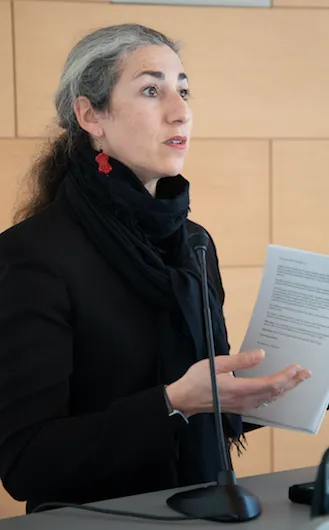
In other business, Faculty Affairs Committee member Nicole Wallack (NT, A&S/Hum) explained a FAC resolution to require up-to-date by-laws of all Columbia schools, departments, centers and institutes as a necessary first step toward transparency in academic governance. She noted that some units don’t follow usable by-laws or in some cases don’t even have any—a state of affairs that leads to faculty grievances.
A second FAC resolution, coming in the fall, will outline key topics that by-laws must address. Wallack said the Arts and Sciences faculty is now working on a related campaign to produce by-laws for all of its units by the end of the 2018-19 academic year. She said these are particularly important to her own constituency in clarifying the rights and responsibilities of non-tenure-track faculty. The Senate approved the measure with one abstention.
It also approved a new advanced certificate program for pediatric acute care nurse practitioners, presented by Education Committee members James Applegate (Ten., A&S/Pure Sciences, a co-chair) and Michael Sutton (Stu., SEAS/Grad).
The meeting concluded with two Student Affairs Committee reports from Sen. Jonathan Criswell (GS). The first was about student food insecurity—insufficient food intake, sometimes resulting in actual hunger—which Criswell characterized as a real problem on college campuses, including Columbia’s. In a recent study of 60,000 U.S. university students, 36 percent were found to be affected by food insecurity to a significant degree. He added that a growing student volunteer and fund-raising effort to address the problem in recent years has established a Columbia food pantry (the only one of its kind in the Ivy League), but it is time to institutionalize the enterprise with consistent and sufficient funding, perhaps with supplementary financial aid, regular publicity and administrative oversight. He said there has been progress toward an agreement on a satellite food pantry at CUIMC.
Criswell also updated the Senate on the work of the SAC Subcommittee for Students with Disabilities, formed three years ago after a quality-of-life survey found that disabled students were the least satisfied group on campus. The subcommittee has helped push for more staff in the Office of Disability Services, and has supported an effort to improve coordination of testing accommodations for disabled students with an online portal, an initiative that added 93 new proctored testing spaces. That partly addresses the growing demand, which now ranges from 100 to 250 spaces per day.
At a recent town hall meeting organized by SAC and other groups, disabled students expressed a conviction—also heard from other minority groups—that their experience is not reflected in Columbia curricula, and called for an advocacy effort to educate the broader community about their status. They also requested access to more American Sign Language classes.
Tom Mathewson is manager of the University Senate. His column is editorially independent of Columbia News.