How Columbians Have Rallied Together to Mentor NYC Students in Reading Since 1998
More than 100 Columbians have volunteered yearly with the Read Ahead Mentoring Program—one staffer and recent volunteer shares his experience.
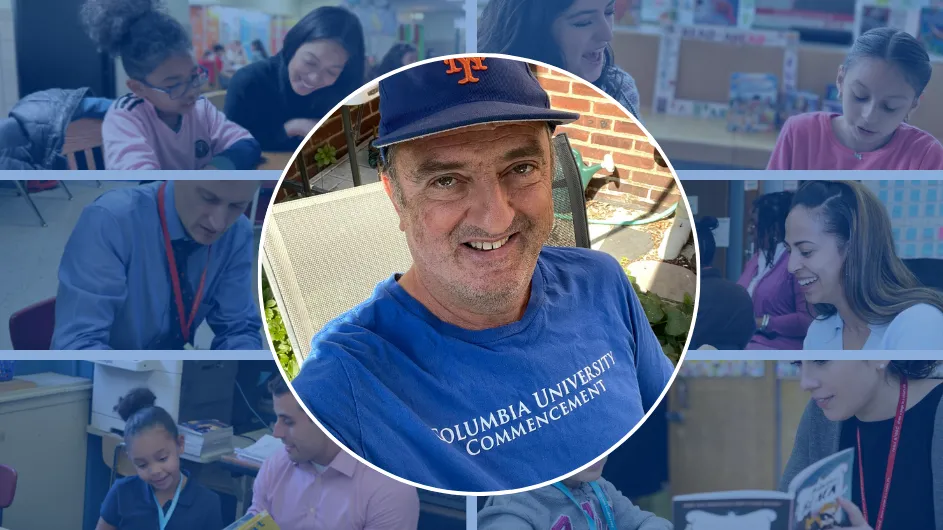
When dedicated CUIT staffer and former public school teacher Doug Ward's kids grew up and left home, he found himself with unexpected new time in his day. Around the same moment, Columbia was deepening its partnership with Read Ahead, a nonprofit founded in 1991 that pairs mentors with public elementary school children for bi-weekly, reading-based sessions. For him, the timing couldn’t have been better. Volunteering with Read Ahead offered a way to keep nurturing young people while also giving back to the community.
"My wife and I read to our kids from when they were born, and we were both teachers as well, so that was a really important value to us," Ward said. "I thought, 'oh, volunteering with this program would be so nice.' Partly because my kids are out of the house, and I needed to fill the void. Not that they would say no if I wanted to read them a book — but at age 24 and 25, those opportunities are waning."
Columbia has partnered with Read Ahead since 1998 and is now one of the program’s largest sources of mentors, accounting for more than 15 percent of volunteers from 30-plus corporate and community partners across the city. In any given year, more than 100 faculty, staff, and students serve as mentors, building trusted, one-on-one relationships that lie at the heart of the program’s mission.
UPCOMING 30-MINUTE INFO SESSIONS
Since 2019, Ward has remained a committed mentor and a vital part of Columbia's IT team as Senior Service Specialist, working on academic services such as Courseworks and Zoom. Columbia News sat down with him to talk about how mentoring has shaped his perspective, what the experience of mentoring is like, and what he's learned over the years.
How did you first get involved with Read Ahead?
I think it was an email from Junior Benjamin in 2019! I’d been at Columbia a few years, and my second child had just graduated from high school, so maybe the timing was right.
I applied, and at that time, the program was in person. My office is in Studebaker on the Manhattanville campus, and the school I visited was just over on Amsterdam, above Morningside Park. I’d walk over once a week and meet with my mentee, who was in fifth grade. It was great—until the pandemic interrupted.
Read Ahead stayed in touch and moved us to Zoom. I was paired with a second grader and keeping her engaged online was a challenge. But by the end of the year, we had bonded. Since then, the program has stayed on Zoom, which has expanded opportunities to stay involved.
It’s been five, going on six years now, and we’ll start again next month.
What are you doing with the program today?
I just finished my third year with the same kid, which has been really neat. I used to be a special education teacher in a bridge classroom, so I’ve always valued seeing extended growth.
He’s still a little kid but a lot bigger now, and we meet every other week. A few times a year, you get to visit your mentee’s school. He’s in Chinatown, which has been fascinating. I’ve been there a couple of times, and he loves it.
What kind of support do mentors get?
Read Ahead is really on top of it. Mentors are paired so you switch off weeks. They handle the Zoom accounts, provide age-appropriate resources, and even track reading levels. They suggest activities for every session, which is key.
Half the battle with young children is that about every 15 minutes, you've got to change what you're doing. Nothing lasts more than 20! But Read Ahead has you prepared with all of the resources to do that.
Sometimes there are group activities with other mentor-mentee pairs, too.
How long is each session?
It’s 45 minutes once a week for the student, and every other week for the mentor. The program starts in early October, once students settle into school, and runs to about Memorial Day.
What’s been a highlight for you?
Meeting in person is the best part. He gets so excited—fist bumps, little games, hugs. He’s so bright, and I’ve seen his English improve by leaps and bounds. To know I played a small part in that is really meaningful. Connection is what it's really about. That's the good stuff.
Do you two pick the books you read during the sessions, or is it part of a curriculum?
They have great resources, including a lot of e-books, which we can read together. Or we can have the book read to us. Some of them have videos of books. There are all different modalities. The students have the account, so the materials that are selected are appropriate to his level, but within that, he and I pick together.
For example, in the fall, there are great seasonal choices with leaves and apples, and Halloween. In the spring, they have a content where kids can earn points for completing different activities.
Basically, we collaborate on picking from a bunch of win-win options. That's one thing you learn as a teacher and as a parent — give kids two or three choices, of which are wins, but let them pick. There are no bad choices.
And, honestly, sometimes we just talk. When we first met, my mentor partner and I made a little slide deck to show a bit about ourselves, what we did the past summer, and pictures. Sometimes we draw together. You really just get a feel for it.
What advice would you give Columbians thinking of joining?
The organization is really well run. They do the heavy lifting: the scheduling, resources, and tech support. You just show up and do your part.
Most important is finding a way to connect with your mentee. Don’t worry about hitting a quota of stories. Kids take time to come out of their shells, and that’s OK.
There's a phrase I remember from when I was first teaching. My first trainer came into the room and said, "Well, obviously, they like you and they want to do well in your class. But that's because you care, and you can't fake that."
Kids know authenticity. If you care, they'll know. And eventually, that's the most important thing.
One final question I ask all Columbians I meet. What's your favorite spot on Columbia's campuses?
Over near my office on the Manhattanville campus, there is the little quad between Geffen and Kravis, the two Business School buildings. I go sit there, and I don't even necessarily take lunch. I just sit, and if it's hot, I hide in the shade. They have these Adirondack chairs, and it's a nice, open, welcoming public space. People come and walk their dogs. It's just a nice space.