What Would You Write if You Were Approaching Death?
In her book, ‘The Rest Is Silence,’ Joanna Stalnaker offers an intimate portrait of Enlightenment philosophers as they faced the end of their lives and their historical moment.
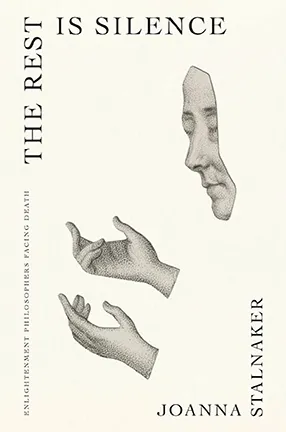
What would the Enlightenment look like if we viewed it through the eyes of the philosophers as they were approaching death? French Professor Joanna Stalnaker asks that question in her book, The Rest Is Silence: Enlightenment Philosophers Facing Death. She brings to light a set of works written at the end of the Old Regime, and at the end of their authors’ lives. These works, all written before the French Revolution, cast a retrospective glance over the intellectual movement their authors participated in, and over the authors’ own lives and works.
Stalnaker shows that the beauty of these works stems from their authors’ efforts to give literary form to the materiality and fragility of their dying bodies. As they reflected on writing as a means of reaching posterity, Enlightenment philosophers embraced the possibility that neither their names nor their writings would survive long beyond the decomposition of their bodies. They inscribed the silence and nothingness of death into their last works.
Stalnaker discusses the book with Columbia News, along with books she’s read recently and recommends, and what she’s working on and teaching now.
How did this book come about?
I first started thinking about this book over 15 years ago. I had considered including a chapter on Rousseau’s Rêveries du Promeneur Solitaire (Reveries of a Solitary Walker), and his practice of botany at the end of his life, in my first book on Enlightenment practices of description. I was fascinated by the way he compared his aging body to the pressed flowers in his herbaria. I didn’t know at the time that I was interested in last works and the question of how the Enlightenment philosophers faced death, but the project grew from that initial seed, as it were.
Can you give some examples from the book of Enlightenment philosophers who gave literary form to their dying?
The motif of silence is a thread throughout this book. In Diderot’s two last works, we see him increasingly incorporating other people’s voices into his writing, to such an extent that his own voice seems to gradually dim and recede from view. This is consistent with his Stoicist belief that our bodies (and brains) are on loan to us during our lives, and that we must give ourselves back to the elements when we die. Rousseau explicitly states that he writes his Rêveries for himself alone, and is not concerned with transmitting his last work to posterity. The work ends with a fragment that breaks off at a very specific moment that is pregnant with meaning, seeming to reach across the divide between life and death.
Madame du Deffand, a once-famous but now-forgotten salon hostess with a brilliant philosophical mind, had no wish to be remembered after her death. She consciously crafted her last letter to her beloved Horace Walpole as a final farewell, and then chose not to write to him again during the last month of her life, even as she continued to host guests at her bedside.
What books have you read lately that you would recommend, and why?
Over the summer I went on a jag of reading Annie Ernaux, the recent Nobel Literature Prize winner. I had taught her account of her illegal abortion, L’événement, during the pandemic, but this summer I read several times in a row her astonishing book Les années, a third-person but deeply personal and somehow intimate record of the years from 1944 to the early 21st century. I felt as if I were watching the years pass before my eyes, with everything they contain, from popular expressions to ads to songs to political and private events large and small. I also became obsessed with her two books about her passionate love affair with a younger, married Russian diplomat, which she recounts in two very different forms, a novel or autofiction, Passion Simple, and an actual diary she kept during the affair, Se Perdre. Both offer absorbing meditations on how sexual passion pushed to its limit can alter our experience of our bodies and selves in time.
I was deeply shaken and moved by Yiyun Li’s Things in Nature Merely Grow, an account of living on after her second son’s death to suicide. Like one of my favorite writers, Virginia Woolf, Li touches things that seem almost to lie beyond human experience, but are the most deeply human experiences possible.
What’s next on your reading list?
A dear friend just sent me A Ghost in the Throat by Doireann Ní Ghríofa. I won’t try to describe it based on the book jacket copy, but it seems to be about an effort to discover an 18th-century woman’s erased life, so I can see why she chose it for me.
What are you working on now?
I am hesitating between a memoir about my years-long, all-consuming obsession with Harry Styles and fan fiction, which suddenly became legible when I was diagnosed with a personality-altering brain tumor, and a book about Enlightenment women on paper and in the flesh.
What are you teaching this semester, and in the spring?
Right now, I have the great joy of teaching our Introduction to French and Francophone Literature, where my students do things like acting out scenes from Molière’s Dom Juan—one of the most profound meditations on life and death that I know of. I’m also teaching a new graduate seminar, What’s Left of Enlightenment?, which tries to make sense of our current crisis through the lens of 18th-century philosophy.
In the spring, I’ll be teaching the capstone seminar for our majors in French. We’ll be reading five novels by women, and students will be developing their own independent research projects on the novels. I consider myself blessed to be teaching such brilliant students.
Which three academics/scholars, dead or alive, would you invite to a dinner party, and why?
That’s a tough one. I would have loved to be able to sit down with Oliver Sacks and talk to him about the brain, mine and others. For the other two, I’ll cheat and say Michel de Montaigne and Joan Didion. Not really academics in the strict sense, but the conversation between those three would be something to behold and participate in. Or we might just sit around playing with Montaigne’s cat.
Joanna Stalnaker will take part in a panel discussion about The Rest Is Silence with Columbia professors Elisabeth Ladenson, Charly Coleman, and Emmanuelle Saada, along with Harvard Professor Deidre Lynch, on November 13, 2025, at 6 pm, at Maison Francaise.