Elisheva Carlebach Writes About Jewish Women in Early Modern Europe
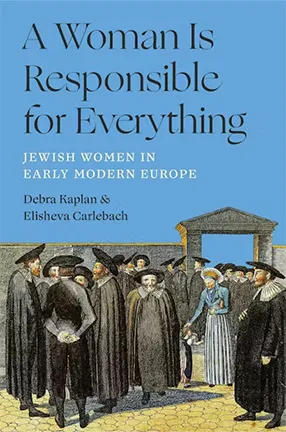
A Woman Is Responsible for Everything looks at the integral role of women in early modern Jewish communal life.
In villages, cities, and ghettos across early modern Europe, Jewish women were increasingly active participants in the daily life of their communities, managing homes and professions, leading institutions and women's groups, and crafting objects and texts of beauty. A Woman Is Responsible for Everything by Elisheva Carlebach, Baron Professor of Jewish History, Culture, and Society, and Debra Kaplan, a professor at Bar-Ilan University in Israel, marshals an array of previously untapped archival sources to tell the stories of these women for the first time.
Carlebach and Kaplan focus on the kehillah, a lively, thriving form of communal life that sustained European Jews for three centuries. They paint vibrant portraits of Jewish women of all walks of life, from those who wielded their wealth and influence in and out of their communities to poor maidservants and vagrants, from single and married women to the widowed and divorced. Readers learn about their homes and the possessions they valued and used, the books they read, and their writings. Speaking in their own voices, the women who are portrayed reveal tremendous economic initiative in the rural marketplace and the princely court, and they express profound spirituality in the home as well as the synagogue.
Carlebach discusses the book with Columbia News, as well as what she’s teaching this year, the best books she’s ever received as gifts, and who her ideal dinner guests would be.
How did this book come about?
As often happens, I did not set out to write a book on this subject. In the course of other work, I had many encounters with primary sources that I hadn’t expected would exist or survive. I began to collect those voices. I had been working on spiritual and intellectual movements among early modern Jews (all rabbinically trained men) when I came across some letters written by the wife of one of my subjects. These letters offered fascinating insights into the daily life and literary habits of a 17th-century Jewish woman.
What was it like to research this book, as archival and material sources for unsung historical women are relatively hidden or obscure, correct?
Correct! It was a decades-long hunt through archives on different continents. During the pandemic, many archives intensified their digitization of troves of primary sources. This was a lifesaver in many ways. I was fortunate that a colleague of many years, Debra Kaplan, shared my interest in the subject—the formation and structure of Jewish communities, and Jewish women—and the early modern period. Over the years, we often sat alongside one another in various archives, while each of us pursued different projects. We kept on interrupting one another with amazing stories, images, and texts that we found within our archival sources, such as private letters, wills, and community records. Each of us had mentors who warned us that such a history “could not be written,” because there were “no sources.” The opposite turned out to be true. So we joined forces, and this book is the product of our collaboration.
What are you teaching this year?
In the fall, the relevant course was Religious Conversion in Historical Perspective. The course put into global perspective the uses of religion for purposes of conquest and cultural domination on the one hand, and the elusiveness of capturing the personal journey on the other.
This semester, I’m co-teaching the Jewish Book in the Early Modern World, in the Rare Book and Manuscripts Library with Norman Alexander Judaica Librarian Michelle Margolis. This is a hands-on exploration of the tremendous leap in literacy and literary production of all types spurred by the availability of printed matter. Jews were the most visible and often marginalized minority in early modern Europe. The advent of print was a game-changer for every aspect of Jewish culture.
The second course I’m teaching this spring is Censorship and Freedom of Expression in Early Modern Europe. We began with the roots of regimes that suppressed various forms of human expression and their early modern ramifications. Every time I teach this seminar, its contemporary relevance becomes even more obvious. Students need to understand the stakes in these debates, which affect every aspect of political and technological developments in their world.
What are you working on now?
A book on the archives and record-keepers of the Jews of early modern Europe. There was no state or centralized repository for the records of this scattered minority. Yet abundant sources survive, and I hope to tell their story. What was recorded and what was omitted? What was destroyed and what survived? This work drills down into the question every historian asks: How do we know what we know?
What is the best book you ever received as a gift, and why?
Just one? When I was about 12, I encountered Jane Eyre for the first time, and it started me on a long journey reading gothic novels. I’ve since recovered from the genre, but not from my love of fiction. At almost the same time, my father bought me a new set of the biblical books of the prophets for my bat mitzvah. I was enchanted by the language and resolved to commit it all to memory. This did not come to pass, alas, but I still have the set and the love for the lyrical language, especially parts of Isaiah. Finally, when I was a beginning graduate student, I read Yosef Yerushalmi’s Zakhor: Jewish History and Jewish Memory, a poetic meditation on his vocation. He became my mentor at Columbia and set me on my professional path.
Which three historians/scholars, dead or alive, would you invite to a dinner party, and why?
If I can invite the spirits of figures past, I would love to speak with some of the women who wrote my primary sources for A Woman Is Responsible for Everything. Glikl of Hameln was a 17th-century Jewish woman who raised 12 children to adulthood, carried on as a successful solo entrepreneur, and wrote the history of her own life within its multiple contexts. Bella Perlhefter, her contemporary, lost her seven children to early death and disease. She too was a spirited entrepreneur, a music and dance teacher, and a gifted writer of poems, letters, and (co-author) of a voluminous encyclopedia of Jewish thought. She saw her writing as a path to the immortality her lack of offspring denied her. Finally, maybe Sigmund Freud? He treated Glikl’s descendant, Bertha Pappenheim, famous as Anna O. Together, we three might try to set him straight on some of his gender theories.
In honor of the publication of A Woman Is Responsible for Everything, the Norman E. Alexander Library of Jewish Studies will be hosting a hands-on event for visitors to view rare books and manuscripts featuring women--writing, printing, managing, leading, and crafting. Following the presentation, participants will hear directly from Elisheva Carlebach and Debra Kaplan about the incredible histories that they've begun to uncover with this field-changing book. The event will take place in Room 523 of Butler Library on February 18, 2026 from 5:30 to 7:30 pm.