Ocean Vuong and Laurie Anderson Discuss Where Ideas Come From
The two renowned artists performed and then talked before a full house at the Lenfest Center for the Arts.
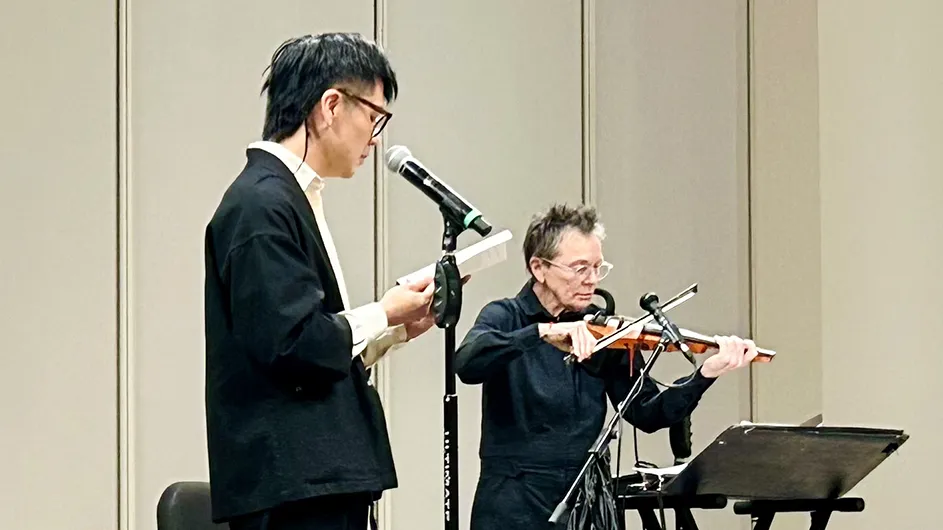
A poetry of pure sound emerged from the throat of acclaimed writer, professor, and photographer Ocean Vuong, hovering over a low synthetic beat provided by the iconic multimedia artist Laurie Anderson (BC’69, SoA’72).
Let me back up: Early on a recent Thursday evening, the area around the Lenfest Center for the Arts was abuzz. The lobby became so crowded that one ticket checker took on a new role as crowd controller, directing ticket holders away from those hoping to get off the waitlist. All these people were there to witness a conversation between Anderson and Vuong.
The event was part of an interdisciplinary series, Where Ideas Come From, curated by Carol Becker, professor and dean emerita of the School of the Arts, which brings together practitioners and theorists from across the arts and sciences to discuss where ideas originate and how they evolve. This installment, Buddhist Practice as Creative Practice, was co-presented by the Center for Buddhist Studies in the Department of Religion, and moderated by Dominique Townsend, the center’s director and Jey Tsong Khapa Associate Professor of Indo-Tibetan Buddhism, who played matchmaker in bringing together the two artists and practicing Buddhists.
Beautiful Short Loser
Improvised in the hour before the event—“You make sounds, I make sounds, until we feel happy”—was Vuong’s description of how his and Anderson’s opening duet came together. Dedicated by Vuong to “Renee Good, Alex Pretti, and all those who have lost their lives to the horrific violence perpetrated by ICE,” the performance rolled into a recitation of Vuong’s poem, “Beautiful Short Loser,” backed by Anderson’s droning electronic composition:
“Stand back, I’m a loser on a winning streak. / I got your wedding dress on backwards and playing air guitar on this dirt road.” Anderson’s music reached an emotional peak with Vuong’s poem, waves of electronic music crashing into his lines: “I recall every follicle in the failure the way they’ll remember God / after religion: alone, impossible, and good.”
When Vuong finished reading, he sat, dabbing his eyes intermittently with a napkin as Anderson delivered a spoken performance over her tape-bow violin, which uses recorded magnetic tape instead of horsehair. The instrument lent an otherworldly tone to her words: “What is love? What is government?” she asked repeatedly, bringing in voices ranging from Cornel West to J.D. Vance and Pope Leo XIV in something of a lyric essay set to music on the topics of love and government.
In an athletic stance, she pulled on a satin jacket as rhythmic vocalizations occurred over a booming bass. She stood tapping her chest for a moment before announcing, “The drum suit doesn’t work. But I’ll tell you what it’s about. She lost no momentum in the performance. “My husband, Lou [Reed], and I made three rules for living: One—don’t be afraid of anybody. Two—get a really good BS detector, and learn how to use it. Three—be really tender.”
She finished the performance in audio-drag, using her signature voice filter that gives her that Darth Vader twang. The deep, authoritative voice sang a rendition of “Twinkle Twinkle Little Star” over a twinkly, hypnotic tune. “What I love about stars,” she boomed, stretching one arm toward the sky, “is that we can’t hurt them—blow them up or turn them out—but we are reaching for them.”
Concluding the performance, Vuong and Anderson shared a hug amid an uproar of applause. Townsend joined them on stage for a conversation that flowed naturally out of the performance, beginning with how they arrived at their respective Buddhist practices.
Putting Fruit on the Altar
Vuong grew up in a Buddhist household, but felt that for his family, “it was just about putting fruit on the altar.” When he questioned the reason behind this practice, besides attracting fruit flies, he was met with the classic, “That’s just how things are.”
If Vuong hadn’t become a poet, he would’ve been a monk, he confessed. Monks were like superheroes in his family; the women who raised him would stand in the kitchen, weeping and laughing, sometimes in the same breath, watching monks’ lectures. “I wanted to be this defiant, dignified hero in their kitchen,” he said. But he sat in front of us in a tailored black ensemble, not brown robes; his high school guidance counselor had recommended that he go to an accredited college. There, he found poetry—“a way of expanding the medium of language so it can hold suffering.”
When Anderson asked whether he regretted not pursuing the monkhood, he told her he did every day. He quoted a Swedish proverb: “Gräv där du står,” or “dig where you stand.”
Anderson, whose ancestry is Swedish, leaned in and asked, “What does that mean?”
“Oh, a filmmaker told me that,” Vuong laughed. “Maybe he meant camera poles—he was severely underfunded.”
The Swedish evangelical church Anderson attended growing up was more of a “coffee church,” as she put it. The teachings were simple: “Be good to other people, it’ll make your life better, then go down to the fellowship room, and get wired on coffee.”
Anderson came to her Buddhist practice in the 1970s, during a period of rapid expansion of Tibetan Buddhism in the U.S. A friend of hers had returned from a silent retreat with an impressive ability to focus: He described his mind as a beam he could train here or there for long periods of time. When Anderson arrived at the retreat herself, her teacher told her, “You must be here because you’re in pain.” She denied this: “No, I want a mind like a beam.”
“Pain. Beam. Pain. Beam,” she said, as she reenacted their disagreement. At the retreat, she meditated for 18 hours a day, and by the end of the experience, she had a revelation: “I was there because of pain.”
Buddhism and Creativity
Townsend recounted asking Vuong and Anderson in an early meeting how their Buddhist practice interacted with their creative practice. “They looked at each other and then at me,” she said, “and answered identically: ‘They are the same.’”
“As a writer, it helps you describe things,” Vuong said of mindfulness. If you are truly present in your experience, “you can write a sentence that’s never been received before.”
He asked us to compare the mimetic term, “sunset,” with Soviet writer Isaac Babel’s version from his story, “Crossing the River Zbrucz”: “The orange sun is rolling across the sky like a severed head.” “You don’t have to know that he was a war correspondent to feel that from his description,” Vuong explained.
For Anderson, mindfulness and art-making are one and the same. She learned that first at School of the Arts’ Prentis Hall on 125th Street, across from the Manhattanville Campus, where she was a sculpture student back in the 1970s (“right over there, across the street,” as she put it). When she tried to push an idea into the material, she failed. “It falls to the ground,” Anderson said. Being present, listening to the material is what creates art. “I’m happiest when I’m nobody,” she said. “When I’m lost.”
“Do you have an idea, or do you embody it?” Vuong asked the audience. “Ideas move through us like weather.”
Along the winding path of anecdote, quote, and laughter, an idea was moving through both Vuong and Anderson, and the audience. Buddhist practice and creative practice, if you wish to delineate them, are about attention, and where you place it. You have some tools—language, the body, an instrument—and you find a way to use them.
“Life is about finding as many ways to dig as possible,” Vuong exclaimed. “The Swedish director was right!”
Emily Hollander is pursuing an MFA in the Writing Program at the School of the Arts.