Columbia’s Knight Institute Co-Hosted Symposium on ‘Forever War and the First Amendment’
The two-day event brought together journalists, scholars, lawyers, and activists to examine how the War on Terror transformed government power, the courts, the press, and democratic culture.
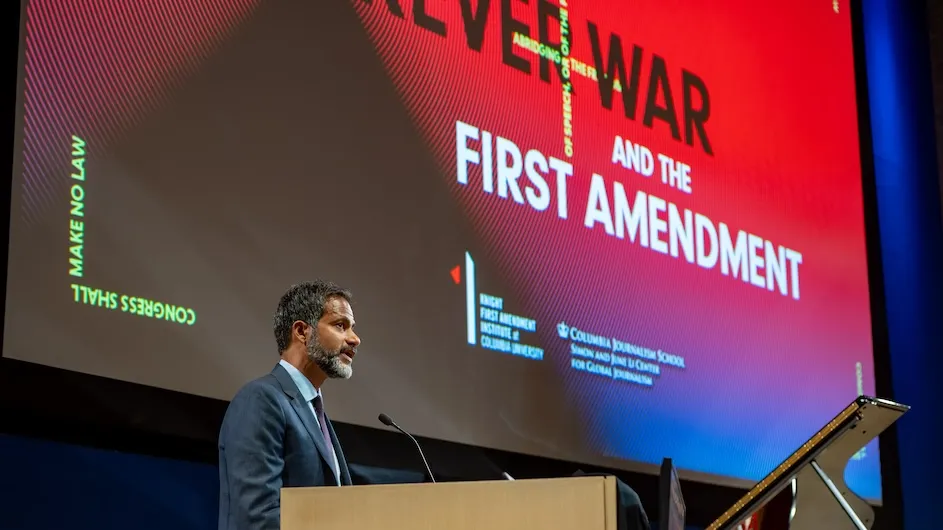
Twenty-five years after 9/11, the consequences of the United States’ response to the attacks are still unfolding. Government powers expanded in the name of fighting terrorism, institutions accustomed themselves to secrecy and deference, and practices once justified as extraordinary became embedded in American law and political life.
Those legacies—and what it will take to confront them—were the focus of “The Forever War and the First Amendment,” a two-day symposium held at the Bollinger Forum on Columbia’s Manhattanville campus earlier this month that brought together journalists, scholars, lawyers, and activists to examine how the “War on Terror” transformed government power, the courts, the press, and democratic culture.
Co-hosted by Columbia’s Knight First Amendment Institute and the Simon and June Li Center for Global Journalism at Columbia Journalism School, in partnership with Harper’s Magazine and the Columbia Daily Spectator, the symposium examined government powers, legal doctrines, surveillance systems, and media practices that were in place before 9/11 and expanded afterward.
Opening the symposium, Jameel Jaffer, Knight Institute executive director, recalled the “apocalyptic feel” of New York City in the weeks after 9/11: smoke and ash in the air, fighter jets flying low over the city, soldiers in the streets, missing-person posters on every lamppost, and everyone on edge about the possibility of another attack.
“Many of us also had a sense of foreboding about how our government would respond,” Jaffer said. “Even in that moment of intense fear and sadness and confusion, it was clear that collectively we faced a momentous choice and that what our attackers did next was probably going to be less important, less consequential than what we ourselves did.”
What came next—the decisions, policies, and normalized ways of thinking that took hold in the years after—was the focus of the symposium.
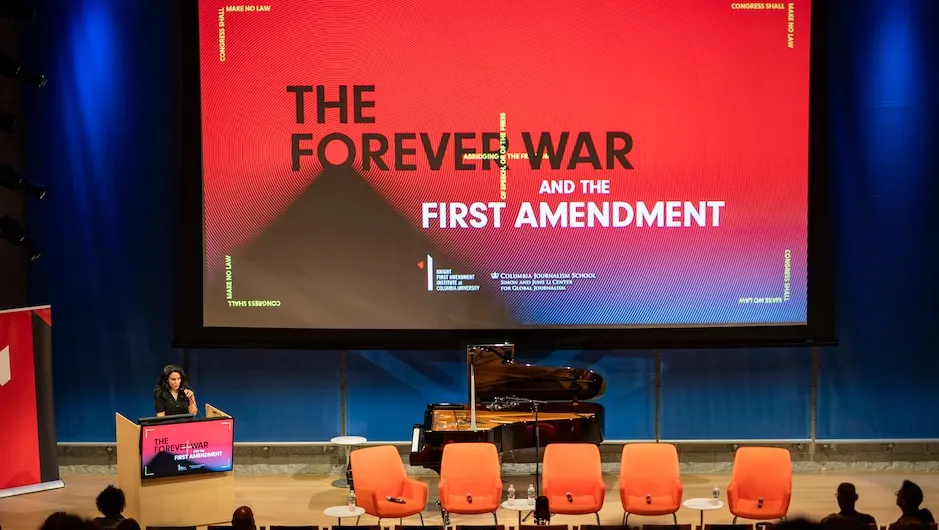
The Deeper Roots of the Forever War
In her remarks, journalist Rozina Ali noted that she had expected her recently published book on Islamophobia, Seasons of Fury, would begin with 9/11, but her research led her to surveillance and law-enforcement practices going back to the 1960s. Artist and filmmaker Assia Boundaoui uncovered another example of pre-9/11 surveillance while making the award-winning documentary The Feeling of Being Watched and developing Inverse Surveillance Project: tens of thousands of pages of FBI files revealing that her Chicago-area Muslim community had been the target of a sweeping pre-9/11 counterterrorism investigation code-named “Operation Vulgar Betrayal.”
“The data that is collected in the surveillance remains in perpetuity,” Boundaoui said. “There’s a double violence in this because it can be reused.”
Across the symposium, speakers returned to a common pattern: Legal authorities and institutional practices that often predated 9/11 were expanded after the attacks and then normalized. They traced that development through the material-support laws, national-security surveillance, secrecy surrounding torture and targeted killing, the use of immigration powers against political dissent, and the weakening of institutions intended to hold executive power accountable.
When the Courts Deferred—or Did Not Decide
ACLU attorney Brett Max Kaufman traced judicial deference to the climate immediately following the attacks: “Even judges that on 9/10 might have been inclined to be skeptical of government power or push back on certain kinds of arguments—on 9/12, that was no longer the case. That fear, the culture of censoriousness, and not knowing when the next attack was going to come affected them as well.”
A day-two panel devoted to the First Amendment examined the consequences of that judicial deference. Panelists discussed cases ranging from Holder v. Humanitarian Law Project, in which the U.S. Supreme Court ruled that providing human rights training to a designated terrorist group could be a crime, to unresolved challenges involving warrantless surveillance and the punishment of noncitizens for political expression. Knight Institute litigation director Alex Abdo asked whether the courts had created “a jurisprudence of ignorance,” in which rights become “effectively unenforceable” because an array of doctrines allows courts to avoid deciding on the merits.
Reporters for the Columbia Daily Spectator interviewed people whose stories intersected in important ways with the symposium’s themes. Alberto Mora, who served as general counsel of the U.S. Navy from 2001 to 2006, discussed his opposition to torture and the imperative to protect human dignity and the rule of law during a crisis. Mohamedou Ould Slahi, who was imprisoned without charge at Guantánamo Bay for 14 years and whose story was dramatized in the feature film The Mauritanian, described what happens when extraordinary powers created for supposedly dangerous people are turned against the innocent.
How the Press Reinforced—and Exposed—the Forever War
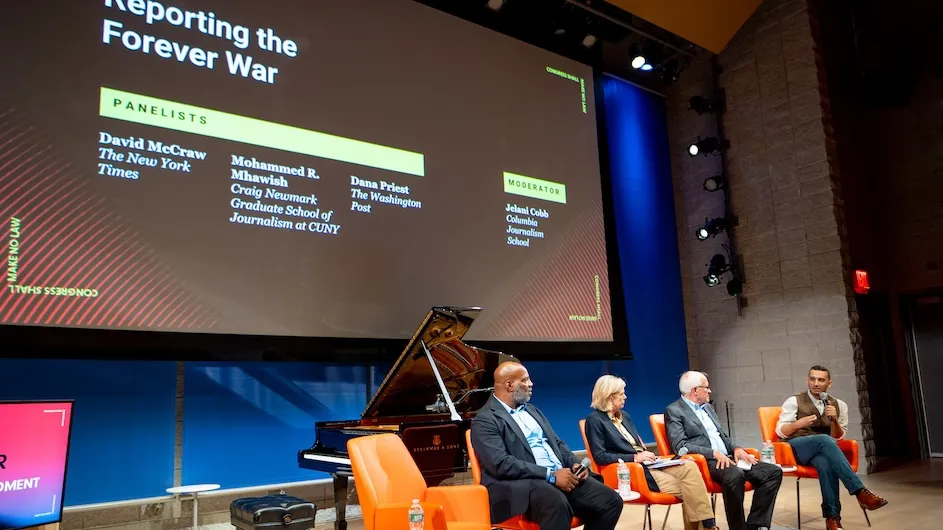
A panel moderated by Jelani Cobb, dean of Columbia’s Journalism School, examined how the Forever War both tested the press and exposed its weaknesses. Government surveillance, efforts to identify confidential sources, and secrecy surrounding the legal basis for torture made reporting more difficult. At the same time, news coverage often amplified official claims and helped legitimize government policies. Yet investigative journalism proved indispensable to exposing what officials had concealed.
Dana Priest, whose exposure of the CIA black sites and other aspects of the counterterrorism campaign in The Washington Post earned her a Pulitzer, acknowledged that reporters and editors at both The Post and The New York Times failed to question official claims aggressively enough, while skeptical reporting was often given less prominence.
A second-day panel examined how nonprofit newsrooms including Airwars, Drop Site News, and Zeteo are developing alternatives to legacy coverage, often through collaboration with local journalists and open-source investigators. Haley Willis, of Columbia Journalism School, described open-source reporting as “taking tools that kind of started in the hands of governments and militaries and turning them on them,” while cautioning that access to satellite imagery and other evidence can still be limited by cost and corporate or government pressure.
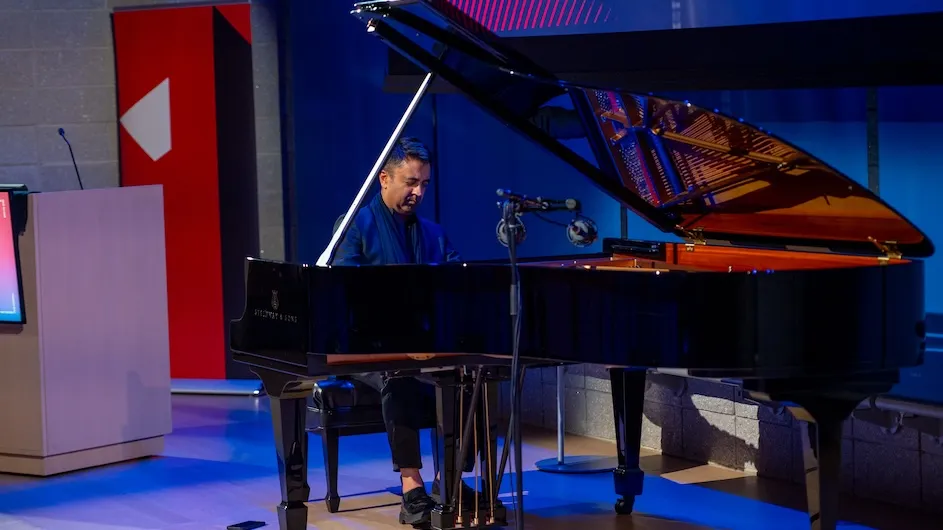
The first day closed with a moving 45-minute performance by renowned pianist and composer Vijay Iyer, featuring work shaped by his response to 9/11 and its aftermath. Introducing the performance, Iyer described music as a way of reaching places words cannot, calling what followed “a kind of séance.”
In connection with the symposium, the Knight Institute and Harper’s Magazine co-commissioned an essay by the writer Hari Kunzru about art created during this period. At the symposium, Kunzru joined journalists Steve Coll, M. Gessen, Nicole Hemmer, and Phil Klay for a panel about “The Forever War and Democratic Culture.” Kunzru’s essay in Harper’s is available online.
Readers can watch recordings of individual panels of the Forever War symposium on the Knight Institute’s YouTube channel.