Exploring the Mozarabic Rite as Spain Became a Global Empire
Susan Boynton looks at this, along with bibliophilia, libraries, and the study of medieval liturgy in her new book.
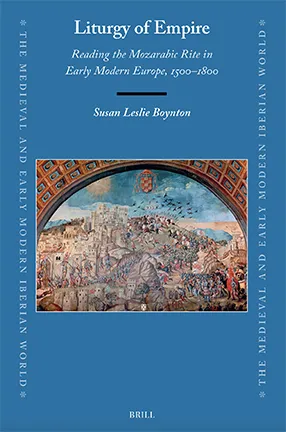
Liturgy of Empire: Reading the Mozarabic Rite in Early Modern Europe, 1500–1800 by Music Professor Susan Boynton examines the European reception of the neo-Mozarabic rite, created under the patronage of the Archbishop of Toledo, Francisco Jimenez de Cisneros (1495-1517). The neo-Mozarabic rite was a liturgical ritual of the Latin church once used generally in the Iberian Peninsula. The book looks at the rite in relation to the history of the Mozarabs of Toledo, who were Christians living under Arab rule in the Iberian Peninsula from 711 to 1492. Boynton also explores the development of bibliophilia and libraries, the scholarly study of medieval liturgy, and the crusading ideology of Spanish expansionism in the Mediterranean. During the emergence of Spain’s global empire, editions of the Mozarabic rite entered collections throughout Europe. The provenance of the copies (studied in this book for the first time) reveals their mediation of knowledge about Iberian history and the political contexts for their acquisition.
“Liturgy of Empire took me far afield into subjects that were unfamiliar to me, such as provenance studies,” said Boynton. “My previous book, Silent Music, which focuses on medieval song in 18th-century Spain, was also very distant from my prior research in the 11th century. Moving outside one’s comfort zone entails a learning curve, but the intellectual stimulation rewards the additional effort. It’s fun and one meets new people along the way.”
Boynton discusses Liturgy of Empire further with Columbia News, as well as why she became a medievalist, and which three 18th-century Spaniards she would love to talk to over a meal.
What was the impetus for this book?
After I completed Silent Music, some unanswered questions remained, which led me to the research that became Liturgy of Empire. For example, in the 1740s, a French diplomat asked his contacts in Spain how to consult early Iberian liturgical manuscripts. The request was intriguing because almost no one in Spain knew about these early manuscripts at the time. I guessed that knowledge about this recondite subject might have traveled to France with copies of the editions published in 1500 and 1502 (under the patronage of the archbishop of Toledo, Francisco Jiménez de Cisneros). And indeed, the key to understanding the reception of the Mozarabic rite in early modern Europe turned out to be the ownership history (provenance) of the editions, copies of which are now preserved in 30 different libraries.
Why is the Mozarabic rite important?
The Mozarabic rite is one of the names for the medieval Latin liturgy original to the Iberian Peninsula. It is also known as the Visigothic rite for the period in which it originated, but the broadest designation is the Hispanic or the Old Hispanic rite. The choice of name is significant. The word “Mozarab” refers to Christians living under Muslim rule, and so the Mozarabic rite strictly speaking was the liturgy of Christians in the Iberian Peninsula after 711. In Toledo, which is the focus of my book, the Mozarabic rite was a local tradition that was maintained by a segment of the population even after the Roman rite was imposed following Christian capture of Toledo in 1085. Although Muslim rule in Toledo ended in 1085, the Mozarabs and their liturgy continued to be known by that designation. In the early modern period, the rite gradually came to be considered emblematic of Iberian Christianity. In the 18th century, some commentators described it as a national treasure. Thus the Mozarabic rite was transformed into something of a symbolic object that was bound up with widespread perceptions of Christianity in Spain.
What is it about the Middle Ages that attracted you and turned you into a medievalist?
During my youth in New York City, I was exposed to early music, such as the 12th-century Play of Daniel. As an undergraduate at Yale, I was permanently drawn into medieval studies by the excellent courses I took on medieval art, history, music, and literature—all taught by outstanding faculty. I quickly became fascinated by the period’s complex ideas, layered temporality, and multivalence, with a profusion of meanings clustering around objects and images. I love studying manuscripts and the multidisciplinary character of medieval studies. That is why I direct the Medieval and Renaissance Studies program at Columbia.
What are you working on now?
An edition and translation (in collaboration with the University of Toronto historian Isabelle Cochelin) of an 11th-century monastic customary from the abbey of Cluny in Burgundy; a book with the Indiana University art historian Diane Reilly, Understanding Liturgical Manuscripts; and my next monograph, a study of Latin hymn commentary from the 8th century to the late-18th century, provisionally entitled The Grammar of Sung Theology.
What did you teach in the fall, and what will you teach in the spring?
I am not teaching any courses of my own this year, but I’m teaching (and supervising and grading projects) in the team-taught course, Introduction to Medieval Manuscript Studies, which meets in the Rare Book and Manuscript Library. A few years ago, I co-designed the course. It is now led by Emily Runde,the RBML’s Curator of Medieval and Renaissance Collections. I also organize and lead an annual team-taught seminar on medieval manuscripts and archives, which will take place in Provins, France, for a week at the end of May 2026. The planning for that seminar requires coordination throughout the calendar year.
Which three scholars/academics, dead or alive, would you invite to a dinner party, and why?
I would like to invite three people who all lived in 18th-century Spain. The first is Andrés Marcos Burriel (1719-62), the Jesuit scholar whose work I described in Silent Music. Burriel was passionate about using unpublished manuscripts and archives in order to understand the past, an approach to history that was not yet widely established in Spain in his lifetime. He was eloquent as well as erudite, and persuaded the powerful to support his endeavors.
Another is the virtuoso calligrapher Francisco Xavier Palomares (1728-1796), who was not a scholar; he made extraordinary handwritten facsimiles of manuscripts for Burriel and other historians, and had an unusual degree of access to early materials. The third guest would be Gregorio Mayans y Siscar (1699-1781), a historian who, like Burriel, promoted original research on archival sources, but he faced opposition for his clearheaded views. Although they were of different ages, all three men knew each other, and I think they would enjoy having dinner together.