A Harlem Renaissance Gathering, Preserved on Film
The documentary Once Upon a Time in Harlem celebrates the artists and intellectuals who helped shape a movement.
Recently, the Lenfest Center for the Arts hosted a screening of Once Upon a Time in Harlem, ahead of the documentary’s theatrical debut. After the screening, filmmaker and School of the Arts Film Program alum David Greaves (’72) and filmmaker Anna de Mare joined Racquel Gates, associate professor of film and media studies to discuss the film, its history, and the process of bringing it to the screen.
The documentary was the final major project of genre-defying filmmaker William Greaves, who worked on it until he died in 2014. He considered the event that the film documented the most important happening he had ever captured on film. After his death, the footage remained in storage until his son, David Greaves, and granddaughter, Liani Greaves, took up the project, carrying forward the work and bringing the documentary to completion.
A Rare Glimpse Into a Momentous Gathering
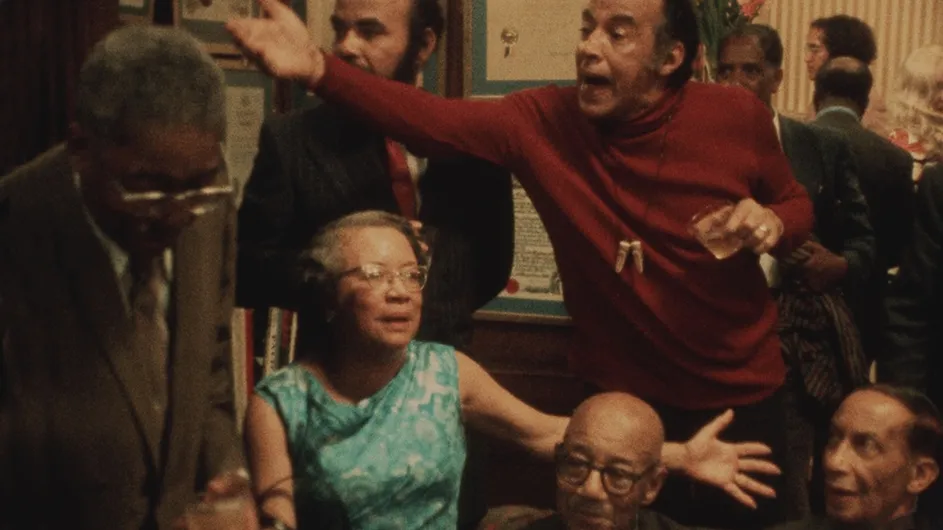
The resulting 100-minute film offers a rare glimpse into a gathering of artists and intellectuals who helped shape the Harlem Renaissance. In 1972, William Greaves hosted about two dozen surviving luminaries at Duke Ellington’s apartment on Riverside Drive. The Harlem Renaissance, a flourishing of African American art, literature, music, and intellectual life in New York during the 1920s and early 1930s, provided Black artists with opportunities to assert their creativity and authority in a culture that had long excluded them.
Among those gathered were painters Aaron Douglas and Romare Bearden; musicians Eubie Blake and Noble Sissle; writer and artist Richard Bruce Nugent; poet Arna Bontemps; bookstore owner and socialist Richard B. Moore; actor Lee Whipper, a founder of the Negro Actors Guild; and Ida Mae Cullen, widow of poet Countee Cullen.
For four hours, attendees reminisced, critiqued, argued, laughed, and drank—many of whom hadn’t seen one another in 50 years. They compared their experiences of Harlem in their youth with the world around them in 1972, reflecting on their work and their place in a rapidly shifting cultural landscape. Greaves imposed no agenda on the gathering, allowing the conversation to unfold on its own terms. By the end of the evening, he had accumulated more than 26 hours of footage on a 60,000-foot roll of film.
Crowded Rooms of Jazz, Conversation, and Dancing
The gathering also echoed a tradition central to the Harlem Renaissance itself—the salon. Artists, writers, musicians, and activists often met in private homes, townhouses, and studios to exchange ideas, discuss current events, and collaborate on creative projects. These gatherings ranged from two artists working together to crowded rooms filled with jazz, conversation, and dancing.
Once Upon a Time in Harlem captures that spirit of intellectual exchange. Rather than imposing a central narrative, the film allows its subjects’ personalities, disagreements, and relationships to shape the viewing experience. During the post-screening conversation, the filmmakers described the film’s progression as being “like jazz music, focusing on letting it move.”
“The film preserves the personalities of these prominent figures, and it reflects the culture of the generation, rather than a history lesson on the Renaissance and its significance,” de Mare said. She emphasized that viewers need not arrive with extensive knowledge of the period or its figures. Instead, she encouraged audiences to “approach the film with a curiosity and willingness to learn.”
That openness allows the film to preserve more than a record of historical figures, capturing how people spoke and related to one another, and offering an intimate portrait of a generation’s shared history with overlapping interpretations of its meaning and legacy. The conversations touch on Black nationalism, the feasibility of socialism, and the representation of women in accounts of the Harlem Renaissance.
A Sundance Film Festival Premiere
After years of remaining unseen, the footage has now found a new life. The documentary premiered at the Sundance Film Festival to critical acclaim, with reviewers describing it as “exquisitely crafted” and “a vital reclamation of a precious history.”
While the gathering took place more than 50 years ago, it offers a model of artistic exchange that remains relevant today. “You don’t move a culture forward by one discipline; it’s the conversation and community between disciplines that inspire change,” Liani Greaves said at the close of the Q&A. Reflecting on the experience of completing the film, she added, “Working on this project has been the gift of a lifetime. This was a time when everybody was so involved and interested in the present moment and what everyone else was doing, and this awareness really opened my eyes to how cultures can survive across generations.”
As for next steps, the filmmakers continue to review the footage, and have received a grant from the Hutchins Center for African and African American Research at Harvard University to process it into a searchable, accessible digital archive, preserving this record of the Harlem Renaissance for future generations.
Rosemarie Rotundo is an MFA candidate in the Fiction Concentration of the Writing Program at School of the Arts.