The Magic of Fiona Shaw
At a School of the Arts event, the actress spoke with the director Oskar Eustis about drama, poetry, and the power of language.
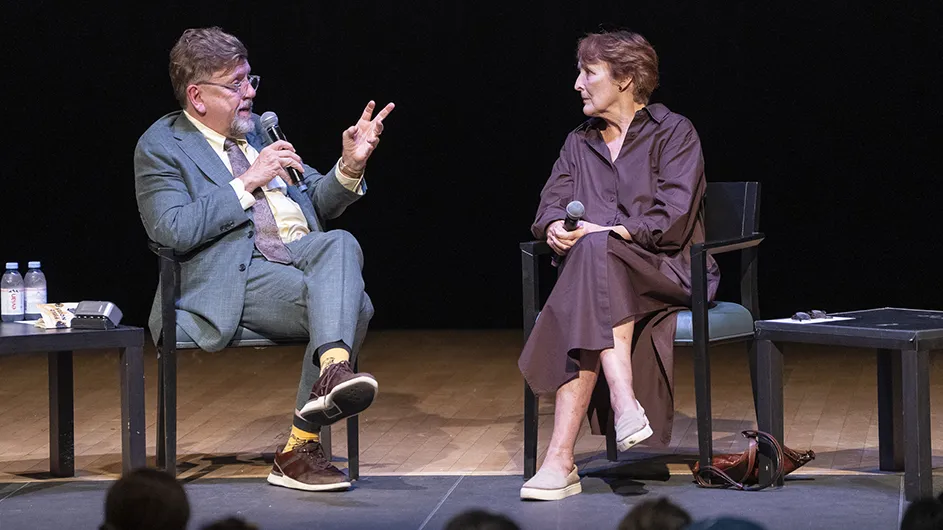
On a recent early autumn evening, people lined up along Broadway outside Miller Theatre for the first Speak Now event of the year. They were expecting to hear acclaimed Irish actress Fiona Shaw speak with Oskar Eustis, longtime artistic director of the Public Theater, about drama. What they may not have expected was the inherent dramatic force of Shaw herself, at one moment bringing the room to a hush by perfectly reciting Shakespeare, then, sending them into spells of laughter with a single sarcastic grimace. Throughout the evening, the audience was as attuned as they’d have been at a full-scale production, a testament to the fact that Shaw wouldn’t be able to turn off her talent if she tried.
In her introduction to the event, School of the Arts Dean Sarah Cole described Speak Now as a series featuring “artists whose work has a kind of urgency and power and need.” Cole told the audience she had had Fiona Shaw in mind since she established the series: “She has brought one staggering performance after another to the stage, showing us what it can mean for an actor of the greatest power to inhabit roles and interpret works in ways that reinvigorate them in stunning new fashion, showing us how to read, and think, and be anew.”
Cole said that when she was a graduate student in London in 1995, she saw Shaw on stage for the first time, playing the titular role of Richard II at the National Theatre. Though the performance was more than 30 years ago, Cole said she could “still remember it like it was yesterday.”
Cole also noted that Shaw has “been nominated for just about everything, including the Olivier, Tony, Critic’s Choice, and Evening Standard awards, among many others.” Shaw was appointed as a Commander of the Order of the British Empire, and awarded the Officier des Arts et des Lettres by the French government.
Drawn to the Dramatic Arts Through Poetry
Eustis first asked Shaw, “What made you attracted to this sometimes raggedy art form? What was it that brought you to theater?” Shaw’s reply: “I think I wanted to be a tennis player, but every time we got to a final, I’d show off and lose the match.”
Though she did not have access to professional theater growing up in Cork, Ireland, Shaw was drawn to the dramatic arts through poetry. As she described her first experience reciting poems for her family, Shaw began declaiming William Butler Yeats’s “Sailing to Byzantium” for the audience. She said that she felt the weight of Yeats’s words at a young age, without even understanding their meaning: “I think there’s something about poetry that makes you feel empowered because the language is bigger than you.” Shaw said she believes drama allows an “atavistic self that we all disguise with our personas to emerge.” When that happens for her, “it’s always through someone else’s language.”
After she completed a degree in philosophy at University College in Cork, Shaw was admitted to the Royal Academy of Dramatic Art in London. She began work in the industry right after graduation, landing her first job in 1983 in The Rivals, directed by Peter Wood at the National Theatre in London.
Shakespeare Does a Lot of the Work for You
“I want to talk about Shakespeare,” Eustis said to Shaw, a playwright with whom she has had extensive experience. Shaw said that through Shakespeare’s plays she “learned that rhythm is the key to the unconscious.” Shakespeare is able to achieve something few writers can, Shaw explained—a distinct cadence for different characters. While she admitted that Shakespeare “does a lot of the work for you,” she also insisted that saying his words alone is not enough to sway an audience. Performers must also “inhabit” the language: “You have to have an imaginative relationship to the word; if you have to say ‘to be or not to be, that is the question,’ it has to be a question that you might have asked yourself.”
Shaw mentioned that prior to her famous portrayal of Richard II, she had already played several of Shakespeare’s heroines at the Royal Shakespeare Company, including Celia in As You Like It. Though she noted an “inherited diatonic fear of Shakespeare,” given the violent history of British colonialism in Ireland, as the production went on, she began to realize she didn’t have to pretend to be anybody else to play the role. She had never been to the forest of Arden in England, where the play is set, so instead she pictured an Irish landscape in her mind. Shaw also felt there was something unique she could bring to the role of Richard II, a kind of femininity in the character. For Shaw, Richard II is not necessarily a play about a man, but a play about “a person who thinks they are a god becoming a human being.”
Greek Tragedies Are More Direct
In comparison to Shakespeare, whose language Shaw described as “generous,” she finds Greek tragedies more direct: “The Greeks are the only people who deal with the black and white of how awful we are.” Shaw played the titular role in a 1988 production of Electra, and recited the opening lines for the Miller Theatre audience: “Light of the morning, sky, canopy above, as the shadows of night melt into day, hear me, I am desperate with grief, I tear my own flesh raw.”
Eustis vividly recalled seeing Shaw as Medea in 2000, and told the audience that he had screamed aloud during a matinee performance: “It was the only time I’d believed a mother just murdered her child. And if you believed that, you’d scream, too.” Shaw explained that the shock lands so viscerally with the audience because, up until that point, they have been won over by Medea, laughing with her right up until she announces that she is going to kill the children. When she walks off stage with the two boys—trusting and not frightened of their mother—the audience still doesn’t believe she is really going to do it. Then they watch in horror as one of the boys runs away, and blood splatters.
Language Itself Is a Kind of Spell
With or without the assistance of clever staging, Shaw places immense importance on language. “Language itself is a kind of spell,” she said, “and the better the language, the more of a spell it is.” In preparation for a recitation of The Wasteland by T.S. Eliot, she said she got as specific as she could about the voices she was speaking in, imagining people she knew in real life. “No one hears the words if you generalize,” Shaw said, but through specificity, audience members are invited to fill in their own person, someone they may know. In this sense, Shaw envisions each live performance as an entirely unique result of every person in the room, not just those on stage. “Once you get on the same wavelength, you aren’t doing it to them or at them,” she said. “That is the magic.”
Shaw has also worked on screen, perhaps most recognizably as Petunia Dursley in the Harry Potter films. For her performance as Carolyn Martens in the hit series Killing Eve, Shaw won a BAFTA Award and was nominated for two Emmy’s. She described playing that part, head of the Russia-focused branch of MI6, as a singular challenge. Someone had told her that “spies don’t speak immediately when they are asked a question,” and though the idea of not speaking kept her up at night, she admitted that “actually, it worked very well.”
The Importance of Artistic Community
At the end of the evening, while responding to audience questions, both Shaw and Eustis affirmed the importance of artistic community. Shaw mentioned being grateful for British director Deborah Warner, one of her long-time collaborators, who has always been attentive to the live dynamics of each cast, “waiting for something to happen in the room that was true—for the air to stir,” Shaw said.
Eustis noted how essential it is to create an alternate value system outside of fame and money, to put effort into building a community that holds you accountable artistically: “I know it’s hard, and it’s different than 50 years ago when I started out, but I just believe in it so strongly.” In reply to an audience-member question about how young actors should deal with the pressure of finding success early, Shaw said, “You can’t expect success, but you can get better at the thing.” She encouraged emerging artists to perform for people around them and expand their worldview: “Have something to offer, something that you wouldn’t have had last year.”
Eustis echoed Shaw’s sentiment, imploring young creatives to “do whatever it is you have to do to become yourself, specifically you; we are always hiring specific souls.” He gestured to Shaw, and said, “Fiona, you’re not like anybody else,” emphasizing that what makes theater so special, what we crave from it, is “to feel like we are in touch with other human beings.”
Katie O’Connor is an MFA student in the Fiction Concentration of the Writing Program at School of the Arts.