Marc Tsurumaki Is the New Director of Columbia GSAPP’s Master of Architecture Program
As the program engages more directly with global concerns such as the climate crisis, he will lead the way.
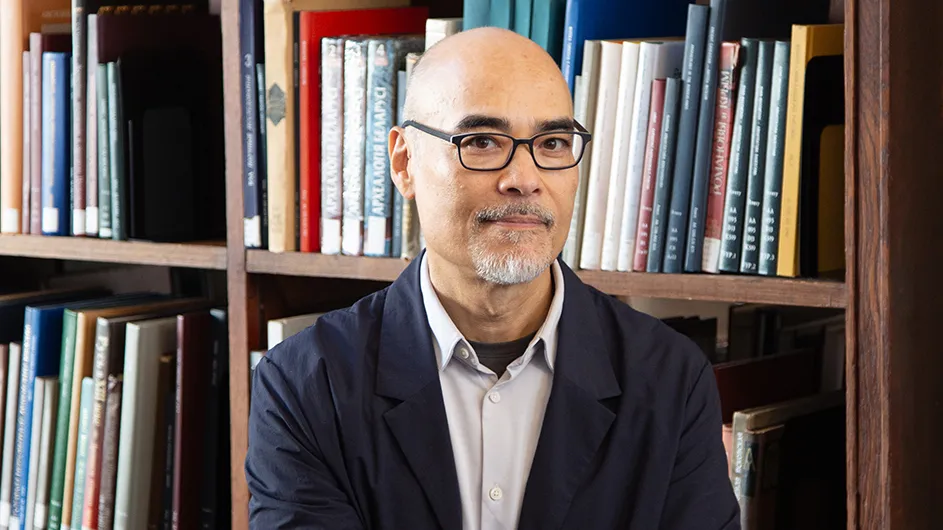
Starting this semester, Marc Tsurumaki is directing the Master of Architecture Program at the Graduate School of Architecture, Planning, and Preservation (GSAPP). The three-year program is known for its experimental pedagogy, connecting research and knowledge to a broader context of environmental, social, and global action. The school’s faculty pioneer complex approaches to technology and computation, shape the program’s design and housing studios, and advance research and discourse in materials, ecology, and inclusiveness.
“Our Master of Architecture Program has a global impact in anticipating how architecture evolves, and Marc Tsurumaki is uniquely prepared to make design, practice, and the profession of architecture the best equipped to address how the climate crisis, societal divides, and geopolitical tensions intersect, and can be addressed through and as architecture,” said GSAPP Dean Andrés Jaque.
Tsurumaki, who has taught at GSAPP for more than 20 years, is a leading practitioner with a research-based practice, LTL Architects, which explores the environmental and societal impact of architecture and develops methods that reduce embodied carbon through the use of plant- and earth-based materials, carbon capture, and material reuse. Uniting research and publishing with material development and design, Tsurumaki has established a new model for architectural practice. This has also resulted in the widely influential books Manual of Section—which reveals how the architectural section functions as a representational technique and shows a building’s formal characteristics—and Manual of Biogenic House Sections, which presents a series of houses selected for using materials with beneficial environmental properties. Tsurumaki co-authored both books with Paul Lewis and David Lewis, his partners at LTL Architects.
As the new director of GSAPP’s Master of Architecture track, what are your plans for the program?
Under the leadership of Dean Jaque and the work of my predecessor, Mario Gooden, as director of this program, GSAPP is uniquely positioned to raise critical questions regarding the potential of architecture amid current urgent issues. While the school has a well-earned reputation for the experimental and for testing the boundaries of the discipline, at GSAPP, architecture is not conceived as an autonomous pursuit, but rather as one intensely intertwined with emergent environmental, technological, and social realities. In this sense, the Master of Architecture track is a curriculum based on engaged speculation.
On one hand, this means taking seriously architecture’s role in and relationship to intersecting crises of ecological devastation, accelerated technological change, ongoing political uncertainty, and radical inequity based on extractivist economies, among other challenges we face today. On the other hand, I hope to provide our students a pedagogical space in which these seemingly overwhelming challenges can be encountered with imagination and optimism—proposing new ecologies, materialities, and collectivities, which can lead to impactful change and a more convivial relationship to our shared environment.
How will you incorporate into the program your focus on the environmental and societal impacts of architecture, and your development of methods that reduce embodied carbon through the use of plant- and earth-based materials?
It is critical that our students understand not just how to deploy materials and systems, but also how our constructive practices impact the planet. For the last hundred years or so, since the emergence of modernism, we have built predominantly with industrial materials like concrete, steel, and glass based on extractive, carbon-intensive processes, which have devastated the environment, imperiled human and non-human life, and intensified existing inequities and created new ones.
One of the most immediate ways to address embodied carbon in the built environment is via biogenic (plant-based) or geogenic (earth-based) materials, which require relatively minimal processing, are plentiful and widely distributed, and, in the case of plants, sequester carbon in their very cell structure. In my own practice and teaching, I have been investigating the architectural implications of these material practices—how they can lead to not only more regenerative modes of building and unbuilding, but also how they can catalyze new architectural possibilities, provoking unprecedented spatial, tectonic, and programmatic ideas and a more co-productive relationship to living systems.
While this interest in biogenic systems is already actively integrated at GSAPP—including in the teaching of colleagues like David Benjamin, Lola Ben-Alon, and others—it is important that we continue to engage a multiplicity of approaches, from biomaterials and reuse to low carbon and even carbon-negative versions of ubiquitous materials like concrete, which are currently under investigation. To me, this interest in rethinking material systems represents one of the most hopeful and exciting potentials of our current moment, and a trajectory that I hope to intensify, linking our work at GSAPP across disciplines with ecologists, material scientists, engineers, biologists, etc., but also in conversation with fabricators, builders, growers, and practitioners.
While program director, will you continue to teach? If so, what are you teaching this semester?
Yes, as part of my role as director, I will be coordinating, along with Lydia Kallipoliti, the director of the Master of Science Program in Advanced Architectural Design, the fourth- and fifth-semester advanced studios, as well as teaching one of the sections. These advanced studios represent the culmination of the program and comprise a fantastically diverse range of approaches and topics, bringing together the most innovative practitioners and thinkers in the field today. My specific studio will be focused on biogenic material assemblies, agro-ecological assemblages, and the revitalization of human-altered landscapes. The studio will invite students to imagine new collaborations between photosynthetic processes, vital material flows, and human and non-human creativity.
What was your path to a career as an architect and a professor?
I started teaching shortly after graduate school and basically never stopped, so my academic work and practice have always been co-extensive and intertwined. My practice, LTL Architects, which I run with Paul and David Lewis, who both also teach, involves constructed work—much of it with academic and cultural institutions—as well as speculative projects, self-generated research, and publication, all of which inform the other. Often, questions we encounter in built projects stimulate research, which in turn leads to design experimentation, and ultimately informs our teaching. Ideas and insights from teaching then fold back into the practice in a kind of perpetual, recursive feedback loop. Teaching is very much reciprocal with and integral to how we work.
What are you working on now?
A range of projects reflecting our focus on biogenic material approaches. Based on our research into straw, we are constructing a prototype dwelling that deploys this readily available agricultural residue as a form of structural insulation. Much of our work also involves reusing existing buildings, a crucial strategy for reducing embodied carbon in the built environment. Currently, we are renovating a historic masonry building for a liberal arts college, amplifying its thermal performance via a new biogenic skin.
We are also collaborating with the Jamaica Bay Rockaway Parks Conservancy on the repurposing of two of the original hangars at Floyd Bennett Field as a hub for the development of nature-based technologies. For the latter project, we are proposing a series of prefabricated mass timber structures nested within the restored envelopes of the 1930s hangars, creating a passively climatized interstitial environment that will act as a thermal buffer for the new program.
Advice for anyone interested in pursuing a trajectory similar to yours?
I would encourage the cultivation of curiosity and a deep attention to the physical environment. Walter Benjamin famously characterized architecture as the art that is perceived in a state of distraction, and today our distractions have multiplied exponentially to the point where one might say they have become our environment. Much greater then is the need to be conscious of and conscientious in how we encounter things—even the seemingly inconsequential, both the apparently negative as well as the positive. This can give rise to new ways of seeing, along with new modes of thinking and making, all of which we need to live creatively within the uncertainties of the current moment.
What is special about teaching at Columbia and in New York?
One of the fantastic aspects of teaching at Columbia is precisely its relationship to New York City. From a more practical perspective, it means we have access to an incredible density of intellectual and creative resources both within the University itself and in the city more broadly. Moreover, as a graduate program in architecture, we can think of the city as an extension of the school, as a richly diverse, complex, and vital field for research, encounter, and experimentation. Our embeddedness in New York, and the ability of our students to experience the city fully and directly, are invaluable assets for a school committed to the intricacies of collective life and its manifold spatial manifestations.