Meet the National Rubik’s Cube Champion Who’s Got Some Great Advice for Your First Year at Columbia
Your first year at Columbia can feel like a puzzle. Lucky for us, Matty Hiroto Inaba (CC’29) is a champion solver who is about to start his second year and he’s got some great advice for quickly making Columbia your own.
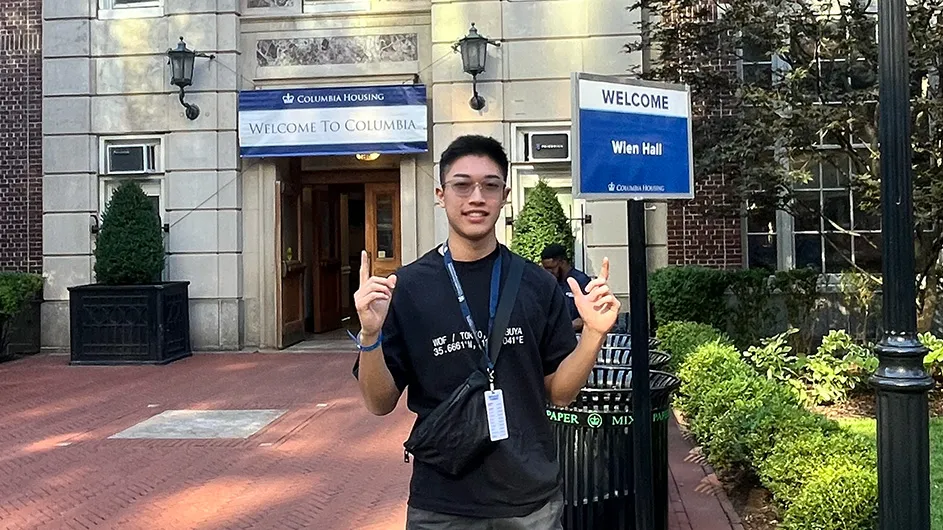
Give Matty Hiroto Inaba (CC’29) a Rubik’s Cube and expect it back in your hands, solved, in a matter of seconds. That’s a skill he’s honed over 10 years, a North American Championship title, and a record for the fastest average time of five solves (the previous record-holder held that position for eight years).
He’s been recognized on the subway for cubing. He’s been DM’d by strangers who watched his competitions on YouTube before meeting him in person.
He’s also a proud transplant from Hawaii who traded a lifetime at one school (from kindergarten to senior year) for a campus three time zones and a whole culture away.
“I went to Admitted Students Day, and I really liked it,” Inaba said. “It was just an amazing energy I felt from the moment I stepped onto campus. Everyone was nice. That was a good first impression. And I just thought of it a little more, and I was like, ‘You know what? I’ve been in Hawaii all my life. Let’s switch it up a little bit and see what happens.’”
That leap is exactly why we at Columbia News asked Matty to be one of our guides for this year’s “Choose Your Own Adventure”-focused Columbia Welcome package. Plus, he’s really learned how to tap into a community of shared interests here—within cubing and outside of it.
Here’s what he’s learned, distilled into advice every new (and returning!) student can use.
Take us back to your first few weeks on campus. What was that like?
Very hot, I remember. A lot of people. They gathered us, especially during the New Student Orientation Program (NSOP), in a bunch of big groups, and I thought that was pretty cool, honestly. Especially when we walked away from Convocation through the main staircase towards Butler Library, that was a cool experience just being with the whole freshman class. I really liked that.
NSOP was very fun. I met a lot of really cool people there and just got to go around New York City. I think that really solidified: “Okay, I’m now in New York. I know what I’m doing. So yeah, let’s just get started.”
You’re majoring in economics. How’d you land there?
I’m just intrigued by how money moves in the world, and I am majoring in economics because of that. It’s just interesting to me personally to see patterns. Just like there are patterns in the Rubik’s Cube, to see how money moves, patterns emerge, people take advantage of it, and then those patterns disappear, and you have to find new patterns.
Matty’s 3 Pieces of Advice for First-Year Students at Columbia
- Talk to anyone you can and don’t be afraid to put yourself out there and introduce yourself to people. Some conversations I had a while ago, toward the beginning of the year, I didn’t really talk to them much, but then in the second semester we reconnected. Since you talk to them at the beginning of the year, you’re like, “Oh, I remember you, how’s this going?” And then you can have those types of conversations as well.
- Don’t be afraid to get out into the city and just go anywhere that interests you. New York is so cool in the way that you can just take the subway anywhere you want in this huge, huge city. You can find basically anything—any passion, any interest, any food you want to eat. You can find anything in New York. On occasion I was just in my room because it gets comfortable, but once I started getting out there more, the whole experience was more fun and engaging.
- Pay attention in your classes, even if it will feel very, very easy to skip lectures here and there. Being in the lecture in person, hearing the professor, being around your classmates, and just being able to talk about the material, I think it helps a lot with learning, and it saves you time afterwards when you have to go back and relearn stuff.
What surprised you most about yourself the first year?
I met so many musicians at Columbia because of the Columbia-Juilliard Program and also the Columbia University Orchestra here. Previously, I was not a big music guy, but now I know a bunch of composers who I didn’t know about before I came to Columbia.
The same goes for reading. I wasn’t much of a reader, though I had read some sports psychology books purely to get into the competitive mindset with cubing. As far as leisure reading, I hadn’t really done much of that. But through Lit Hum (Editor’s Note: Literature Humanities, for the uninitiated), I really found an interest in books in general. I have to admit, in that first semester I was not reading the full books, but in my second semester, I had to get every single page in. That felt really important for me and I enjoyed it. Now I miss Lit Hum.
Favorite Lit Hum read?
Oh, To the Lighthouse, 100%. The plot is kind of convoluted at times, but I think the way I like to read is just reading pretty, or delicious, sentences, as my classmate called it. Virginia Woolf has a lot of delicious sentences.
What’s the best spot on campus?
I like St. Paul’s Chapel. Sitting in there is so nice, just for five minutes, to de-stress. And of course, going up Low Steps and sitting on the little overhangs on the right or left with the lampposts. Everywhere you go on campus is meticulously designed and maintained in a way that’s so nice to look at—trees, nature, flowers. I think just walking around campus when you need a breather is so enjoyable.
Anywhere in the city a new student absolutely has to go?
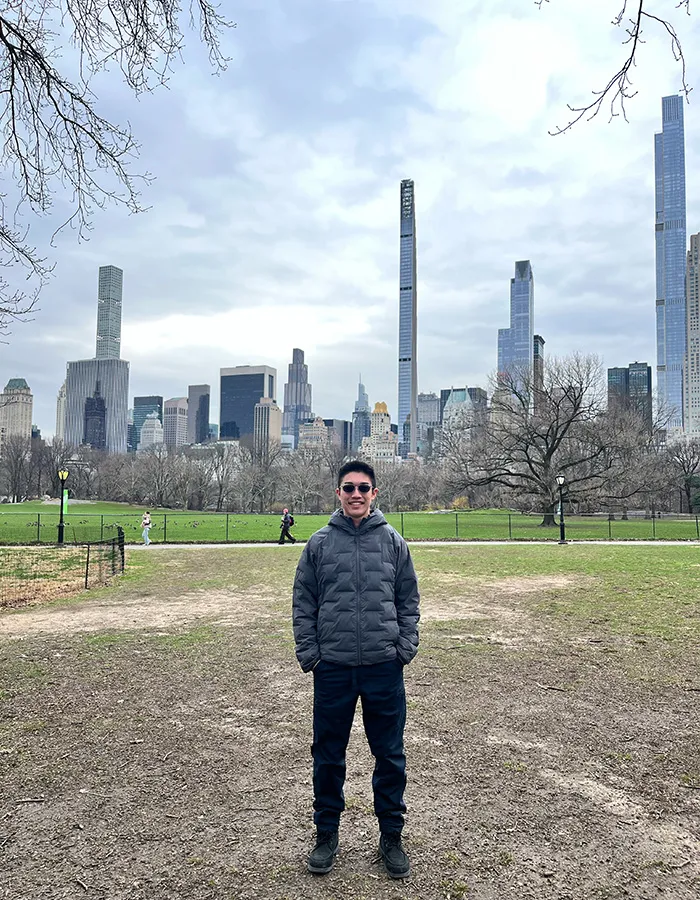
Central Park when the cherry blossoms are blooming is pretty nice, especially because the weather was right after it stopped snowing, so it was still cool but not super cold.
You go to The Met during Lit Hum, but it is just such a cool place to go. It might be biased because I love painting.
Flushing [in Queens] is amazing, even though it is a little far away. I had a lot of friends who liked to go and try the Chinese cuisines over there.
Any Columbia first-year life hacks you swear by?
- Bring a Brita filter—go late at night or early in the morning when no one’s in the lounge and fill it up in the sink, and just put it in your room so it is there ready for you when you want a drink.
- I tried a lot of different times to find the perfect laundry time, and I had this gap in classes right after lunch and before 3 p.m. That time I found was not very busy!
- Finally, get a big jacket for winter, because I didn't have one. Coming from Hawaii, we don't need that stuff. I didn't have boots. I didn't have any warm clothes. Just don't bring it with you because there's not a lot of room in your suitcase. When you get here, just get one—it'll help you survive when it's cold.
Other than that, I don’t know: pick your own journey. Doesn't really matter what you do. Just come here with an open mind. Just bring an open mind, and the connections will follow.
“Pick your own journey. ... Just bring an open mind, and the connections will follow.”
And If You’re Thinking About Picking Up a Rubik’s Cube Between Classes...
How did you first get into cubing?
I was nine, visiting Japan, and in a department store. I saw Rubik’s Cube, and I asked my mom to get it for me. She was initially like, “No, I don’t want to because you won’t be able to solve it.” But later we went back to the same store, and I convinced her to get it. Came back to Hawaii, learned how to solve it.
It just kind of got addicting after a little bit when you start to get a little faster, and you start to time how long it takes you. You want to get faster and faster. Five years later, I was third in the world.
It’s never too late to start. If you want to get really, really fast, then starting a little earlier would help, just to build the pattern recognition. But look, if you’re 80 years old, you can learn how to solve a Rubik’s Cube and do it pretty fast.
How can Columbians participate in the scene?
New York is actually one of the most active competitive regions in the United States, aside from the Bay Area of California, which is where I grew up competing. Some are in Manhattan: NYU’s Rubik’s Cube Club hosts a few a year, and then a lot in New Jersey. Head to the World Cube Association website for a schedule of competitions. It’s just a fun thing to do. There are a lot of opportunities to get into the community, and I’m working on setting up a Columbia Rubik’s Cube Club too.
Do you ever feel boxed in as ‘the Rubik's Cube guy’ on campus? How do you connect with other interests?
I’m not really that opposed to it because I love doing it and that's my thing. But as well as that, I’ve found other people in the Columbia community that I've been able to connect with because I have a few other passions.
I really love golf, both just playing golf and watching golf. And I joined the Columbia Club Golf and I'm going to be on the e-board this year. Those are some of my closest friends, just sharing our passion for hitting a little ball around. And I think that's pretty cool to find people like that.
I also enjoy oil painting a lot. And during NSOP, a few of my NSOP group members were passionate about painting as well. So, we had some pretty good conversations.
There’s a Columbia Hawaiian club (Mālama Hawai’i), and they did a collaborative event with the NYU Hawai’i Club, which was a really cool cultural thing to connect back to my home. We did this thing called a lūʻau: traditional Hawaiian food prepared and served. And then they had a hula performance, a traditional Hawaiian dance.
Ok, final question: Any cube etiquette we should know?
The one thing I always follow is that I never leave a Rubik’s Cube unsolved if I see it on a table or something. That’s the only rule I give. I let people interrupt me whenever; that’s fine, but as long as every cube on the table is solved, we’re all good.