Once a Pediatrician, Now an Educator and Children’s Book Author
For Sayantani DasGupta, storytelling is a powerful tool for pursuing social justice.
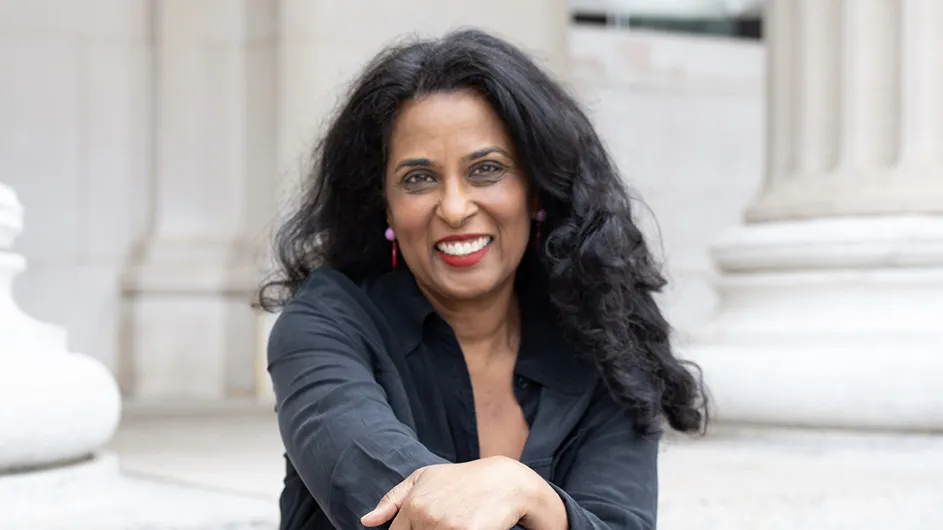
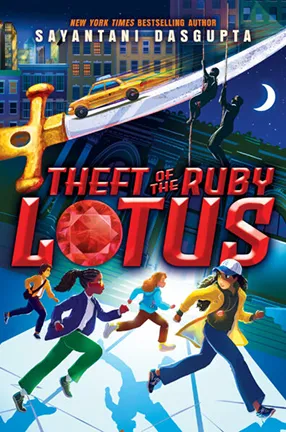
Theft of the Ruby Lotus is a New York Times bestseller and the latest young-adult novel by Sayantani DasGupta, a co-founder of and senior lecturer in the Master’s Program in Narrative Medicine at Columbia’s School of Professional Studies. She also teaches at the University’s Center for the Study of Ethnicity and Race, and its Institute for Comparative Literature and Society.
In the book, Ria Bailey finds herself in a fix, and it's all because of a strange treasure that turns up in the mail one day. It might be a ruby, and it might hold the key to some troubling developments in her life. If she and her besties, Miracle Owusu and Annie Hernandez, can trace the treasure’s significance, and stay one step ahead of the strangers tracking their moves through the Metropolitan Museum of Art and the streets of New York, maybe Ria can turn things around for herself.
What was your path to writing children’s books?
I grew up in a household that was equally about social justice and story. My mother was a prominent activist, who began her immigrant anti-domestic violence organization out of our house, so my childhood was full of rallies, fundraisers, and protest marches. In the last few decades of his life, my father, who retired early from his job in telecommunications, became a very successful Bengali-language detective novelist—so much so that TV serials and movies based on his Eken Babu books continue to be produced and loved in India today.
I went to medical school because I saw medicine as a concrete tool for social justice—something I could contribute to making the world a better place. But it was the storytelling and story-listening aspects of medicine that really spoke to me. This, of course, is why I eventually co-founded with some colleagues Columbia’s Master’s Program in Narrative Medicine, in order to rigorously train students to give and receive stories in healthcare contexts.
But the love of books and stories remained. I wrote a book of folktales before medical school; a memoir during my residency training; while already at Columbia, I collected and co-edited a volume—Stories of Illness and Healing: Women Write Their Bodies—and more. I didn’t start writing for children, though, until my own kids had become avid elementary school readers. The thing that struck me was that they experienced the same lack of representation, which I had experienced as a daughter of Indian immigrants more than 30 years prior. At the time, there were still very few heroes of color centered in children’s books. (Now there are wonderful organizations like We Need Diverse Books, which effectively opened the door for many more writers of color, as well as queer and other marginalized writers in the children’s literature space.) I began writing for my own kids and for my own young self who had never seen herself in books. Narrative erasure is a kind of psychic violence: Because when you don’t ever see someone like you portrayed as heroic, brave, or beautiful, you start to believe that you can’t be any of those things either.
Looking back now, I see that the transition to children’s writing was probably inevitable. When I was in practice as a pediatrician, I wrote almost daily prescriptions for reading. I’d take a special reading prescription pad that we had in the office and write, “Read to your baby 20 minutes a day.” With the help of literacy groups like Reach Out and Read, I was able to give families an age-and-language-appropriate book to take home with them.
I knew, like pediatricians across the country continue to know, that stories are good medicine. Being read to increases language acquisition, language production, improves early literacy, increases caregiver-child attachment, and more. When a child is older, reading doesn’t just help with school performance: It also aids emotional regulation, broadens intellectual curiosity and imaginative horizons, and, through diverse books, helps children recognize themselves and each other in literature.
My children’s writing careers, my career in academic narrative medicine, my career as a pediatrician: They’re all interconnected, and in my mind, all healthcare practices. When I was in clinical practice, I cared for the corporeal and emotional health of young people. In my graduate and undergraduate classrooms, my purview is their intellectual health. And as a children’s writer, I’m tasked with the responsibility of contributing to young people’s imaginative health—which, to me, is one of the most vital aspects of our overall health, not to mention the health of broader society!
What was the impetus for Theft of the Ruby Lotus?
This book is a museum caper and art heist written for 8-to-14-year-old readers and set at the Metropolitan Museum of Art. It’s inspired as much by E. L. Konigsburg’s From the Mixed-Up Files of Mrs. Basil E. Frankweiler as it is by museum heist movies like How to Steal a Million or Oceans Eight. My novel is both a love letter to New York’s immigrant kids and an examination of colonial art repatriation.
I’ve always loved museums—and, of course, in New York, we have such a wealth of museums to visit. In a vast institution like the Met, visitors can travel across time and space, spanning continents and centuries in the course of an afternoon. But it’s not just a place to learn from other cultures or remember times gone past; museums are also places where we can remember what’s personally precious. These are spaces of deep and profound beauty, where—as former Metropolitan Museum guard Patrick Bringley writes in his memoir, All the Beauty in the World: The Metropolitan Museum of Art and Me—we can step out of the hectic, day-to-day world, and remember those we have personally lost. Like Bringley, I, too, found myself frequenting the Met after the unexpected loss of my vibrant father in 2023, and asking myself: “How can we remember that which is most precious?”
Michel Foucault considered museums to be heterotopias, worlds within worlds, spaces that both represent and reflect the broader societies in which they exist, and also trouble those reflections. Museums can hold such contradictory truths. They are on the one hand places of splendor, inspiration, and knowledge, but they are as well often sites of unexamined colonial violence and misery. These are places that hold looted colonial treasure under the guise of protecting other people’s histories. This narrative is consistent with what former Columbia Professor Edward Said named as Orientalism, the notion that there are other peoples too barbaric, primitive, or incompetent to be trusted to take care of their own precious treasures. Therefore, Western countries and their cultural institutions must protect these things for them.
As a daughter of Indian immigrants, I was always aware of histories of colonial looting. I grew up hearing stories, for instance, of the Koh-i-Noor diamond—the 105.6-carat diamond supposedly gifted to the British Raj by the boy king Duleep Singh after the British imprisoned his mother. The diamond was recently in the news after Mayor Zohran Mamdani suggested that, if given the opportunity, he might ask King Charles III to return the precious gem, which remains to this day in the Tower of London as part of the British Crown Jewels.
Objects like the Koh-i-Noor inspired Theft of the Ruby Lotus, which in turn, I hope, inspires young people from New York and throughout the country to ask critical questions when they visit museums, including: Who should own and protect treasures from elsewhere? At a time when immigrant communities in the U.S. are being dehumanized, vilified, and terrorized, I think it behooves us to ask what’s really precious, and what we should treasure—art and artifacts obtained by violence or other problematic ways from formerly colonized countries? Or the kids and families from those countries, the immigrant communities who make places like New York City great?
What are you working on now?
My daughter just graduated from Barnard, so this year, instead of attending Columbia’s graduation as a faculty member, I was there as a proud parent! (My daughter is probably pursuing a career in journalism, while my son just finished his first year in medical school, so it’s fun to see them following my footsteps in their own ways.)
This summer, I’m working on the next book I have on contract, which is a young-adult feminist fantasy. It’s a retelling of some stories from the Indian epic, The Mahabharata, with a gender swap of one of my favorite characters, the brave and forgotten warrior Karna. My story is inspired by Nobel Prize-winning economist Amartya Sen’s contention that there are 100 million missing girls and women in Asia, including children who have died from neglect, feticide, and infanticide. In my book, I ask what would happen if, one day, these discarded girls were to be reborn as warriors seeking revenge? How might humanity answer for turning its back on its daughters?
What will you teach in the fall?
I’ll be teaching my Illness and Disability Narratives seminar for Narrative Medicine graduate students, as well as my advanced undergraduate and graduate seminar on Abolition Medicine.