Remembering Beau Rose Jessup
The Columbia Journalism School student was interested in “cultural journalism, particularly how institutions, identity, and social expectations influence the way we live and understand one another.”
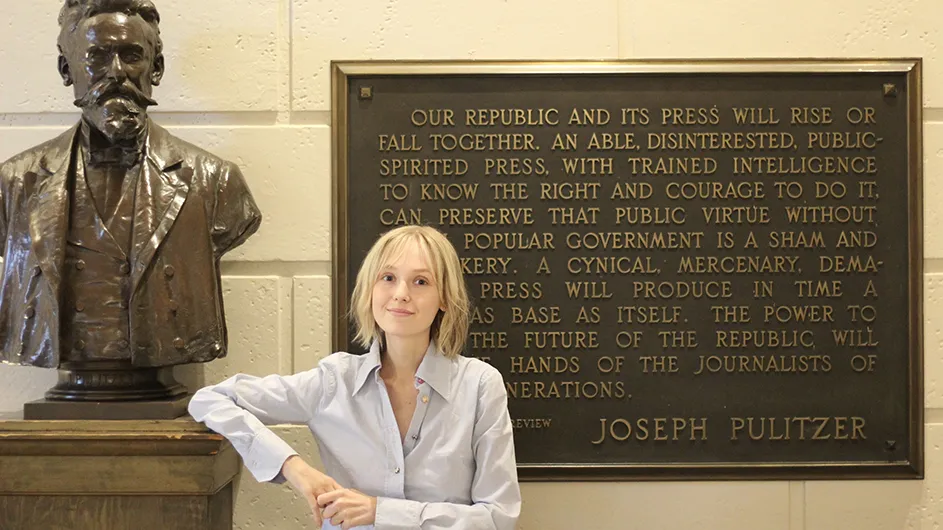
Last month, Columbia News reached out to Beau Rose Jessup, a student at Columbia Journalism School, as part of the Notebook series, which highlights some of the many fascinating students who study at the University.
Sadly, after interviewing Jessup and going over an edited version of the interview with her, Jessup passed away. With permission from her family and encouragement from leaders and her peers at the Journalism School, Columbia News decided to publish this insightful discussion in memory of her far-too-brief life and experience at Columbia and in New York City.
When will you graduate from the Journalism School, and what is your degree/specialization?
I graduate from Columbia Journalism School in May 2027 with an M.S. in Journalism. I previously studied Social Anthropology at the London School of Economics and Writing for Performance at the University of Cambridge, which shaped my interest in cultural journalism—particularly how institutions, identity, and social expectations influence the way we live and understand one another.
Has there been a professor (or more than one) during your time here who has inspired you? If so, who and why?
I’ve been particularly inspired by Alexandra Zayas, an adjunct assistant professor of journalism, who has deepened my interest in investigative journalism and the discipline of pursuing difficult truths. Also, Assistant Professor Nina Alvarez, whose teaching has shown me how rigorous reporting, verification, and editorial judgment underpin responsible journalism.
Before you arrived at Columbia, you created SpecialName and pursued other entrepreneurial ventures. Can you discuss those? Are any of them ongoing?
I’ve never really thought of those projects as entrepreneurial ventures. I was less interested in starting businesses than in finding ways to connect with people.
As the daughter of a television actress, I grew up with an unusual awareness of the distance between people’s lives and the stories told about them. I saw how journalism could illuminate someone’s experiences, but also how those experiences could be distorted, simplified, or transformed into a public narrative over which the subject had very little control. I was curious, from quite a young age, about who gets to tell people’s stories, and what happens when those stories enter the public domain.
At 16, I started Beau’s Community Bakes, a weekly column for my local newspaper in England, which used recipes as a starting point for conversations with older people, many of whom were experiencing loneliness or social isolation. The recipes were almost incidental; what interested me were the lives, memories, and personal histories that emerged through those conversations, and the possibility that sharing them might help people feel more connected to their community.
Around the same time, I created SpecialName, a website that helped Chinese parents choose English names for their children. The site unexpectedly attracted international media attention, and eventually led to a TEDx talk I gave about how and why I had helped name around a million babies.
What interests me, looking back, is that these projects placed me on opposite sides of the storytelling process. With Community Bakes, I was the journalist, using a platform to represent other people’s experiences. With SpecialName, I became the story, watching my own intentions and experiences interpreted and repackaged by journalists around the world.
Together, those experiences gave me an early appreciation of both the power and the responsibility of storytelling. They made me interested not simply in what makes a story compelling, but in who controls the narrative, what gets lost in the telling, and what we owe the people whose lives become our subject.
How do you like studying in the city? What are your favorite urban pastimes?
If you ask any master’s student at the J School what they do in their spare time, their eyes will glaze over and become distant before they tell you, “There is no spare time.”
But when I do escape, I love theater, so I’m making the most of everything from Broadway to Off-Broadway. While completing my Master’s in Writing for Performance at the University of Cambridge, I wrote my first play, The Sandbag, which interrogates how family, memory, the body, and inherited narratives shape the stories we tell about ourselves.
I’m represented in New York by THORO Artists, who are helping me navigate the next stage of the play’s development. If I can arrange a table reading of The Sandbag in Pulitzer Hall, I’ll technically be able to claim my first play was performed on Broadway. Geographically speaking, at least.
Any specific recommendations for things to do beyond campus?
In the little free time I do have, I love visiting the 79th Street Greenmarket, exploring the Upper West Side, and then turning some of what I’ve seen, read, or been thinking about into my regular LinkedIn blog, #BeauinNYC. I don’t drink, but I’ve discovered a new love of New York mocktails. Pappardella on Columbus Avenue does a great non-alcoholic Moscow Mule.
And a budgeting tip—Maple Grove Farms Complete Pancake & Waffle Mix. It doesn’t stink out your studio apartment, and one box is breakfast for about three weeks.
What’s been the most special thing about studying at Columbia?
The most special thing has been learning from my professor journalists, whose careers I aspire to emulate, surrounded by people who are equally curious and ambitious about the world. Studying in New York City, at the center of global journalism, makes that experience even more exciting.
I also love being part of the wider Columbia community. I’m currently preparing to workshop my play, The Sandbag, in New York, and hope to collaborate with actors and directors from across the University.
What are your plans post-graduation?
I want to work as a journalist and writer, reporting on people, culture, and social questions with the rigor I’m learning at Columbia. I’m particularly drawn to journalism for its power and immediacy, while continuing to write for theater when a subject benefits from being explored through a different form.
I’m inspired by journalists who have also written plays: Jeff Biggers, whose reporting has appeared in The New York Times and The Guardian, alongside his work as a playwright, and Josh Duboff, who worked as a senior writer at Vanity Fair before writing plays, including Scarlett Fever.