This Student Wants to Put the Humanity in Engineering
Nosakhare Iyoha studies biomechanics in the lab, rides with Columbia’s student ambulance corps, and teaches free CPR classes to anyone on campus who wants to learn.
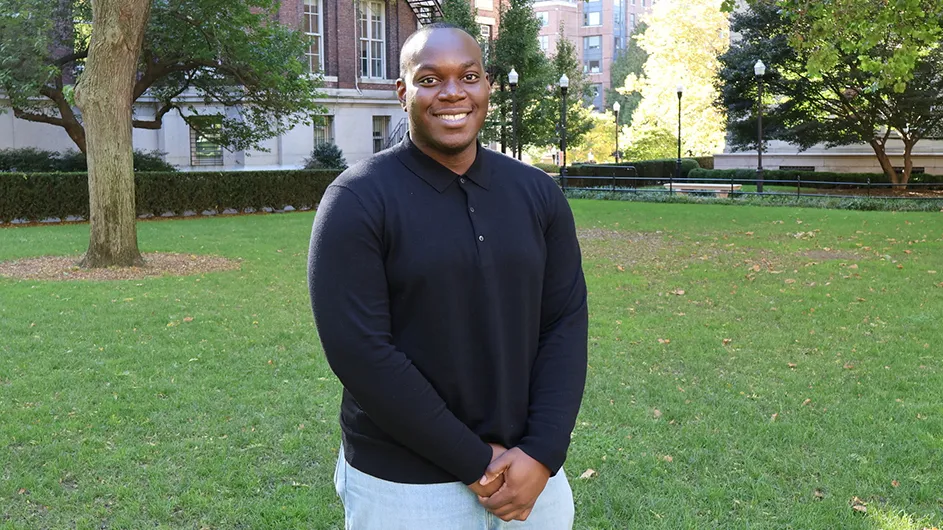
When Nosakhare Iyoha arrived at Columbia from a suburb north of Houston, he had never lived in a city, ridden the New York subway, or driven a car. Four years later, he has done all three, including driving an ambulance through New York with its lights flashing and sirens blaring.
Iyoha, who goes by Nosa, is a Columbia Engineering senior majoring in biomedical engineering and a C.P. Davis Scholar. He serves as vice president of communications for the Engineering Student Council and as a resident adviser (RA) for Black Mecca, a special interest community. He conducts research in the Morphogenesis and Developmental Biomechanics Lab with Nandan Nerurkar, associate professor of biomedical engineering. He also finds time to serve as an emergency medical technician (EMT) with Columbia University Emergency Medical Service (CUEMS), which he has done since his first year. He is currently applying to PhD programs.
When will you graduate from Columbia Engineering, and what are you studying?
I will graduate in 2027. I’m majoring in biomedical engineering with a minor in ethnicity and race studies.
Biomedical engineering encompasses quite a lot. It includes bioinstrumentation, imaging, and biomechanics, the study of how mechanical forces act on and within living systems, from bones and joints down to cells and tissues. I became interested in developmental biomechanics, and I study how forces help shape an embryo as it develops.
Why did you choose to study at Columbia?
I get asked this a lot, and my answer has stayed consistent over the past three years. Columbia offered the combination I wanted in an undergraduate experience. I knew I wanted to study engineering, although I wasn’t sure whether I would choose biomedical or chemical engineering, so I applied to a lot of engineering schools.
During the application process, I focused mainly on engineering. But once I had my acceptances and had to choose, I went back through my notes on each school. Columbia stood out for its emphasis on social innovation through its “Engineering for Humanity” vision. I was drawn to the idea that humanity should be at the center of engineering.
The built-in liberal arts education mattered to me, too. I wanted an undergraduate experience that would help me grow as a person and prepare me to contribute to the society I’ll be living in.
What does the “human” side of engineering mean to you in practice?
It’s important that the focus be on the actual people the devices are meant to uplift or help. It’s easy to focus on yourself—on making money or getting a job once you graduate. To me, Columbia’s emphasis on humanity is about advancing society and building devices not because they’re profitable but because they’re going to help communities. I’m less on the side of innovation that builds the products. I’m more on the side of teaching people to understand the nuances: thinking about the different communities that will be affected by your product, and how you can edit or tweak it so that it fits that community better. I think BME does a good job of making us think about this side during Senior Design.
Can you give an example of where that came up for you?
In my sophomore year, I co-led the Columbia Space Initiative’s Space Microbiology mission. Our team of about 30 undergraduate and graduate students studied how microgravity affects bacteria and human cell lines.
One of the cell lines we used was HeLa. It’s named after Henrietta Lacks, who went to Johns Hopkins for treatment for cervical cancer in 1951. Doctors took tissue from her for research without her consent.
When we got the opportunity to use HeLa cells, everyone was excited to use them in a student-led club. But we hadn’t properly acknowledged what it means to use human cells, or the history of those cells. So as mission leads, one of the first things we did was host a session teaching people the history of the cells we were using, so that we treat the research with care. It's been about 75 years since Henrietta Lack’s cells were taken, and many other important biomedical innovations have similarly complicated histories.
Outside of research and classes, what have you most enjoyed here at Columbia?
The sheer number of student clubs and organizations on campus. I’ve been part of CUEMS, our student ambulance agency, since freshman year, and I’ve served as an EMT for almost three and a half years now.
I first joined thinking it seemed like a cool way to give back to the community. It also helped that I didn’t have to pay to get certified because CUEMS paid for the class. But in the end, being able to help people on their worst days on campus has been so rewarding.
Being part of CUEMS taught me skills I can apply outside of a clinical setting, including empathy and de-escalation. Working as an EMT taught me that when someone is being difficult, it’s often because they’re scared. Being able to calm them down and connect with them is what allows them to get the medical care they need. I’ve found I can apply those same skills in other aspects of my life, including teaching and mentoring.
Joining CUEMS also helped me to improve my driving. I’m from Texas, and I had a license, but I had never really driven before Columbia. Driving in New York City has been a huge learning curve and adding sirens to that has been a fun challenge.
CUEMS has also given me the opportunity to teach. As an RA, you can’t work as a Teaching Assistant, so I’ve never had the on-campus experience of teaching a course. Through the CU-CPR program, I’ve been able to teach others this skill, including faculty members, which has been so cool.
What advice would you give students who are just starting out?
I had the chance to be a student speaker at a class assembly, and the advice I gave was less about school itself (how to study, what not to do) and more about finding something outside academics that you’re truly interested in, whether on or off campus.
A lot of people go into college expecting it to be a steppingstone to the next degree or the next job. Yes, college is meant to prepare you for that. But people sometimes forget how much reward there is in having a community.
So put yourself out there a little. If you hear about a club that sounds kind of interesting, check it out. That’s how I ended up joining Third Wheel Improv, a comedy group, as a senior and I’ve had so much fun with it.
Most clubs here are so easy to just join. And you don’t have to be the best or the smartest person in the room to find enjoyment in it. When I joined the Space Club, I had no interest in space whatsoever. I initially only joined because my friend wanted to join, so I’m going to be there for him. Then I found out that I really do enjoy learning about space medicine, and I enjoy building components to create microgravity. I never would have guessed that.
Any specific recommendations for things to do in New York beyond the campus?
One of my favorite things, especially when friends come to visit, is taking them out for karaoke. Koreatown has good places, but they’re usually expensive, which is why I go for two hours at most. There are also great spots on the Lower East Side and near Washington Square Park.
What are your plans for after graduation?
I’m currently applying to PhD programs. When I first started at Columbia, I was thinking about pursuing an MD-PhD. That goal hasn’t so much changed as become clearer: my real passion is research, and the clinical side comes second.
My goal is to stay in academia. My goal used to be splitting my time between academia and clinical practice. Now I want to stay as a professor and help mentor the next generation of engineers go on to do amazing, beautiful things, while continuing to emphasize the human side of engineering.