Two Columbia Faculty Members Named Sloan Research Fellows
They were recognized for contributions to economics and physics.
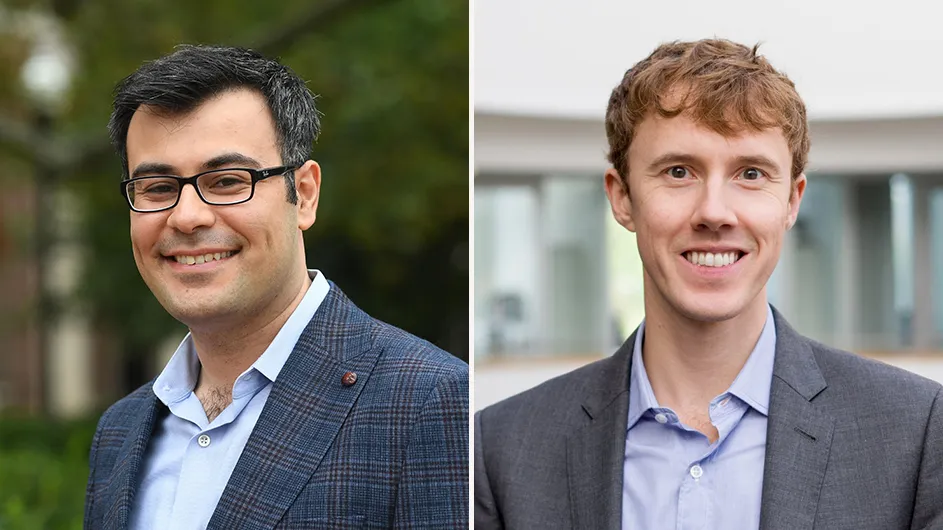
Two Columbia faculty members—Hassan Afrouzi, an associate professor of economics, and James McIver, an assistant professor of physics—have won 2026 Sloan Research fellowships. The fellowships recognize “exceptional researchers at U.S. and Canadian educational institutions, whose creativity, innovation, and research accomplishments make them stand out as the next generation of leaders.”
“The Sloan Research Fellows are among the most promising early-career researchers in the U.S. and Canada, already driving meaningful progress in their respective disciplines,” said Stacie Bloom, president and chief executive officer of the Alfred P. Sloan Foundation. “We look forward to seeing how these exceptional scholars continue to unlock new scientific advancements, redefine their fields, and foster the well-being and knowledge of all.”
Open to scholars in seven fields—chemistry, computer science, earth system science, economics, mathematics, neuroscience, and physics—the fellowships are awarded in close coordination with the scientific community. This year, 126 young scientists across the U.S. and Canada were awarded the two-year, $75,000 fellowships. Since the first Sloan Research Fellowships were awarded in 1955, 188 faculty from Columbia have received the awards.
The Alfred P. Sloan Foundation is dedicated to improving the welfare of all through the advancement of scientific knowledge. It disburses approximately $80 million in grants each year.
Hassan Afrouzi is an associate professor of economics. His fields are macroeconomics, monetary economics, and behavioral and experimental economics. He specializes in the aggregate implications of informational frictions, nominal rigidities, and market imperfections. In his research, Afrouzi combines theoretical frameworks with empirical, experimental, or survey-based evidence to study how these micro-level frictions operate and interact to shape macroeconomic outcomes, particularly in the transmission of monetary policy to inflation and real activity.

James McIver is an assistant professor of physics. His lab studies the electronic and optical properties of quantum materials at terahertz frequencies and ultrafast timescales. MacIver and his team are particularly interested in how those properties change in the presence of strong laser fields, with the goal of understanding how light-matter interactions can be used to both probe and control material properties.