Casa Muraro Is Columbia’s Research Center in Venice
The historical building is now hosting an exhibition of work by artist Johanna Unzueta.
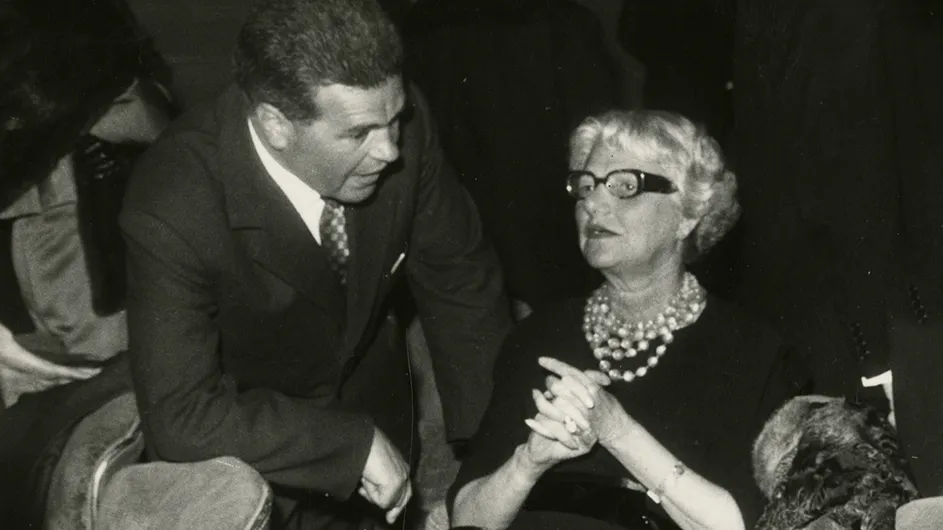
Casa Muraro is the former home and library of Venetian art historian Michelangelo “Mic” Muraro (1913–1991) and his wife, theater historian Maria Teresa Muraro. Located a few steps away from the Peggy Guggenheim Museum in Calle Barbaro, halfway between the Gallerie dell’Accademia and the Punta della Dogana/Pinault Collection in Venice’s Dorsoduro quarter, Casa Muraro was bequeathed to Columbia University in 2003 to honor the memory of Mic Muraro, and to celebrate his lifelong friendship with fellow art historian and revered Columbia professor David Rosand (1938–2014). From the early 1960s through the late 1980s, Casa Muraro developed into an informal academy, an international gathering place for scholars and students from all over the world, especially the United States.
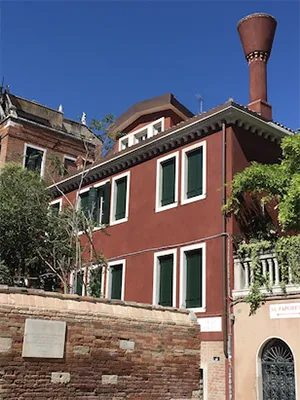
In 2005, Columbia’s summer program in Venice was established at Casa Muraro, which has formed the core of the University’s academic activities in the Italian city ever since. Casa Muraro is now a state-of-the-art research center and library for Venetian studies.
Miracles of Plumbing
Through July 18, 2026, Casa Muraro is hosting an exhibition, Miracles of Plumbing, featuring work by the Chilean-born, multidisciplinary artist Johanna Unzueta. The show is curated by Julia Bryan-Wilson, a professor of art history and archaeology. Taking the intricacies of Venetian water systems as a point of departure, Unzueta brings together two distinct, but related bodies of her work in this exhibition: hand-sewn felt faucets and indigo abstract drawings based on classical geometries.
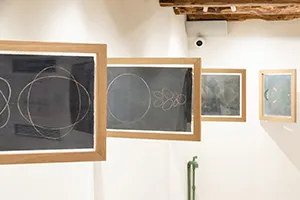
Based in New York and Berlin, Unzueta has rooted her artwork—spanning installation, sculpture, drawing, film, and mural-making—in the history and practices of labor. For the past three decades, she has investigated issues of labor, production, and gender through fiber-based sculptures that mimic building pipes and municipal drainage tubes.
“For Casa Muraro, Johanna Unzueta has created a site-specific installation that takes into consideration the unique challenges of Venice as a miracle of plumbing in which water, bodies, and resources are channeled and redirected,” said Bryan-Wilson. “Seeing her felt pipes together with her drawings showcases Johanna’s interest in everyday feats of engineering across human and non-human realms.”
“Casa Muraro provided the opportunity to explore themes of work and production in Venice, one of humanity’s rarest habitats and infrastructures,” said Unzueta. “I was excited to partner with Julia once again. A gifted curator, her research in the areas of artistic labor, fabrication, and craft histories has always been of interest to me, and provided a perspective from which my pieces could take on additional layers of meaning.”
Bryan-Wilson is teaching in the Venice summer program at Casa Muraro this year with a course on the history of the Venice Biennale, having chaired the international jury for the Biennale in 2024. She recently co-curated the Lotty Rosenfeld exhibition at the Wallach Gallery.
In addition to this exhibition at Casa Muraro, Unzueta’s work is now featured in the 2026 Whitney Biennial, on view at the museum in New York through August 23.
Anna Barranca-Burke is senior director for strategic communications in Columbia's Office of Alumni and Development; Beatrice Mazzi is a PhD candidate in Italian Studies and Comparative Literature and Society at Columbia.