The Dynamism and Messiness of Raw Building Materials
GSAPP’s Lola Ben-Alon has edited a book that expands architecture’s and design’s lexicon and unsettles its boundaries.
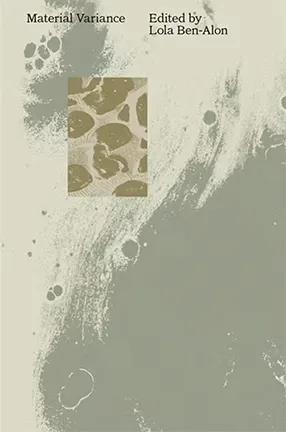
Raw building materials are inherently variable. This variability shapes global supply chains, labor relations, infrastructure, and trade networks. And yet, within the context of building design, materials are often treated as static commodities. Material Variance, edited by Lola Ben-Alon, an assistant professor at the Graduate School of Architecture, Planning, and Preservation (GSAPP) who runs the school’s Natural Materials Lab, resists this perception. Instead, the volume unfolds a framework for designing through and with living matter that is uncertain, messy, and dynamic. The book insists on materials not as passive inputs, but as unruly agents, shaped by and shaping the political, ecological, and cultural processes around them.
Convening material researchers, building scientists, architects, and artists, Material Variance aims to collectively expand architecture and design’s material lexicon and unsettle its disciplinary boundaries. The book interrogates the assumptions of refinement, standardization, and technocratic control to advance alternative fabrication practices, alchemical processes, and methods for working with indeterminate matter. From poetic field recordings to scientific analyses, the book opens up a space for thinking across theory and practice, geological particles and living species, and various scales, forms, and practices.
How did this book come about?
Material Variance emerged through the work of the Natural Materials Lab at Columbia GSAPP, and followed the Material Variance symposium held at Columbia in 2023. The book developed as a continuation of ongoing conversations between designers, scientists, artists, architects, and theorists working with earth, fibers, biological additives, fabrication technologies, environmental life-cycle studies, and critical material discourse. The book project unfolded from a desire to reposition matter as active, relational, and politically consequential. Material Variance ultimately aims to offer a space to bridge material science, environmental humanities, embodied craft, and architectural technology through both scholarly inquiry and materialized experimentations.
What are the differences between building materials that are static versus those that are living? How do they affect—and are they affected by—political, ecological, and cultural processes?
I would challenge the premise that there are static materials. One of the central arguments of the book is precisely that matter is never fixed. Materials only exist in stages of transformation. Whether raw earth, concrete, steel, plastics, or timber, all materials participate in exchanges of energy, labor, extraction, decay, and environmental consequence. They absorb histories and produce effects.
What differs is the degree to which those transformations remain visible, reversible, or relational. Earth- and fiber-based materials, for instance, remain porous to water, air, microbial life, and cycles of repair and return. Many industrial materials, by contrast, are engineered through processes that immobilize matter, and suppress these exchanges through chemical permanence. But even those materials are not static; they simply conceal the planetary systems, extraction chains, labor conditions, and energetic violence often embedded within them.
The book therefore situates materials within geological, political, ecological, and cultural systems simultaneously. It looks at building materials, their stories about social perception, and histories of industrialization.
As editor of this volume, what was your criteria for the contributors and subject matter you selected?
I was interested in assembling a broad constellation of scholars, artists, architects, scientists, and designers who engage matter at its utmost rawest. The contributors work across themes and material families, including dust, acoustics, rubber, biological systems, fibers, soil, and material sensing. Rather than organizing the book around a singular disciplinary framework, I wanted the volume to resist easy classification and instead inhabit the spaces between environmental humanities, material science, fabrication research, and political ecology.
A central criterion was that the work treat materials as lively and culturally situated, rather than static or performative. The volume is therefore less about green materials in a conventional sense, and more about reopening architecture to questions of variability, impermanence, tactility, labor, metabolism, and site specificity.
What books have you read lately that you recommend, and why?
I recently revisited The Life of Plants: A Metaphysics of Mixture by Emenuale Coccia, alongside Bodies of Water: Posthuman Feminist Phenomenology by Astrida Neimanis.
Both books profoundly shaped the way I think about material exchange with environments, and interdependence of elements. Coccia writes beautifully about the transformation of sun, atmosphere, soil, and plants into shared planetary life, which helped inspire an essay I wrote for Architectural Design, “Sun-Developed Matter, or, the Raw Transformations of Soils and Plants.”
Neimanis theorizes bodies and environments through water, and collective material continuities. Those ideas resonate deeply with my view of the world as a trans-corporeal continuum between bodies, earth, and water. The book inspired me while writing the prologue to Material Variance, particularly around moisture and porosity. For me, the notion that sentient bodily fluidity is in continuum through environments and water bodies is a key design inspiration.
What’s next on your reading list?
There are some technical and materially grounded books I am excited to read next, including Wild Clay: Creating Ceramics and Glazes from Natural and Found Resources by Hitomi Shibata, Matt Levy, and Takuro Shibata. I’m especially interested in this book’s attention to localized clay sourcing, mineral variability, and experimental making processes. I am increasingly drawn to books that move fluidly between craft, environmental ethics, and technical, more engineering-based apparatuses.
What are you working on now?
A curatorial project at the Center for Craft in Asheville, North Carolina—Crafting Variance: Worlds in Formations, which directly extends many of the ideas explored in Material Variance. The exhibition examines material irregularity, embodied knowledge, environmental exchange, and craft as a form of fugitive intelligence, along with ways of linking diasporic threads. The show will include contributors from the book—for example, Felecia Davis—and there will also be a book launch for Material Variance and public programming around material experimentation and thinking through making.
Any summer plans?
I am embarking on two funded research initiatives that continue many of the trajectories developed in the book and more broadly at the Natural Materials Lab.
The first is an interdisciplinary collaboration with researchers from Columbia Mechanical Engineering (specifically, Professor Adrian Buganza Tepole), which investigates the full life-cycle thermomechanical behavior of earth-fiber composites through computational modeling and physics-informed AI. This is important because many times, vernacular earth construction is excluded from building codes due to its lack of thermal resistivity. The project explores how earth, fibers, and biological stabilizers can be computationally tuned to achieve targeted thermal behaviors across diverse climatic conditions. What excites me most is the attempt to link data science with material variability itself, rather than suppressing variability through standardization.
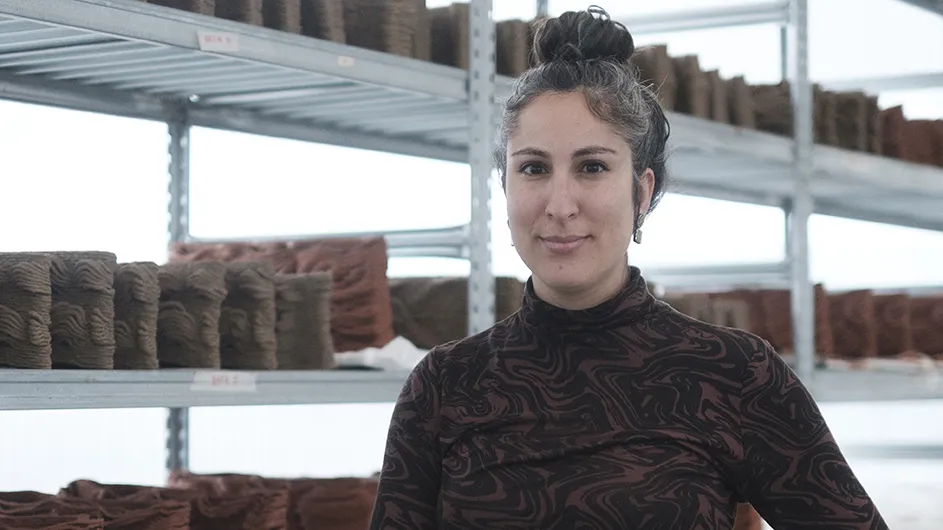
The second project advances the Natural Materials Lab’s 3D-printed, clay-fiber systems into full-scale architectural implementation through a public demonstration structure at a major site in New York. The project combines structural validation and fabrication research, culminating in the large-scale public installation. I see both projects as part of a broader effort to rethink building materials not as static commodities, but as responsive, carbon-storing, radically local and healthy systems.
What are you teaching in the fall?
Tech I: Environments in Architecture, the first core course in the Building Technology curriculum at Columbia GSAPP. The course introduces students to climate-responsive and environmentally situated architectural design through passive systems, thermodynamics, energy flows, comfort, solar radiation, ventilation, and environmental analysis tools.
But beyond technical performance, I also approach environmental design as a cultural and sensory question: How architecture mediates relationships between bodies, climates, materials, and energy systems. Students examine environmental conditions not only quantitatively, but also experientially and spatially, integrating climatic thinking directly into architectural design processes.
Which three academics/architects, living or dead, would you invite to a dinner party, and why?
Architects Anna Heringer, Martin Rauch, and Nader Khalili (who passed away in 2008). All three fundamentally transformed the discourse around earth construction, but through very different approaches—social practice, material craft, technological experimentation, pedagogy, and spiritual or ecological thinking. I imagine the conversation would move between labor, ethics, cosmology, structural experimentation, and the future of construction beyond extractive industrial systems.