What Are the ‘Traffic Rules’ of Quantum Technology?
To improve quantum computers, Zhenjie Yan wants to understand how to efficiently shuttle quantum information.
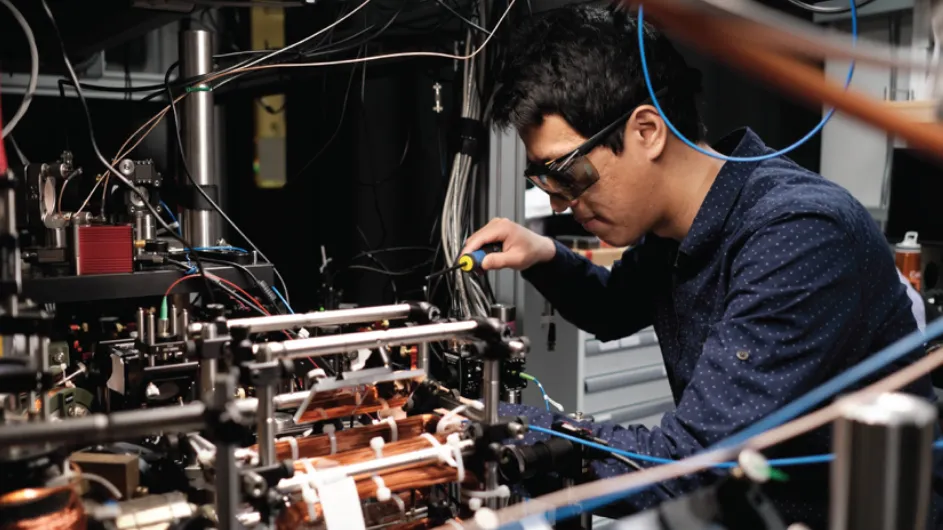
Imagine a city with thousands of drivers on the streets every day. How might you make their commutes more efficient? With lane markers, traffic lights, responsive tow trucks, or notification systems that provide real-time traffic updates. Addressing errors in a quantum computer is not unlike managing traffic disruptions: The goal is to identify where a problem occurs as quickly as possible and apply mitigation efforts, much like deploying tow trucks, adjusting traffic lights, or sending real-time traffic updates, said physicist Zhenjie Yan.
Quantum computers are envisioned as powerful machines that could simulate the quantum world and solve certain hard computational problems far faster than classical computers. These capabilities rely on the precise flow of quantum information, but quantum “vehicles” bring added challenges. They can, for example, exist in multiple places at once. Some will sync up and travel as a larger whole, while others will insist on avoiding another quantum vehicle at all costs. These properties make quantum computers powerful, but complicated.
Yan joined Columbia as an assistant professor of physics in January. He took a break from building out his new lab to explain to Columbia News more about his vision for quantum computers.
What is your main research goal?
Here at Columbia, I’m aiming to make more efficient, more robust quantum computers using ultra-cold neutral atoms as the “vehicles” that transport quantum information. These are a clean platform: each atom is identical by nature, so there is no need to worry about fabrication errors. We can also cool these atoms to near absolute zero temperature.
To achieve this robustness, we want to develop controls that monitor the quantum system, detect problems, and apply feedback corrections. A key challenge is extracting information efficiently and fast enough. To address this, we plan to place the atoms inside a high-finesse optical cavity—two highly reflective mirrors that allow photons to bounce back and forth and interact with the atoms many times. This greatly speeds up information extraction compared with free space. The cavity photons can also act as messengers between atoms, much like real-time traffic updates that help drivers across a city coordinate their routes more efficiently.
Long term, we hope this work will help quantum computers operate more reliably—a challenge much like solving traffic congestion in New York City.
What brought you to New York?
There’s a great science community and a lot of atomic, molecular, and optical (AMO) scientists here, some of whom I had already worked with for years, and others I hope to work with soon.
I also just love city life. I grew up in a big city, and I love the feeling of being close to so many interesting places again. In 30 minutes, I can be at the Met!
What exactly is AMO physics, and how does it relate to quantum science and technology?
Historically, AMO physicists looked at how atoms and molecules interact with light. By studying how they absorb and emit light, we gain insight into the fundamental laws that govern the microscopic world. AMO physics helped develop quantum mechanics originally. When scientists looked at light emission and absorption from atomic gases, they observed discrete wavelengths, which was among the earliest and most important evidence for quantized energy levels.
Today, AMO physicists have the scientific and engineering know-how to control atoms precisely with laser light as if they were quantum Lego blocks, and to build complicated quantum devices from the bottom up that can simulate complex systems and perform computations.
AMO labs are visually striking. Can you explain what you are building?
We use highly stable optical tables, carefully isolated from vibrations, to support the vacuum chambers where we hope our atoms will happily live. All the lenses and mirrors you see steer and shape lasers, which, to continue with the metaphor of the city and drivers, are like traffic lights and lane markers that guide and dictate how quantum objects, in our case, neutral atoms, will move around.
You can imagine we need a lot of these to have organized traffic, so we are building very intricate optical systems to orchestrate the movement and monitoring of our quantum objects.
One end goal is making a more useful quantum computer—how close are we?
There are already quantum devices that perform comparably to, or even better than, classical computers in simulating specific quantum materials or tackling certain mathematical puzzles.
In an academic sense, that’s already helping us. With an experimental setup I worked on during my PhD at MIT, our results helped guide theoretical physicists and improve their assumptions about a complex, many-body quantum system.
To make quantum devices useful for applications with broader societal impact, such as quantum-accelerated search queries, we need to make them more reliable—we need to reduce how often cars break down, or at least make sure we can tow them very quickly. That’s an area in which I hope my research will help. We are seeing disruptive innovations across various platforms every few years, and while it’s much harder to predict real-world applications, I think we are getting close.

Tell us about a hobby.
I love to see what interesting things I can make in the machine shop. For example, I’ve used a laser cutter to create electrical panels, and also to make beautiful lamps for my home. I’ll 3D print optics holders, and also decorative figurines. I find it delightful that the tools and skills developed for research can also bring joy to everyday life.