Can Art Change the World?
Vishakha Desai has edited an anthology that examines the recent intersections between visual art and social movements.
Over the past decade, social and political movements transformed the arts. From the streets of Chile and Iran to museums in Europe and the United States—and from questions of representation and repatriation to demands for equity and justice—protest and activism affected the creation, presentation, and interpretation of visual arts around the world.
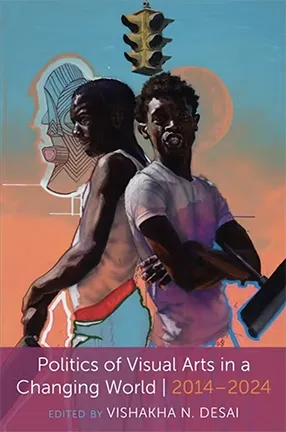
Bringing together artists, scholars, activists, and museum professionals from varied fields and backgrounds, Politics of Visual Arts in a Changing World, 2014-2024,edited by Columbia Global Senior Advisor Vishakha Desai, explores the recent intersections between visual art and social movements. Spanning themes of protest art, museum ethics, restitution, and institutional transformation, this collection considers how visual arts have both responded to and shaped politics and society. Contributors highlight the role of artists as catalysts for change, and delve into how institutions grapple with their colonial pasts.
Featuring essays, case studies, and artist spotlights, the book not only documents a critical time in the art world, but also raises questions about its future. In the current moment of global unrest and threats to the future of art institutions, Desai offers insight into art’s place in the politics of representation, memory, and resistance.
How did this book come about?
The impetus for this project came from several simultaneous developments, which happened in the middle of the last decade. On the one hand, there was a rising anti-colonial movement with demand for the return of art objects, which culminated in the famous report commissioned by French President Emmanuel Macron in 2018. On the other hand, there were increasing protests against museums about issues ranging from representation to the environment to funding from pharmaceutical companies involved in the development of addictive drugs. The striking thing about these various forms of protests was that they were mainly started by progressive groups, unlike the culture wars of the 1990s when the attacks on the arts and arts institutions were primarily coming from conservative forces.
The book project started with small workshops and public programs on campus, and around the world with the cooperation of Columbia Global Centers. The project grew to include international artists engaged in changing their political systems with strong visual and performative art forms. Social media made it possible for artists and audiences to learn about protests elsewhere and create effective strategies. These activist tendencies were reminiscent of the more aspirational strategies of the 1960s to make the world and art institutions more inclusive and just.
Many of the global street protests with powerful visual images led to removal of the old guard, but fell short in developing more responsive governments. In the U.S, with the arrival of the second Trump administration, the mood changed dramatically. All the efforts of institutions to be more inclusive and more socially relevant came under attack. It felt as if the era of idealistic protests, so prevalent in the last 10 years or so, was already behind us. Politics of Visual Arts in a Changing World, 2014-2024 became a chronicle of that decade, which was born out of a desire to make our society more just and more responsive to changes all around us.
Can you give some examples from the book of how the arts and arts institutions have dealt with all these issues?
The book has many such examples. In Iran, Sri Lanka, and Chile, artists were front and center, in particular, creating innovative performance tactics by using language and their bodies, as well as colorful posters with slogans, to give voice not only to unjust practices of the ruling governments, but also to imagine a better future. In the U.S. and the U.K., artist coalitions produced major artistic interventions in museums to protest these institutions’ complicity with oil companies and the acceptance of support from big pharma leaders such as the Sackler family. Such interventions resulted in the withdrawal of support and the removal of donor names in certain places, and the toppling of governments in other places.
The restitution of looted or unethically purchased art objects during colonial periods is more predominant in museum operations. Compared to 25 years ago, there is now much greater sensitivity to the provenance of works of art. Such concerns as when and how objects were purchased, and who owned them before they came to museums, are all taken into account. However, some contributors to the book also point out that there is value in sharing one’s cultural heritage more widely as part of cultural diplomacy.
As editor, how did you decide which subjects and contributors to include?
Right from the beginning, I was interested in a diversity of voices, not just from different countries, but also from different disciplines. Additionally, I wanted to hear from senior scholars as well as younger ones who could provide fresh perspectives. But I was equally aware that this kind of project can’t and should not pretend to be comprehensive. At best, the book can shed light on the pulse of the decade, with a broader global perspective rather than a predominantly Euro-American viewpoint. So, for instance, the anthology includes Irina Bokova, a Bulgarian politician and the former director-general of UNESCO; French and philosophy professor emeritus Souleymane Bachir Diagne; a young activist writer from Baltimore; and the director of a new museum in Bengaluru, India.
What books have you read lately that you recommend, and why?
Since I finished the anthology, I have been focused on reading fiction and memoirs that deal with grief over the loss of loved ones. The books that affected me deeply are Kiran Desai’s The Loneliness of Sonia and Sunny, Arundhati Roy’s Mother Mary Comes to Me, and Olivia Ames Hoblitzelle’s Ten Thousand Joys & Ten Thousand Sorrows: A Couple’s Journey through Alzheimer’s.
My big preoccupation at the moment is AI: I’m reading articles, listening to podcasts, and trying to understand AI’s potential and pitfalls in the broader cultural and social spheres.
What’s next on your reading list?
I have several different kinds of books on my list. I have just started reading Hamnet by Maggie O’Farrell, as I had not read it before, and I was captivated by the expressions of grief in the film version. I also want to read, or at least peruse, Paul Within Paganism, an anthology by leading scholars that argues for a new interpretation of Paul as a figure deeply immersed in the pagan-polytheistic landscape of the Roman empire. This is because I am interested in how new scholarship on a well-researched topic over centuries can shed new light on that topic. It relates to my interest in rethinking the multicultural context of pre-colonial India, a period I studied for my dissertation on 17th-century court paintings in Rajasthan, India.
What are you working on now?
A new book focusing on my changing relationship to my husband, who suffered from Alzheimer’s and passed away two years ago. He started writing his early reflections and felt strongly that it should be a joint endeavor. So I am writing not so much about being a caretaker, but what I learned about love in the process.
I will also start work on an exhibition/research project on Viraha, an Indian concept of love-in-separation or yearning. While it takes me back to my dissertation on concepts of archetypal love and its illustrations in 17th-century India, I will look at the issue not only historically, but also socially and culturally by including contemporary Indian culture. I am excited about returning to my earlier scholarly interests after living in the global arena for a while.
Summer plans?
A bit of crazy travel related to the new book, along with some of my advisory roles and board commitments. Destinations include Salzburg, Riyadh, and Athens. I hope that July and August will be quieter, at my place by the Peconic Bay on the North Fork of Long Island—finishing the Alzheimer’s book, seeing friends and family, walking on the wonderful beaches of the East End, and cooking fun dishes!
Which three scholars/artists, dead or alive, would you invite to a dinner party, and why?
Hard to choose, but I would say Rabindranath Tagore (1861-1941), Chinese painter Bada Shenren (1626-1705), and Columbia art historian Meyer Schapiro (1904-1996). Tagore was one of the earliest globally minded writer-poets and thinkers in India. When every leader was focused on the political independence of India from the British, he steadfastly stood for a more capacious way of thinking about the world and India’s place in it, looking as much to the East, to China and Japan, as to the West.
Bada Shenren was born into a princely family during the Ming dynasty in China, but became a monk and fled to a temple when the Ming rulers were overthrown by the invading Qing emperors. A some-time recluse with some spiritual inclination, Bada created a kind of free-flowing ink painting style that opened up the tradition of classical Chinese painting. He was a radical in that context, and reimagined the way one could paint in 17th-century China.
As a young art history student working on 17th-century Indian painting, I was mesmerized by Schapiro’s way of thinking about larger concepts of text-image relationships in medieval manuscripts and his grasp of Cezanne’s still lifes. I guess all three of these men were way ahead of their times: They looked beyond their own training or background and tried to make sense of the inherent humanity of creative actions. I am drawn to people and ideas that try to make sense of a larger conceptual canvas without losing their core essence.