What a 9/11 Hero Can Teach Columbia SIPA Students About Crisis Leadership
On September 11, 2001, Joseph Pfeifer was the first FDNY battalion chief to report to the World Trade Center with his unit.
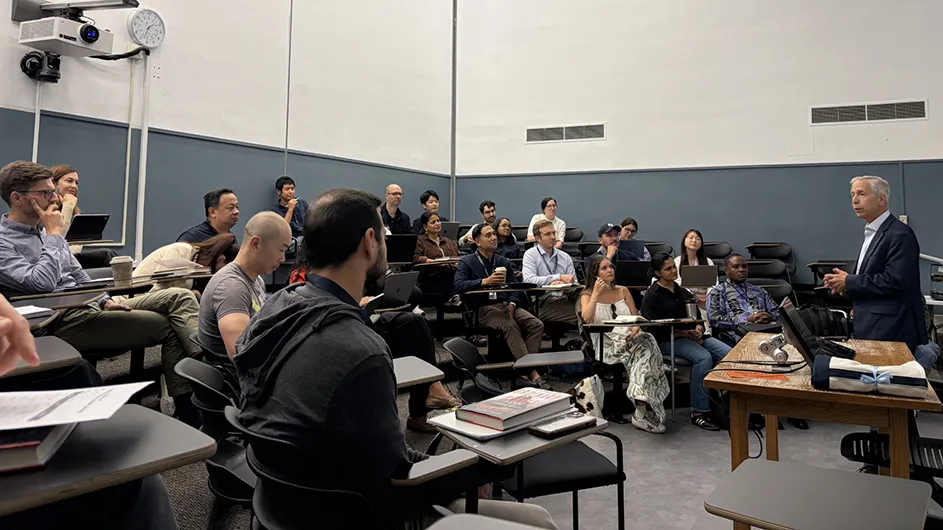
Sometimes when Joseph Pfeifer, an adjunct professor at the School of International and Public Affairs, is in the classroom talking to his students about September 11, 2001, it hits him that some of them were toddlers or not even born yet on that day 25 years ago. “Because of that, we have a responsibility to teach our young the lessons we learned,” he said.
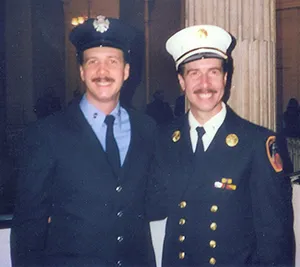
Pfeifer was the first battalion chief in the New York City Fire Department (FDNY) to report to the World Trade Center with his unit that day. “I arrived with my fire unit and took command in the North Tower lobby. I ordered firefighters to go up to evacuate the building and rescue those trapped by smoke and flames,” he said. One of those firefighters was Pfeifer’s younger brother, Kevin, who died that day.
In the years since 9/11, Pfeifer’s life has changed in ways that were unimaginable to him before terrorists flew planes into the Twin Towers. He left his battalion and began to ascend rapidly through the ranks of the FDNY, serving as deputy assistant chief, assistant chief, first deputy commissioner, and acting fire commissioner, among other positions. During those years—from 2002 to 2024—he developed and refined the department’s first-ever strategic plan and formulated the FDNY’s first terrorism and disaster preparedness strategy. This culminated in his becoming the founding director of the department’s Center for Terrorism and Disaster Preparedness, as well as the chief of counterterrorism and emergency preparedness for the FDNY.
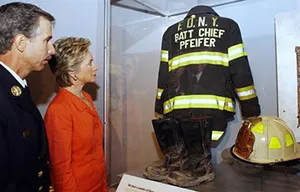
Along the way, Pfeifer led multiple responses for some of the city’s most complex disaster operations, including the 2003 citywide blackout; the landing of a plane that had lost its engine power in the Hudson River in 2009; Hurricane Sandy in 2012; and an Ebola case in 2014, which could have become a larger outbreak had disaster prevention measures not been in place. He has also visited other cities, as a consultant on the responses to the Boston Marathon bombings in 2013, and the 2015 terrorist attacks in Paris, as well as the 2019 fire in Notre-Dame Cathedral.
‘A Master Teacher, an Inspirational Speaker’
“I never imagined being a professor,” said Pfeifer. “But I am excited every time I teach.” Since 2006, he has been a guest lecturer in the classes of Columbia SIPA Professor William Eimicke. Pfeifer came to Columbia and SIPA through the school’s Picker Center FDNY Officers’ Management Program, said Eimicke, who was the program’s faculty director and the founding director of the Picker Center for Executive Education. He and Pfeifer worked alongside each other when Eimicke was the FDNY deputy commissioner from 2007 to 2011, and together they developed the FDNY’s strategic plan.
“Joe is a master teacher, an inspirational speaker, a true American hero, who helped lead us through 9/11,” said Eimicke. “His classes nearly always end with applause, and his approach to crisis leadership is a model for all.”
At Columbia SIPA, Pfeifer directs and teaches the Executive Education program on Leading With Impact, a course that provides public and private sector managers with the skills for leading in various crises. He teaches a SIPA modular course in the spring semester on crisis leadership and adaptive management, along with a SIPA capstone course on climate change security, in which he discusses how the environment affects national and international security. The course examines climate risk, adaptive preparedness, crisis leadership, disaster response, humanitarian assistance, and community resilience. Pfeifer is also the director of crisis leadership at the Columbia Climate School’s National Center for Disaster Preparedness.
Pfeifer teaches as well at the Harvard Kennedy School, the United States Military Academy at West Point, and Tsinghua University in Beijing. Over the years, he has been a guest lecturer around the world, offering his expertise in crisis leadership, disaster management and recovery, climate change security, and global risk assessment.
A Man With a Mission to Spread Global Unity
On a recent late summer day at Ground Zero, Pfeifer stood between a pear tree, the only tree that survived 9/11, and the spot on the parapet surrounding the South Tower footprint reflecting pool where his brother Kevin’s name is carved in bronze. A trim, unassuming man, he was dressed in a navy suit, his jacket casually unbuttoned over a light blue dress shirt.
Pfeifer stood among the tourists wandering around the 9/11 Memorial Plaza, pointing, chatting in many languages, pushing children in strollers, snapping photos with their smartphones. A few of them who recognized Pfeifer stopped to talk to him, introducing themselves, and thanking him for his service.
Listening to Pfeifer speak to these people highlights the sort of teacher and person he is: dignified, resolute, a man with a mission to, as he puts it, “spread a message of global unity.”
After 25 years, Pfeifer has distilled that message into a succinct call for “kindness, compassion, resilience, unity, and hope,” he said. He points to the pear tree as a symbol of those words. It stands inside a circular barrier, to which are affixed notes (“You will never be forgotten”) written by visitors on multicolored tags. The tree’s seeds are sent to places around the world that have been affected by disasters: Haiti; Paris; Parkland, Florida; Ukraine; Uvalde, Texas.
“When I’m here, I feel emotional,” said Pfeifer, “remembering my firefighters and my brother, the many people who raced into the buildings, going up to rescue others. And then the weeks and months afterwards,” as he and others endured the memorials and funerals of the 343 firemen who died on 9/11.
“But I also think about how, sooner or later, every one of us will be called to exemplify courageous kindness,” he continued, “how each of us will become what I call an ordinary hero, someone who is able to do something when others are in need or in extreme moments.”
The Making of an Ordinary Hero
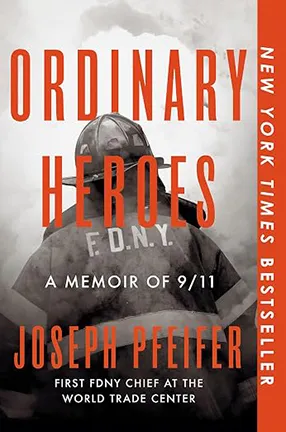
Ordinary Heroes is the title of Pfeifer’s bestselling memoir about 9/11. He came early to a life of public service. He grew up in Queens, the product of a close, loving family. “Each summer,” he said, “my family spent time in Breezy Point,” which is a Queens neighborhood located on the western end of the Rockaway Peninsula. When Pfeifer was 18, he joined the Rockaway Point Volunteer Fire Department—one of only several volunteer fire departments in the city at the time—and also became an emergency medical technician, so “I could respond on the ambulance and on the fire truck.” Pfeifer joined the FDNY in 1981, choosing that over becoming a seminarian.
He views his university teaching as an expansion of the call to service. “This past spring, when I taught my crisis leadership class at SIPA,” he said, “there was a real emotional connection when I spoke about 9/11, not only about what happened on that day back then, but what it means for us in the future, especially at SIPA, where so many of my students are international,” he said.
Instead of having his SIPA students write a term paper—“which they can do in their sleep,” said Pfeifer—he has them compose a series of weekly reflective papers that answer these questions: What did you learn in this class today? How are you going to apply it in your life, or did you apply something similar in your past?
“I limit it to one page, because that’s harder to write than five,” said Pfeifer, “and I get the most amazing reflections.”
“What students get from me is a story,” he continued. “If you want to change the world, you do it through storytelling. And from those stories, we learn the principles of leadership, what works and what doesn't work.”
It’s hard for Pfeifer to believe it’s been 25 years, and that so much has changed in the United States and in the world. “We should remember the people we lost on 9/11, and the people we saved,” he said. “But we also should remember 9/12, when the world came together to help New York City.”
Joseph Pfeifer will be participating in an Institute of Global Politics at SIPA event on Sept. 9, 2026. Visit The 9/11 Attacks 25 Years Later: Lessons Learned, Lessons Forgotten | Institute of Global Politics | SIPA for more details and to livestream the discussion.