How Arctic Ecosystems Shape Our Climate
Professor Duncan Menge is the new chair of Ecology, Evolution, and Environmental Biology. In his spare time, he plays guitar in the department band.
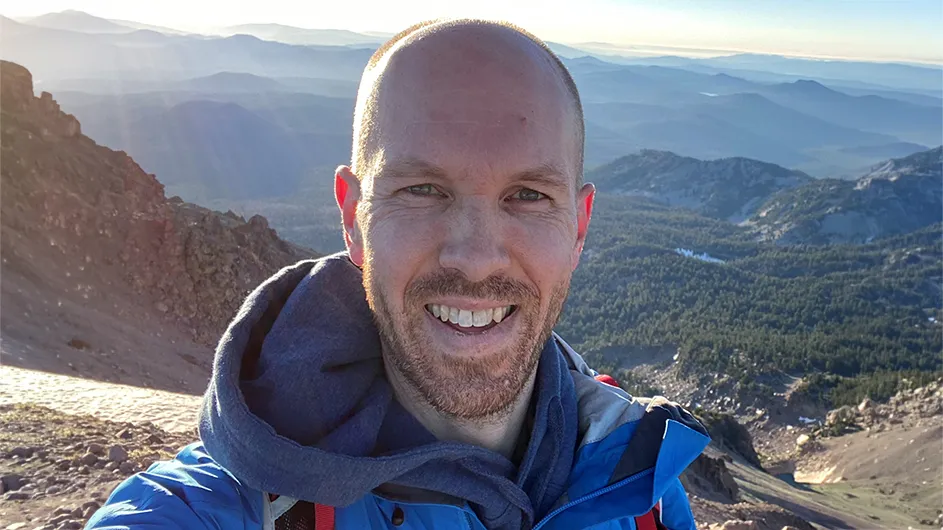
The apple didn’t fall far from the tree for Duncan Menge, the new chair of the department of Ecology, Evolution, and Environmental Biology (E3B). Menge’s father is a professor of marine ecology, who continues to teach now, in his 80s, at Oregon State University. His mother, also a professor at Oregon State, worked on science policy under two presidents, Obama and Biden, and led the National Oceanic and Atmospheric Administration.
Still, Menge didn’t really fall for biology and ecology until college, at Stanford, when he took a class with the ecologist Peter Vitousek, who “made ecology feel like detective work,” as Menge put it. “That class hooked me,” he said.
Menge got his PhD at Princeton, did postdoctoral work at the National Center for Ecological Analysis and Synthesis in Santa Barbara, and had another stint as a postdoc at Princeton and visiting scholar at Stanford, before joining Columbia in 2013. Columbia News spoke to Menge about his research, his path to Columbia, and the spare time he spends playing guitar in the department band.
Broadly, what does your research focus on?
I study how ecosystems—such as forests and tundra—cycle carbon and nitrogen, and how that, in turn, affects climate change. Sometimes that means looking at big, global patterns. Other times it’s very local, down to individual plants, microbes, or even plant organs like leaves and roots. A central question is how much carbon dioxide ecosystems can continue to absorb as the climate warms, and whether soils and nutrients will limit that capacity in the future.
Right now, terrestrial ecosystems like forests and tundra are doing us a huge favor. They take up about 30 percent of the carbon dioxide humans emit through burning fossil fuels and deforestation. Climate change would already be dramatically worse without that “free” service from nature. The question is what happens next, whether that help will stay the same, weaken, or even reverse.
You focus a lot on the Arctic. Why is that region so important for the climate?
The Arctic is an enormous lever on global climate. Its soils, including permafrost—ground that has stayed frozen for years to millennia—store vast amounts of carbon. Because there’s so much carbon locked away, even a small increase in the rate at which it escapes into the atmosphere can have a large impact on global warming.
The region is also changing faster than almost anywhere else on Earth. Recent estimates suggest the Arctic is warming about four times faster than the global average. One reason is albedo, or how much sunlight a surface reflects. Snow reflects a lot of light. Darker surfaces, like plants or bare ground, absorb more and warm up. As snow cover shrinks and vegetation expands, the surface darkens, creating a positive feedback loop: Warming reduces snow, which causes more warming.
Monitoring suggests the Arctic has recently flipped from being a carbon sink, absorbing more carbon than it releases, to a carbon source, now emitting more carbon dioxide than it takes up. That’s a deeply concerning shift, and a big part of what my lab is trying to understand.
What exactly are you measuring in the Arctic?
We’re especially interested in how carbon, nitrogen, and phosphorus interact to shape greenhouse gas emissions. As the Arctic warms, organic matter in the soil, like dead plants, microbes, and so on, decompose faster. That releases nutrients like nitrogen and phosphorus into forms that plants can use, effectively fertilizing them.
That sets up a kind of tug-of-war: On one side, plants may grow faster, taking up more carbon dioxide from the atmosphere. On the other, microbes may also “breathe” faster, releasing more carbon dioxide back into the air as they break down soil carbon.
We run experiments that add different levels of nutrients to see how much plants can ramp up their growth and how much microbial respiration increases in response. From space, you might see the Arctic getting “greener” and assume that’s good news. But because there is so much carbon stored in these soils, even a tiny increase in microbial respiration can cancel out the gains from more plant growth. Understanding that balance is one of the core scientific challenges.
You grew up mostly in the Pacific Northwest, and are clearly drawn to the outdoors. How do you like living in New York City?
I grew up mostly in Oregon, with a year in New Zealand during high school, and I also did some of my PhD research there. So I’ve been spoiled by big landscapes, mountains, coasts, and dramatic outdoor environments.
Before moving here, I’d never actually lived in a big city. The Bay Area is crowded, but it’s not New York. I knew I’d miss West Coast mountains and weather, and I definitely still do. But I like New York a lot more than I expected.
I enjoy the things the city does uniquely well, like going to concerts and symphony performances, taking my kids to the zoo, and walking just a block and a half to campus. That commute is hard to beat. I still spend time outdoors. I go rock climbing at the Gunks upstate, hike with my family, and head back to Oregon in the summer for mountain biking and to see my parents. And I get to Alaska for fieldwork a couple of weeks a year.
How do you like to spend time outside the lab?
I spend most of my time with my wife and two kids, who are now teenagers, 15 and 13.
I also play electric guitar in our departmental rock band, the E3Band. It started a couple of years ago and has become a fun community within the department. So far we’ve mostly played in-house events within the department. There are some YouTube videos floating around. It’s a great way to bring people together in a different way than we usually do.