Eleanor Johnson Looks at Why Women Threaten the Patriarchy
In her new book, Monstrous Bitch, she traces the origins of female monstrosity back to ancient times.
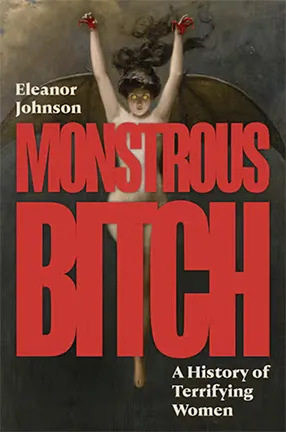
For as long as human societies have been telling stories, the patriarchy has felt threatened by women. In Monstrous Bitch: A History of Terrifying Women, Professor of English and Comparative Literature Eleanor Johnson provides an engaging cultural history of the notorious female who has haunted the patriarchal imagination for centuries, feared for her sexual promiscuity, her exercise of reproductive agency and control, and her outspoken way of contesting patriarchal power.
Johnson traces the origins of female monstrosity to the demoness Lamashtu of ancient Mesopotamia, showing how this infanticidal, hypersexual, loud-mouthed monster appears in different guises throughout history. In classical Greece, she reemerges as the sorceress Medea, the child-devouring monster Lamia, and the vengeful Furies. In the medieval and early modern periods, she is an oversexed, baby-slaying, spellcasting witch; in the Romantic and Victorian eras, a vampiress; and in the modern age of psychoanalysis, a mental patient.
Johnson shows how monstrous bitchery has been challenged and reinterpreted in contemporary cinematic popular culture, becoming an expression of heroism and resistance in films like Ginger Snaps, Jennifer’s Body, and The Witch. She demonstrates how deeply embedded the roots of misogyny have become, and why it is so critical today that they be exposed and addressed.
How did this book come about?
I started building Monstrous Bitch out of my Substack—eleanorshorrors.substack.com—which had a series of 2,000-word posts about “monstrous bitches.” After I had enough of those individual posts, I started thinking seriously about trying to put them together into a narrative, if I could find a good, useable, natural one. I knew I wanted to start as early historically as possible, so I began searching around in Mesopotamian literature, until I found a bunch of poetry about Lamashtu, who I quickly realized was kind of the great-great-grandmother of the much later monstrous bitches I had already been interested in. From there, I simply traced her lineage forward in time.
Can you share some of your favorite monstrous bitches from the book?
Erichtho, the Roman witch, is probably my absolute favorite. Wild-eyed, scraggly haired, tying snakes into her hair as scrunchies, she has the power not only to resurrect the dead and compel them to perform prophecies for her, but also to terrorize the patriarchal gods of ancient Rome, including Hades and Zeus. Erichtho has the three canonical traits of a monstrous bitch: She’s loud-mouthed, hypersexual, and infanticidally bloodthirsty. But she also appears to be having a rather charmed life, at least by her own standards, and she is taken quite seriously by her male interlocutors, which is not something many of the other Roman-era witches can say.
Apart from Erichtho, I love Thomasin, the main character from the 2015 film The Witch, and I love Susie Bannion from the 2018 film Suspiria. Basically, I like badass witches who don’t get murdered by patriarchs.
What are you working on now?
Right now, I’m working on two books. One, Mother of Frankenstein, is coming out in the fall of 2027, and is about Mary Shelley’s life, her brilliant novel, Frankenstein, and major 21st-century feminist adaptations of her novel. I’m looking at how and why Shelley’s novel has provided such a powerful spur to feminist retelling in the last 25 years.
The other book, The Dead Don’t Die, is about the past 100+ years of zombie cinema, looking at what the whole zombie trope allows modern culture to think about, and why zombies just literally never seem to die out of mass culture.
What are you teaching this year?
This fall, I’m teaching Frankenstein and its Vicissitudes, and Literature Humanities (part one); and The Literature of the Undead, and Literature Humanities (part two) in the spring. Whenever possible, I try to teach big lectures on my research projects as I’m finishing them up, because running lectures on chapters helps me tighten and solidify my ideas. Plus, I think it’s exciting for the students to be “in” on a scholarly work that’s not yet public. Monstrous Bitch, for example, was the structure behind my big lecture course, Early Horror, in the spring of 2025.
Do you prefer books that reach you intellectually or emotionally?
I love this question, because it allows me to say something I say in class all the time. This division between the thinking self and the feeling self is false, just a historical construct that we’ve gotten used to in Western culture. My emotional life and my intellectual life feel very much unified to me, and so the works I like most are those that are intellectual and emotional: The Iliad is one of my favorites, or Paradise Lost, or Anne Carson’s Decreation, or Julian of Norwich’s Revelations of Divine Love.
Which three writers, dead or alive, would you invite to a dinner party?
Easy. St. Augustine, Virginia Woolf, and Julian of Norwich.