Visit ‘We be the luminous blues’ in the Lobby of the Lenfest Center for the Arts
Adama Delphine Fawundu’s 11 banners celebrate ancestors and alumni of Columbia.
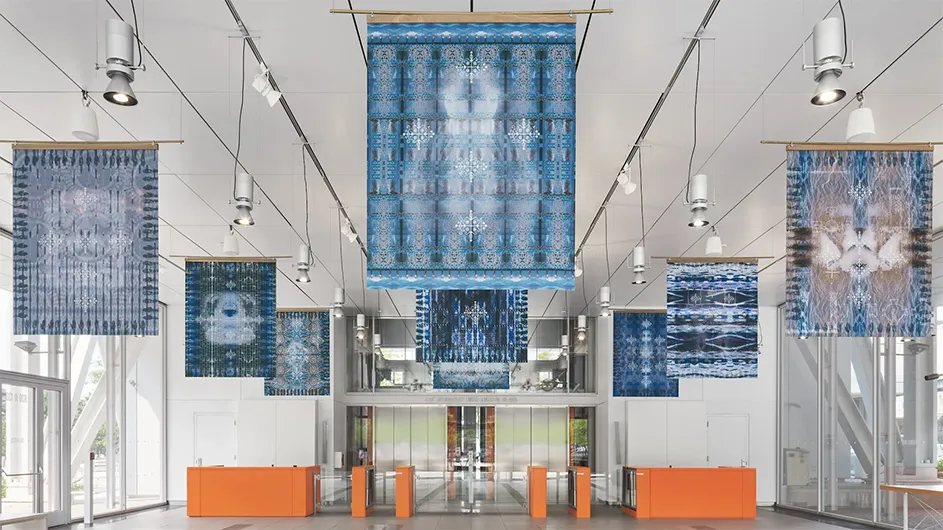
The School of the Arts is presenting We be the luminous blues… by Adama Delphine Fawundu (SOA’18), artist and assistant professor in the Visual Arts Program. The exhibition is on view through March 14, 2027, in the lobby of the Lenfest Center for the Arts.
Fawundu’s 11 banners celebrate ancestors and alumni of Columbia: anthropologist Ruth Benedict; biochemist Marie Maynard Daly; dentist Annie Elizabeth "Bessie" Delany and her sister, educator Sarah Louise “Sadie” Delany; cultural preservationist Ella Cara Deloria; folklorist, novelist, and writer Zora Neale Hurston; minister and suffragist Mabel Ping-Hua Lee; organizer and social worker Antonia Pantoja; actor and singer Paul Robeson; attorney and advocate Frederick Wells; and Jamaica, Cuffy, Prida, Caesar, Jenny, Betsy, Pompey, and Richard Jenkins—all of whom were enslaved by Samuel Bard and his family—as well as James, who escaped in 1776. Bard was the founder of Columbia’s College of Physicians and Surgeons.
In Fawundu’s collages, these individuals appear alongside sacred geometric symbols inspired by Yoruba, Bakongo, Mende, Navajo, and Lenni-Lenape traditions. With her artistic process, Kpoto Patchwok, Fawundu mines and regenerates her expanding image archive of her body, textiles, hair, and various water bodies into new forms.
How did this project come about?
We be the luminous blues grew out of my ongoing exploration of memory, ancestry, and what we can learn from past stories. I have been thinking about the need to retell stories of people whose intellectual, creative, and cultural contributions have made a significant contribution to society. Some of these stories are forgotten, and they can inspire us and help us think critically about our current circumstances.
When I was invited to create a project at Columbia, I began thinking about the University as a site of accumulated knowledge, and as a place inhabited by generations of people whose presence continues to resonate. I became interested in figures such as Paul Robeson and Zora Neale Hurston, along with the many others who moved through and around the institution, creating knowledge while challenging the structures of their time.
The color blue has long been important in my practice, evoking water, indigo, spirit, memory, and the expansiveness of the cosmos. For this project, I created 11 works on textured paper with the visual and tactile presence of textiles. By layering photographs from my archive along with cultural symbols and portraits of each ancestor, I wanted the works to feel like timeless portals.
How did you select the ancestors and alumni of Columbia who are portrayed in the 11 banners?
I am fascinated by people who were born in the late-19th and early-20th centuries, particularly those who, through their brilliance, found ways to shift societal thinking toward the betterment of all humanity at a time when their own humanity was not fully valued in America.
Paul Robeson and Zora Neale Hurston embody this for me. To consider that their parents were born into slavery, and that within a single generation they became extraordinary thinkers, artists, and cultural forces, speaks to the profound human capacity to find a way forward even when the odds seem insurmountable.
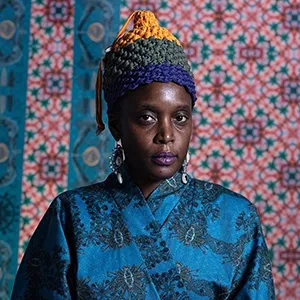
Their lives also force us to recognize that the people who were enslaved were thinkers, brilliant and resilient human beings living within a violent system. When we think of them, we must think beyond the dehumanizing image of docile servants. We must remember their intellect, creativity, resistance, and capacity to imagine lives and futures beyond the conditions imposed upon them.
Can you describe your artistic process, Kpoto Patchwok?
Kpoto is a Mende word meaning “to gather,” and patchwok is a Krio word for “patchwork.” Together, these words reflect how I gather, layer, piece together, and mend seemingly disparate materials, histories, geographies, and ways of knowing.
Kpoto Patchwok is a way of remembering, imagining, interpreting, and conjuring. It allows me to move between the ancestral, present, and futuristic, while making space for uncertainty, opacity, and new possibilities.
Earlier this year, you published your first monograph, Praise House. What was that like?
Praise House, in many ways, brings together more than 25 years of thinking, photographing, traveling, and searching. The project began in 1998, when I encountered my first Gullah Praise House on St. Helena Island in South Carolina. I had traveled there because I was curious about the historical and cultural connections between the Gullah people and Sierra Leone.
I grew up in Brooklyn in a West African household, surrounded by Krio and other African diasporic cultures, so when I arrived in the Sea Islands off South Carolina, there were gestures, language, spiritual practices, and ways of being that felt strangely familiar to me. That experience changed the way I understood the African diaspora. It made me ask: If these connections exist here, where else can we find them?
Over the years, that question took me across Africa, the Caribbean, Europe, and the Americas. With photographs in Praise House, I am searching for connections—between bodies, landscapes, spiritual practices, memory, and the ways African-descended people have carried knowledge across generations and geographies.
I often place my own body within the photographs, performing as an ancestral, present, and futuristic entity. The book moves between these different times and spaces rather than following a linear chronology. In that sense, it reflects the way I understand memory itself—layered, fragmented, embodied, and constantly being reimagined.
The title Praise House returns me to that first encounter in South Carolina, but the “praise house” has become much larger for me: Our bodies, the earth, and our cosmic connection as humans are all the praise house.
What are you working on now?
I am so excited about what will be birthed from my studio and mind over the next couple of years. Here are the ingredients:
- A deep dive into the archive of art historian Sylvia Ardyn Boone, which is housed at Columbia Libraries.
- Photographing as many Sande masks as possible in museums globally.
- Indigo dyeing using ancestral indigo grown in North Carolina at Nebedaye Farms.
What are you teaching this fall and in the spring?
This fall I am teaching Photobook and Graduate Studio. We are experimenting with various handmade formats in Photobook. Next semester, I’ll be teaching Senior Thesis for our undergrads and Graduate studio again.
Which three artists/scholars, dead or alive, would you invite to a dinner party, and why?
I would definitely invite the ancestors that are whispering in my ears—Sylvia Ardyn Boone, Zora Neal Hurston, and Olayinka Miranda Burney-Nicol.