This Columbia Toxicologist’s Podcasts Are Perfect for Spooky Season
Professor Adam Blumenberg, a board-certified medical toxicologist and emergency physician, knows a thing or two about poisons. So much so, he made not one, but two podcasts about them.
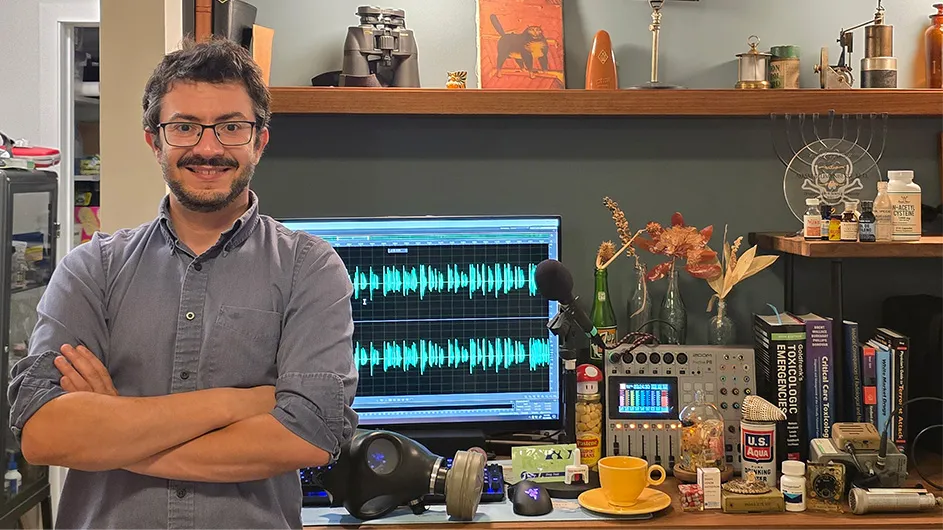
It’s a perfect fall day in New York City: the air is crisp, the leaves are crunching, and a variety of wild plants are giving it their last go with a final explosion of color before season’s end. But as Adam Blumenberg, Associate Professor of Emergency Medicine at Columbia University Irving Medical Center (CUIMC), will tell you, some of those plants deserve a second look before taking them home.
Pokeweed, with its purple berries, can cause gastrointestinal distress. Jimson weed, with its spiky seed pods and white flowers, can cause severe delirium. Ginkgo leaves, when ingested in large amounts, can cause seizures.
Blumenberg is an emergency physician and board-certified medical toxicologist at CUIMC, where he cares for patients who have been poisoned and teaches the next generation of doctors. He also happens to make two podcasts about poison. We’d say this makes him a pretty good person to interview in this mysterious season.
The first, Toxic History!, is a nonfiction series in which toxicologists and other scholars tell stories from the history of poison. His newest project, The Consulting Toxicologist, is fiction. The characters are made up, but the toxicology is absolutely not.
With Halloween around the corner, Columbia News chatted with Blumenberg about how the podcasts come together, which episodes to queue up next, and how exactly a toxicologist’s mind works.
How did you get interested in toxicology?
I grew up in New York City. I went to Bronx Science for high school, and I went to med school and residency at Downstate in Brooklyn. I love New York. To me, this is the center of the world, although other parts of the world can be quite wonderful too. I was always drawn to science and medicine because it’s both technically interesting and a good way to help people.
With toxicology specifically, there’s this really cool intersection between basic science down to the cellular level, how these poisons behave as chemicals in our body to disrupt processes, all the way up to how an individual deals with those problems and how we can treat them as a physician. And even further, all the way up to a more societal and political level: how do we regulate potentially dangerous substances and how do we keep groups of people safe?
What kind of personality does a toxicologist need?
There are a lot of different personality types in toxicology, but I think a few of the common threads are: be curious, love learning for the sake of learning, and never needing to feel like you know everything because there's always more to learn. One of the cool things about toxicology and poisons in general, there’s this very old saying that “the dose makes the poison and everything is poison.” It's just the dose that determines whether it's a poison or not.
‘The dose makes the poison, and everything is poison.’ It's just the dose that determines whether it's a poison or not.
That has a very interesting implication: you can think of every single chemical that you can imagine could be poisonous, and there's no way to learn all of that in one lifetime. So we certainly focus on the hundreds and hundreds of most common and available substances, but there’s always more to learn.
How did you get into podcasting, and what is Toxic History!?
I would say it actually started in high school, when some friends and I made some not very good, but definitely very fun, student films for our English class. We were using a VHS camcorder, and none of us were very good actors, but we all had a really wonderful time. I always loved that creative process, the storytelling process. When I was in training in med school, I certainly took a break from it just because the training was so intensive.
Now that I have this great opportunity as an educator, as a faculty member at Columbia University, I realized that this is, in many ways, just another form of storytelling and education. So I started this nonfiction podcast, which I'm really proud of called Toxic History!
I invite these fantastic speakers to be on a webinar, which is recorded live, and they give a story from history that has a poison at its center. Because they're both excellent storytellers, but also toxicologists and scientists, scholars in other ways, they have a very detailed understanding of toxicology as well.
How do you make the podcast?
It's hosted on Zoom. It occurs about four times a year, and there are about 100 to 120 people in the audience. This is part of an organization called the American Academy of Clinical Toxicology, which is a national organization, and I'm the chair of the toxicological history section of it. I record it using software called OBS, and Zoom can record too. So I get an audio-video file, and then over the next few months I release each episode one at a time per month. I use Adobe Premiere Pro to edit.
Do you have a favorite Toxic History! episode?
I don't have a single favorite, but the one that comes to mind is the episode called Laboratory X, which is about the Soviet poison laboratory that was involved in political assassinations. The speaker is a pharmacist, Dr. Rachel Gorodetsky, and she's just fantastic. The way that she interpreted and described both the history, but also the medicine, was really special and really cool.
It’s spooky season, and New Yorkers love to claim Edgar Allan Poe, whose final days are still a mystery. What’s the poison theory?
It’s unknown, but there are different theories. He could have had tuberculosis, which is an infectious disease. He may have had consequences of very serious alcohol use disorder, either withdrawal or intoxication with alcohol. There’s always the possibility that there was some toxic opium involved, or maybe even jimsonweed itself. These are all speculative. We don't know exactly what happened during his final days, but we know that he was delirious for several days before he died, so any of these intoxicating substances are possible.
Toxic History! also has an episode on the subject, The Toxic Examination of Edgar Allan Poe’s Final Days:
Your new podcast is fiction. Where did ‘The Consulting Toxicologist’ come from?
A little bit of both real life and imagination. It's based on a few of my different interests. One, of course, is toxicology and medicine, which ties really well into mysteries, puzzles, and intellectual problem-solving, and also the world of Sherlock Holmes. The main character of this podcast is Dr. Joan Watson. She is a toxicologist, and in this fictional universe, she is able to work at different hospitals in New York City. It's modern-day New York City, and she will make medical diagnoses of these rare and specialized poisonings. The specific details of the poison are always central to the plots.
In other works of fiction, poison becomes very generic: someone is harmed or killed by poison. But of course, as a toxicologist, the very specific, granular details of different poisons are all very different. Maybe it affects the heart in a very specific way, maybe it affects the skin in a very specific way, etc. Those types of details become really important to the storyline of each episode.
My goal is to make it accessible for an intelligent audience who’s interested in the topic, but they don’t have to be toxicologists. It’s meant to teach. I drew some inspiration from Radiolab, where you don’t have to be an expert on the content, but you learn a lot just listening.
Where should a first-time listener start?
You can definitely pick and choose. They’re meant to be much more episodic, so you can start wherever you want. I think the second episode, The Inventory of Stolen Light, is probably the best place to start. I won’t give any spoilers, but that was a really fun one to think through the toxicology, puzzles, and problem-solving.
Is there a lot of overlap between your clinical work and the creative side?
It's a bit of both. It reminds me of this interview I listened to once with a neurosurgeon who also played violin. He said something that I thought was really funny and a nice thing to say: he really tries not to be creative when he's performing neurosurgery, but he does when he's playing violin. I think that tracks.
On the other side of it, with the fiction podcast, what I think about is: what are the laws of nature in terms of biochemistry, how cells behave, and how the human body works? These are somewhat grounded in the reality we live in, to a large extent, and they influence how we live our lives and how we behave, but they don't necessarily dictate it. So that human element adds a whole lot of interest to a story.
What is a party full of toxicologists like?
I promise we don't just sample small doses of different little poisons. We do not do that ever. As you can imagine, it's a nerdy hangout. We have fun, we talk about our lives and events, same as any other group of friends, but we definitely nerd out about different things we've learned recently. One of the fun things about such a broad field is that no one knows everything. So we might talk with each other about unusual things we've learned, unusual cases. Sometimes we'll make poison-related jokes, things like that.
A lot of toxicologists are interested in antiques and older objects from a time when material safety was less emphasized. An example might be something like a fire grenade, which is a really interesting object that, about a hundred years ago, was used for fire safety. They were these glass objects that looked kind of like a large light bulb, filled with a chemical called carbon tetrachloride, and a person would literally throw this glass sphere at a fire, and it would extinguish it. From a fire safety perspective, it was cutting-edge, amazing technology. Unfortunately, carbon tetrachloride is a very potent liver toxin, and it can be potentially fatal to be in an enclosed space with it for a long period of time. So every so often, one of these will show up at an antique shop, and we'll have to tell the proprietor, “Oh, we should probably call hazmat about that particular thing.” But that definitely makes for a good story to tell other toxicologists.
What’s the most useful thing someone can do before they ever need a toxicologist?
One of the most common patterns for poisoning would be unintentional exposures. For example, a young child has an exploratory ingestion, meaning they find something; they're a toddler, so they put it in their mouth, because that's what toddlers do.
A good recommendation I would have for all parents or anyone who has young kids in their life is “up and away” for anything that could be dangerous, but also have the Poison Center in your contacts list. The phone number is 1-800-222-1222. It's a great public resource, because kids do get into these substances, and a lot of times they're going to be just fine, but that uncertainty is really frightening.
What should someone with a budding interest in toxicology read or listen to?
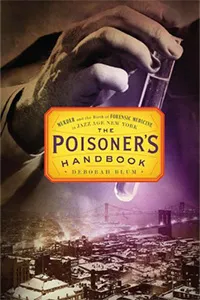
It kind of depends on someone's interest. If they're dabbling in it and want to get their feet wet, the author and journalist Deborah Blum has written some really good books on the subject. One of them is The Poisoner’s Handbook, which is excellent. She’s also written The Poison Squad, which is also excellent. I think that's a good first taste to develop the interest.
If someone is thinking about it for their career, there are a lot of different opportunities within toxicology. I'm a medical toxicologist, a physician. I take care of poison patients, and for that you would certainly need to go to medical school and subspecialty training. But there are a lot of other wonderful parts of toxicology where, if someone doesn’t want to become a physician, they can still develop a career.
There are environmental toxicologists who study the impact of poisons on ecosystems. There are toxicologists who have a background in chemistry, and toxicologists who have a background in epidemiology, so more of a public health standpoint: how populations deal with toxic substances. History, of course, and public policy as well.
Is there a show or movie that gets toxicology right?
There are a couple. From a nonfiction standpoint, there’s a very unique show called Hamilton’s Pharmacopoeia. It’s really well done. The narrator has a background in chemistry, and it's essentially a documentary-style show where he'll explore different substances of abuse and come at it from the standpoint of a chemist who's also exploring the societal effects of these different drugs.
On the fiction side, Breaking Bad is excellent. Obviously, it’s fictionalized and hyped up a bit, but there’s a lot of poison on that show. Methamphetamine is the big one, of course, but they also talk about lily of the valley, ricin, phosphine, and hydrofluoric acid. There’s a lot of discussion of different specific poisons on that show.