Columbia Researchers Spot First-of-Its-Kind Stellar Merger
Astronomers directly observed an aging, puffed-up, supergiant star explosively consume a star only slightly smaller than our Sun.
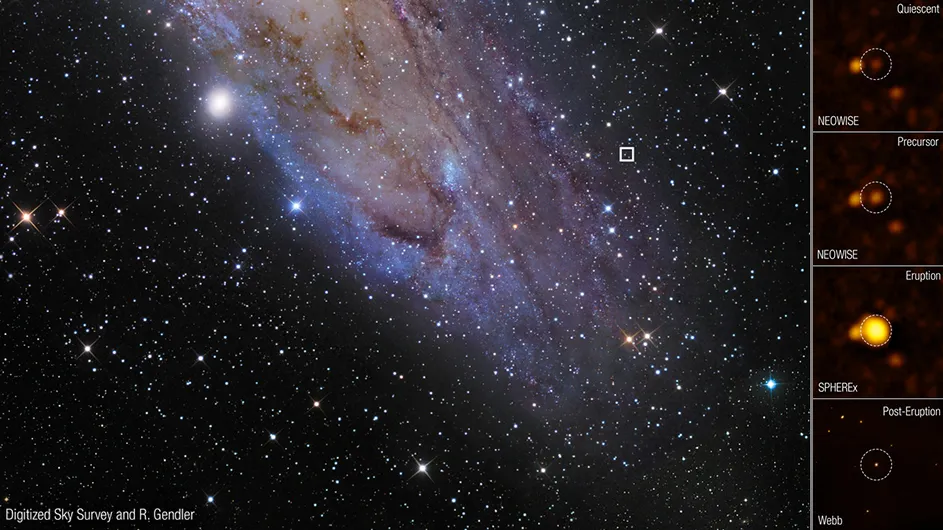
Columbia researchers recently identified a first of its kind event: A star slightly less massive than the Sun spiraled into and merged with a puffy supergiant star at the outskirts of the Andromeda galaxy, the Milky Way’s nearest major neighbor.
“Stellar mergers are very, very difficult to observe in real time because they are hard to predict,” explained Viraj Karambelkar, the first author of a new paper in Nature and a NASA Hubble Fellow at Columbia University. “However, we noticed something unusual was going on in 2023 and continued to monitor the system to see what it would do.”
They nicknamed the newly single, potentially “rejuvenated” star Bao.
Before their transformation, the two stars spent millennia placidly orbiting one another as a binary pair. Their “unification” happened after only seven orbits (in this case, about seven years), once the smaller star came into contact with the giant star. Other known binary star mergers, featuring two smaller stars, occurred after thousands of orbits.
“We thought it would take centuries for an outburst to happen,” said co-author Nadia Blagorodnova, an assistant professor at the University of Barcelona in Spain. “And then one day it erupted! We were flabbergasted.”
“When a companion star begins to interact with the outer surface of the primary star, it produces a subtle effect—a slow brightening, which we clearly saw in Bao’s data,” said co-author Kishalay De, an assistant professor at Columbia University. “As the companion continues its orbit, it keeps peeling off the primary star’s outer layers, and that gas flows away into the surrounding space.”
This is the beginning of a high-stakes showdown some binary stars go through, known as a common envelope evolution. The gas between the stars at this stage is known as a common envelope because it’s shared between them. In this system, the primary star engulfed the smaller star and the companion plummeted, spiraling through the envelope as it was robbed of orbital energy by drag.
Their discovery was bolstered by quick-turn observations from NASA’s James Webb Space Telescope that were carefully cross-referenced with extensive data from telescopes in space and on the ground.
“Webb observed Bao only 47 days after the stars’ eruption, the earliest ever follow-up of an event like this. The telescope’s data helped us characterize what the system looked like before, during, and immediately after the merger, which is absolutely mind-blowing,” Karambelkar said.
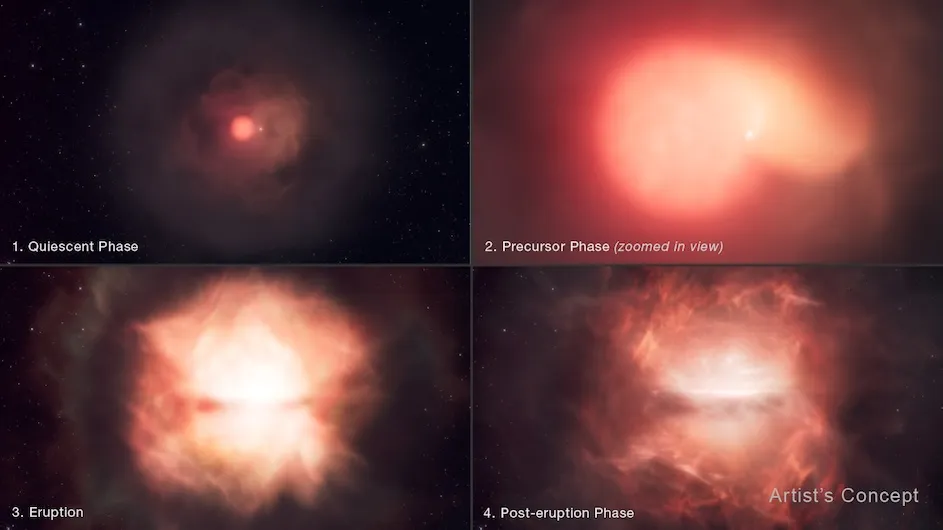
While the team used Webb’s data to prove that the stars merged, that wasn’t the only possible outcome. In other systems, both stars have been shown to “escape,” shedding a lot of mass along the way, but remaining independent in tight orbits. The results can include transformation into neutron stars and black holes, supernovae explosions, ripples in space-time known as gravitational waves, and millisecond pulsars.
The Columbia group—overseen by Professor De—led the identification and follow-up of this event from the start. The changes in the star were first identified by the group in early 2023, almost three years before its actual eruption. When analyzing data from the NASA telescope known as NEOWISE (Near-Earth Object Wide-field Infrared Survey Explorer), De’s group noticed that the star, which had previously been stable, had begun to brighten and shed dust.
Karambelkar began to observe the star more closely, looking at its ultraviolet, visible, and near infrared light emissions.
For decades, astronomers have known that the common envelope evolution, in which binary stars orbit each other at perilously close distances until a smaller star is slowly engulfed by a bigger star, were theoretically possible. This paper marks the first time that that possibility has been directly observed. These findings also offer clues about how common envelope evolution unfolds, lending some support to models such as those developed by Rochester Institute of Technology researcher Jason Nordhaus.
It’s just one of the discoveries that De’s team has made using data from NEOWISE: In February, his group announced that they had directly observed a star collapsing and giving birth to a black hole, an event that astronomers have anticipated for decades, but have had limited convincing observational evidence for.
Building on the success of these two finds, De’s group is extending their search for variable infrared sources—stars that exhibit dramatic changes in their infrared brightness as signposts of their dying gasps. The group will look for these objects using data from the NASA SPHEREx mission and the recently launched Nancy Grace Roman Space Telescope. “These surveys are opening up completely new avenues to study dying stars and perhaps even discover new phenomena we haven’t seen before,” De said.
This news story was adapted from a press release by the Space Telescope Science Institute.