Professor’s Freewheeling Investigation of Wheels

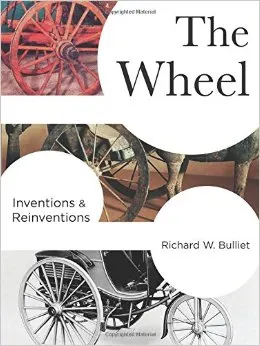
Yes, it is possible to reinvent the wheel. Just ask Columbia historian Richard W. Bulliet, whose latest book is on the ubiquitous and circular object long considered one of the world’s greatest inventions.
The Wheel: Inventions and Reinventions, published by Columbia University Press, is the continuation of an intellectual journey that began decades ago when Bulliet realized he didn’t know the word in Arabic for “wheel” even though he’d been studying the language for seven years.
Nor, for that matter, did he remember seeing the words for wagon, cart or axle in any of the medieval Arabic texts he studied. “Why not?” he wondered. “They show up in European languages. Maybe they didn’t have any wheels.”
Looking anew at the literature, Bulliet, a history professor at Columbia since 1976 who specializes in Islamic society and institutions, concluded that wheels disappeared in the Middle East between about 200 and 500 AD and did not reappear in most areas until after 1800—even though they had existed in ancient times. Middle Easterners “abandoned them,” he says. “And that to me was a major historical question.”
The answer, it turned out, was economic. The wheel was supplanted because it was cheaper to move goods using camels. They were stronger than oxen and fed cost-free on desert vegetation.
This insight would eventually lead Bulliet to pen two books on human-animal relationships: The Camel and the Wheel in 1975 and Hunters, Herders, and Hamburgers: The Past and Future of Human-Animal Relationships in 2007. His latest is the third in the trilogy.
The professor, who for many years taught a class at Columbia called “Domestic Animals and Human History,” also has published six works of fiction, the first under a pseudonym. He began that one—a murder mystery—in the 1970s to fend off loneliness and boredom while researching The Camel and the Wheel in a Sahara oasis town.
When he got back to the United States, he wrote it up and sent it off to the nation’s bestknown murder mystery editor. “I didn’t know you needed an agent,” he says. Titled Kicked to Death by a Camel, it was accepted for publication. But fearing that such a work might jeopardize his academic future, Bulliet used the pen name Clarence J.-L. Jackson, a combination of his father’s and grandfather’s names. “I didn’t have tenure. I was afraid people might think I was not serious.”
Nobody would question Bulliet’s gravitas now. The Harvard-educated scholar is considered one of the world’s foremost experts on medieval Islamic societies and is a sought-after commentator on the region.
He pioneered a method of demographic research that tracked the pace at which Islamic beliefs spread in the ancient world. Many had believed that Islam spread in a single century, but Bulliet demonstrated that it evolved over many generations.
Among the revelations in his new book: There are three different kinds of wheels, each invented at a different time, in a different place, and under different circumstances.
The earliest wheel, developed between 4000 and 3600 BC in Eastern Europe, was a simple axle with two wheels affixed to its ends that did not turn independently. “It seems to have been invented for moving ore in copper mines in Eastern Europe,” he says.
About 300 years later a second type appeared in the steppes north of the Black Sea, in what is now Ukraine. It consisted of two wheels that rotate independently around a fixed axle. This design superseded the other kind almost everywhere, though fixed wheels remained the standard in European mines.
The third kind of wheel, the caster, emerged in England and France around 1700 AD; it consists of a small wheel that rotates and pivots, allowing for directional change. It is the kind seen on baby strollers, wheelchairs, shopping carts, dollies, gurneys and roll aboard luggage.
“We literally go from cradle to grave on vehicles that are pushed by hand and steered by a device that was invented in 1700,” he says. “And we don’t know anything about how it developed or who invented it.”
Wheels were not common in Europe until about 1450 to 1560. Until then, farmers used them on carts, and noblewomen were transported in coaches while men of nobility rode horses. Then, “you have a revolution and the upper class of Europe goes crazy over acquiring carriages,” Bulliet notes.
“The wheel has been invented and reinvented more than once,” he says. “The amazing thing, given that people assume that wheeled vehicles are so important, is that whole societies, such as pre-modern Japan, chose not to use them.”