Teachers College Lab Looks at the Links Between Media and Social Change
Lalitha Vasudevan directs MASCLab, a hub for creating, curating, and supporting multimodal and digital scholarship.
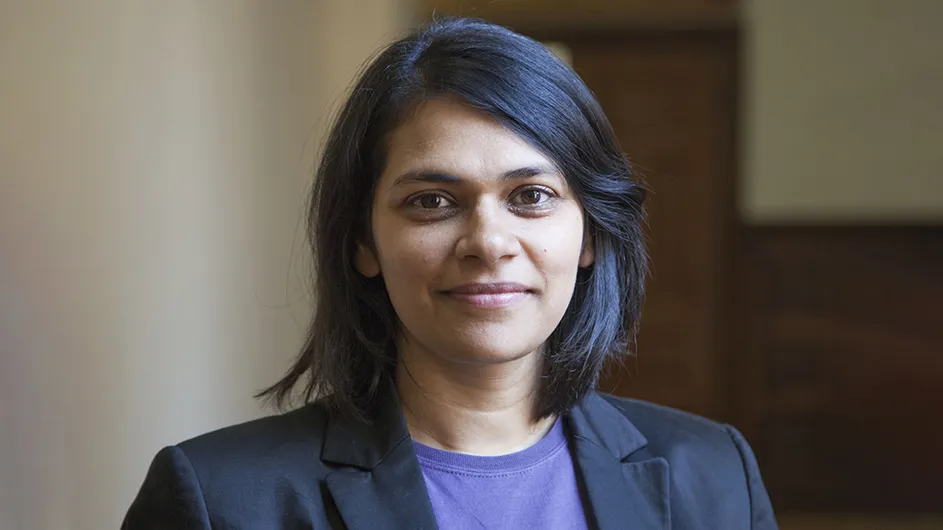
Lalitha Vasudevan plays a number of different roles at Teachers College (TC): She is a professor of technology and education, a vice dean for digital innovation, and managing director of TC’s Digital Futures Institute. Additionally, she directs the college’s Media and Social Change Lab (MASCLab), which is a hub for creating, curating, and supporting multimodal and digital scholarship, especially in the relationship between media and social change.
Vasudevan talks about the busy lab with Columbia News, including its origins, the type of research that goes on there, and some of the lab’s recent exciting events.
When and why did MASCLab start?
The Media and Social Change Lab was established in the fall of 2014 as a hub for multimodal scholarship focused on the intersection of media and social change. The idea of such a lab had been brewing for several years prior to its founding, and two key events catalyzed this effort.
I had been working with a group of students to initiate 3-Minute Media, a media festival that invited submissions of audio and visual media under three minutes in length, focusing on social issues. The original idea grew out of discussions with graduate students who had taken courses with me, and imagined other venues for the media that they had produced as class projects. What began as a local vision expanded into something that drew international submissions and catalyzed partnerships with regionally based media NGOs. As a junior faculty member at the time, in an academic program focused on technology and education, I was energized to see such a growing focus on media, both media outputs and media technologies.
3-Minute Media ran from 2010 to 2012, and showcased over three dozen short films and audio pieces, which addressed topics ranging from the Arab Spring to the experiences of international students in graduate school to the importance of art-making in schools.
A few years later, building on the momentum and widespread student interest in 3-Minute Media, some other graduate students and I established a space that would bring together students and faculty to explore the impacts that media was having on society, and vice versa—and not only once a year, as with 3-Minute Media, but on a regular basis. Thus, the Media and Social Change Lab was born.
An important added element was that of multimodal scholarship; that is, attention paid to the changing nature of research with the advent of emerging technologies and other tools with which to observe, analyze, and report on phenomena in expanded ways. We wanted to invite students’ curiosity about what research could look and feel like. This invitation has resulted in a number of master’s theses that incorporate digital and multimodal methods of data collection and analysis, as well as Teachers College’s first podcast as a dissertation.
The lab’s focus on media and social change was similarly intentional: to shift the gaze to the intersection between both concepts, which was ripe for curiosity and investigation. We posed questions such as: How was information shaping people’s understanding of the world given the increasing emergence of social media platforms and mobile technologies with which to produce media artifacts? What media were people creating? How was it circulating? What media could we make to investigate various phenomena? In what ways could media serve as both an input and output in making sense of the world? A multimodal scholarship approach to these questions invited expanded ways of seeing and knowing, and an important consequence of that framework is the inclusion of voices, perspectives, and practices that tend to be left out of research.
MASCLab also served as a place to convene around empirical questions of change and education that were affecting youth, in particular. At the time, I was in the midst of what would become a 15-year collaboration with an alternative-to-incarceration program, which involved several MASCLab students in the process of research with and about youths’ media practices in this unique setting.
Over the last 11 years, as the media landscape has continued to evolve, the lab has similarly evolved to reflect emphasis and interest in emerging topics about social media, digitally mediated gender identity performances, media literacy, and online activism. More recently, there has also been a growing interest in the ways that artificial intelligence technologies are impacting the media landscape by shaping the narratives that influence how and what knowledge is consumed.
But the sense of community and collaboration at MASCLab has remained and even deepened, as new lab members have joined and as many alumni stay connected in different ways.
Can you give some examples of lab projects?
In the last 11 years, we’ve seen a number of projects take root in the lab. For example, the MASCLab podcast launched shortly after the 2016 presidential election, in response to the fraught political climate at the time. Lab members sought to find a creative outlet and, in doing so, they cultivated practices of storytelling and public scholarship, as well as audio editing skills. Other examples of projects and initiatives that have emerged over time:
- Lamboozled! is a media literacy card game that grew out of media literacy research led by Ioana Literat and Yoo Kyung Chang.
- Media Fest (formerly PodFest) is an annual celebration of media projects developed and launched by students, faculty, and partners. The fest also serves as an opportunity to explore curation and exhibition as a form of public scholarship.
- Student research and media projects—these include small- and larger-scale studies that span media-related topics, such as feminist comedians in China to representations of first-generation college students across social media to Sudanese youth navigating political action through digital platforms.
What is the process for how projects happen in the lab?
We have cultivated a studio-like environment in MASCLab, where members can propose ideas that are in various stages, from emergent to well established. In this way, we function more like a collective rather than pursuing a single focus or problem to work on together. Students pitch ideas for media projects that they want to work on, and look for collaborators, as in the case of the MASCLab podcast. Other times, students seek collaborators for exploratory research they wish to pursue, such as one of our former student’s qualitative study of adventure playgrounds, which provided research experience for other master’s and doctoral students who were interested in the multi-sited photography methods being developed.
This semester, with the increased attention being paid to artificial intelligence, students in MASCLab joined forces with students in two other Teachers College/Columbia labs, Snow Day Learning Lab and the Transformative Learning Technologies Lab, to start a cross-lab exploration of AI and education. This effort builds on work that has been underway in the respective labs, and provides students with the space to talk across different theoretical approaches. We’re excited to see what emerges from these collaborations.
MASCLab has also included faculty-driven research that provides students with opportunities to work on interdisciplinary research teams. For example, in the long-term partnership with the alternative-to-incarceration program for which I was the principal investigator, a number of MASCLab students worked as research assistants and collaborated with youth researchers and the young people in the program. Over 15 years, we pursued questions about adolescents’ digital media and storytelling practices, explored interrupted educational trajectories of court-involved youth, and mapped the emerging communicative practices that flowed between sites and devices as mobile technologies were becoming more available. More recently, MASCLab students have worked in K-8 schools to provide critical media education curricular experiences for fifth-grade students, and some of their multimedia work was incorporated into previous Media Fests.
What are some of the things that went on in the lab this spring?
One of our students (Abu Abdelbagi) was part of a Pulitzer Prize-winning team at The New York Times! Abu is a doctoral student in the newly renamed Technology, Media, and Learning Program (formerly, Communication, Media, and Learning Technologies Design) and a core member of the lab.
Earlier this spring, we held our sixth annual Media Fest, which was well attended by current students and alumni, as well as several community partners that we’re engaged with through our work. This year’s showcase included opportunities to explore and engage with lab members’ developing projects, as well as a featured dance performance by two of our members—Emmy Semprun, a former master’s student who will be starting her doctoral studies at Teachers College this fall, and OreOluwa Badaki, formerly a TC postdoc, and currently a research scholar at the Teachers College Digital Futures Institute.
Collectively, the goings-on at MASCLab reflect a robust spirit of multimodal scholarship in which inquiry, analysis, and representation are not merely studied or consumed through reading texts, but are actively investigated and embodied. Dr. Badaki, for instance, incorporates dance and movement in her qualitative empirical research about climate education and sustainability. She draws on dance to inquire as well as to communicate the stories her empirical work uncovers and produces.
We know that research does not follow a linear path, and emerging technologies and creative practices invite more capacious practices of noticing and seeing. These practices in turn allow for new questions to be posed, and for new knowledge about the changing world—especially the communicative landscape, infused with rapidly evolving technologies—to surface.
Are you ever surprised by unexpected outcomes in the lab, or do you ever learn something new from lab results?
Always. As our student population has become more international, we have had the benefit of expanded perspectives on how media—especially social media texts and performances—are shaping understandings about formative ideas around the world, like gender. A few years ago, I walked into our space and realized that I didn’t know about several of the projects that were going on, nor did I know all of the people who were connected with the lab. This was fantastic because it meant that the lab had evolved past my imagination into a dynamic space, which reflects its diverse membership. What I find continually inspiring are stories of students who find community and a sense of belonging in the lab, two elements that are key to nurturing inquiry and curiosity. I’m proud that this ethos, that was present at the launch of MASCLab, continues as new members make their intellectual home here.
Is there an overlap between what you teach and what goes on in the lab?
Absolutely. My teaching over the last two decades has centered on the intersection of media and social practice, specifically the engagement and impact of media practices and tools in shaping the communication practices of youth.
What will you be teaching in the fall?
A course called Video as Art. Like other courses I teach, students in the class will be exploring and experimenting with a variety of media, technologies, and texts as they pose questions and prepare for the unpredictable.
I just want to add that since its launch, MASCLab has supported students’ inquiries, and has benefited from the curiosity and ideas that students bring to the community. Having such spaces of belonging, that are open to intellectual risk-taking and that form meaningful human connection, is always needed. But there’s a now-more-than-ever quality to such a statement at this moment, when higher education is under a microscope. We can’t always quantify the impact of an experience, but as faculty and members of a higher ed community, we should aim to tell stories of our work—our collaborations, our short- and long-term findings, the internal and external impacts of our efforts—early and often. At MASCLab, we provide support and means for affiliated faculty and staff to do so by leveraging modes and forms beyond the written word. Not only will this approach strengthen our collective ability to reach this goal, but we will bring more people into the fold along the way.