Meet an Architect Who Is Also an Engineer, Scholar, and Curator
Lydia Kallipoliti engages in a wide-ranging practice, and encourages her GSAPP students to do the same.
Lydia Kallipoliti has just completed her first year at Columbia’s Graduate School of Architecture, Planning, and Preservation (GSAPP), where she is an associate professor and directs the Master of Science Program in Advanced Architectural Design (MSAAD). Her research is at the intersection of architecture, technology, and environmental politics, in particular, recycling material experiments and theories of waste and reuse, as well as closed and self-reliant systems and urban environments. Kallipoliti’s work is presented in a variety of media, including online digital platforms, lexicons, databases and archives, and exhibitions and holographic animations, with the scope of engaging a wide audience in what she calls “immersive scholarship.”
Kallipoliti discusses her work and teaching with Columbia News, along with how her career developed and advice for students interested in pursuing a similar path.
What did you teach in the spring semester?
An advanced design studio, Building Microbiomes, and an MSAAD seminar, An Archaeology of Infection and Environmental Control. I also coordinated the advanced studio sequence at GSAPP alongside Mario Gooden (who directs the Master of Architecture program), and I started a pedagogical program initiative for the MSAAD program, Edible Summits, which was truly a revelation. In this framework, two student teams reimagined the ontological connections between architecture and food, and staged an “eating” event as a performance at Avery Hall. Both student teams were beyond dedicated, and delivered nuanced installations and performances on foraging materials deemed edible within a specific radius from Avery Hall. They also worked on creating food for worms, decentralizing the human from the center of the ecosystemic equation. Additionally, it was wonderful to find alliances between GSAPP and the Food for Humanity Initiative at Columbia Climate School, and craft collaborations between the two programs.
In the courses I taught in the spring, I focused on the microbiology of the built environment, basically, on the integration of biotic matter into living environments, which impact the health of humans and other organisms, but also the diagnostics of building properties. In the framework of the studio, we investigated the microbiome as a trans-scalar, heterogeneous, and boundless entity, an invasive matter/energy residue that supersedes political, social, spatial, territorial, glandular, and even cellular boundaries; a transcontinental system that envelops and intoxicates or nourishes insides and outsides, rendering the architectural object a benign form of protection. From using resin to heal decaying cement walls, to composting fruit peels and regenerating soil patches, the students explored how the microbiome is changing the physical, social, political, sensorial, and emotional life of our cities and buildings.
What was your path to a career as an architect, engineer, scholar, curator, and educator?
It was definitely non-linear and non-strategic. For my terminal degrees, I trained as an architectural historian at Princeton, engaging deeply with archival material. Before that, I was a building technology researcher at MIT’s Building Technology Lab, where I worked closely with biodegradable composite materials, adaptive structures, and recycling systems. In both areas of study, I attempted to crossbreed methods, epistemologies, and approaches to knowledge, transposing one field to the other. When writing historical papers, I expected the work to transcend the historical dimension, to be used in multiple ways, and to form projective archaeologies that reveal current crises. I hoped not only to examine the history of architecture and the environment as a collection of facts that broaden our understanding of the present, but also to delve into a critical understanding of temporality: To witness a time and space where existential ideas about world orders migrate.
This type of interdisciplinary research, which has always been inherent in my work, certainly slowed down my career as a junior researcher and educator. I was rejected from many jobs, struggled to build credibility in any one field, and was often asked whether I am a scientist or a historian. Eventually, it was at the Cooper Union—where I was a tenure-track, and later tenured faculty member, in the school of architecture—when my expertise in history, theory, environmental technology, and design fit within the multitude of voices that the school brought together.
Every project has always been an experiment, an interdisciplinary think tank, where, in many cases, I collaborated with experts in different fields. For example, in the project Life on Mars, I collaborated with genetic engineers, whereas I have also worked with the company Friendship Bottles LLC, which has patented and manufactured interlocking plastic bottles that are intended for reuse as building materials. Every project opened a new field of investigation and an opportunity to use the project itself as a test bed for learning. Therefore, it becomes a workshop of collective production, a creative type of exhaustive, but rewarding struggle, with a newly established small community that forms and reforms.
How do you balance the demands of your own work and teaching?
The very idea of balance is a precarious one that I have not managed to become friends with. I encounter beauty and struggle in my life, much more than balance.
The most common way to answer this question is to set clear boundaries and schedules, and to block out dedicated times for teaching and practicing. Even though this is advisable, in my case, my practice as a researcher and teaching as an educator are indivisible and intertwining. I would argue that my work is an activist type of scholarship, as a tool of engagement with current environmental debates.
A main thread in my work both as a researcher and an educator is to examine, monitor, and map emissions, effluents, and waste streams in urban environments, not only as technical matters, but also as matters of territorial inequality, justice, and equity. Through design and engineering, my objective is to interrogate how architecture gets its power, economy, materials, and labor, as well as to understand the present and future role and operational capacities of buildings within urban environments. In some cases, by mapping the wider territories and environments that architecture influences, and the different scales of its influence from the microscopic to the macroscopic, I experiment, design, and fabricate inhabitable digestive machines, which can process waste into viable energy or water input for domestic environments.
What are you working on now?
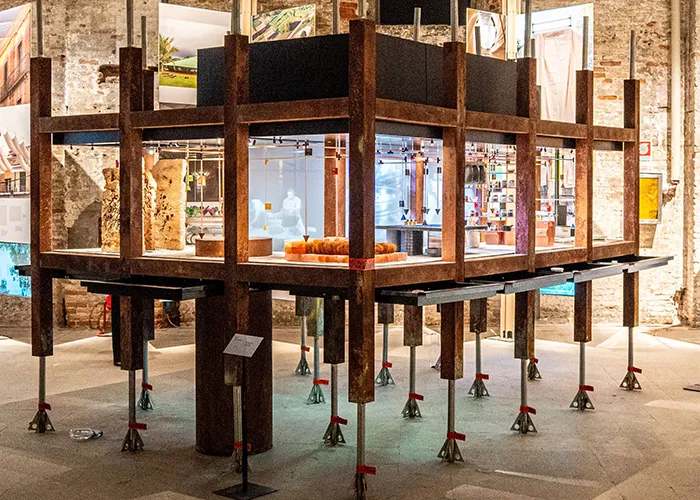
My latest project is Building Metabolism, which is a book and a built manifesto with Areti Markopoulou, an architect, researcher, and urban technologist. The book that we co-edited was published recently, while the built prototype was also recently unveiled at the Arsenale (Corderie) of the 19th International Architecture exhibition at the Venice Biennale. The Metabolic Home presents an archetypal program for inhabiting dense cities, conceived as a living stage set where humans and other species—along with their physiology of ingestion, occupation, and excretion—become combustion devices and integral components of cohabitation. The installation presented a 1:5-scaled living model of a home, featuring nine distinct domestic spaces—kitchen, toilet, lounge, bedroom, laundry, storage, garage, balcony, and light well—that reveal how metabolic processes are linked to everyday domestic activities.
Each part of the house communicates with the others, receiving waste matter from one space as input and converting it into resources as output in another. This living prototype was proposed as a microcosm of the world and a test bed for how resources may be recirculated and life reimagined—an allegory to larger, as well as smaller, spheres of action, but also an intimate space that brings actions of decarbonization to the ground field of everyday life. We are currently seeking ways and venues to realize the prototype and test in 1:1 scale in a habitation experiment.
Advice for anyone pursuing a career similar to yours?
I always encourage my students to stay curious and focused; and to constantly ask questions, but questions of a specific nature that indicate knowledge and know-how of the subject at hand, rather than developing generic rhetoric for the sake of being heard. I believe in forensic analysis and in what small, seemingly insignificant details may reveal about the larger context of which we are a part. In that regard, I love a quote by one of my favorite writers, Ursula Le Guin, who wrote in The Language of the Night that: “Science fiction is not predictive; it is descriptive. Science fiction does not predict the future. It describes possible worlds in the present.”
Observation is key to imagining new worlds, fields, and disciplines. As a famous cinematographic line suggests, “open your eyes” to the broken, flawed, abject realities that we often look away from. Then, develop an eros with the abject; because only if you love, you care enough to not idealize the subject of your love, and see it in all its dimensions.