Astronomers Discover Star-Shredding Black Holes Hiding in Dusty Galaxies
Unlike active galaxies that constantly pull in surrounding material, these black holes lie dormant until a star passes by.
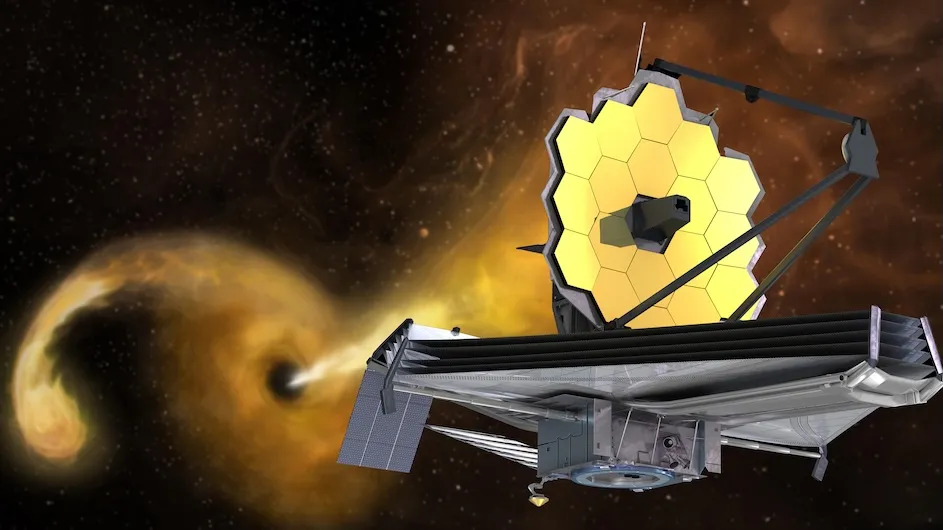
Astronomers at Columbia University, MIT, and other institutions have used NASA’s James Webb Space Telescope (JWST) to peer through the dust of nearby galaxies and into the aftermath of a black hole’s stellar feast.
In a study appearing today in the Astrophysical Journal Letters, the researchers report that for the first time, the telescope has observed several tidal disruption events—instances when a galaxy’s central black hole draws in a nearby star and whips up tidal forces that tear the star to shreds, giving off an enormous burst of energy in the process.
Scientists have observed about 100 tidal disruption events (TDEs) since the 1990s, mostly as X-ray or optical light that flashes across relatively dust-free galaxies. But as researchers recently reported, there may be many more star-shredding events in the universe that are “hiding” in dustier, gas-veiled galaxies.
In their previous work, the team found that most of the X-ray and optical light that a TDE gives off can be obscured by a galaxy’s dust, and, therefore, can go unseen by traditional X-ray and optical telescopes. But that same burst of light can heat up the surrounding dust and generate a new signal, in the form of infrared light.
Now, the same researchers have used JWST—the world’s most powerful infrared detector—to study signals from four dusty galaxies where they suspect tidal disruption events have occurred. Within the dust, JWST detected clear fingerprints of black hole accretion, a process by which material, such as stellar debris, circles and eventually falls into a black hole. The telescope also detected patterns that are strikingly different from the dust that surrounds active galaxies, where the central black hole is constantly pulling in surrounding material.
Together, the observations confirm that a tidal disruption event did indeed occur in each of the four galaxies. What’s more, the researchers conclude that the four events were products of not active black holes but rather dormant ones, which experienced little to no activity until a star happened to pass by.
The new results highlight JWST’s potential to study in detail otherwise hidden tidal disruption events. They are also helping scientists to reveal key differences in the environments around active versus dormant black holes.
“This is the first chance we’ve had to observe tidal disruption events in the mid-infrared wavebands, and they look very different than what we normally see around other active black holes,” said Kishalay De, a Columbia astronomy professor, and one of the study’s lead authors. “We’re excited by the possibilities that the JWST telescope opens up for us to understand much more about black hole environments.”
The new study expands on a previous result from De’s work with archival data from NASA’s Near-Earth Object Wide-field Infrared Survey Explorer (NEOWISE) mission. By searching for bursts of infrared radiation in the data, De and collaborators had demonstrated the existence of a completely overlooked population of energetic eruptions caused by stars being shredded by supermassive black holes in the centers of nearby galaxies. Because these events were heavily veiled by dust close to the supermassive black holes, they has been overlooked for many decades.
To unambiguously confirm this hypothesis, De designed the program, outlined in this new study, that obtained the JWST observations of these objects. “The exceptional infrared sensitivity of JWST allowed us to peer through the dust that enshrouds these events and directly see the material that is being eaten by the black hole,” De said. The data and the team’s analysis confirm that the properties of the infrared radiation are entirely consistent with a black hole that is slowly gobbling up the remaining stellar material up to a decade after the beginning of the disruption.
“The data confirm our hypothesis about the nature of these events and demonstrate the spectacular power of using infrared light to probe the dustiest regions of our universe that are otherwise missed in other observational methods.”