Did You Know That Columbia’s German Department Also Offers Yiddish, Dutch, Swedish, and Finnish?
New chair Oliver Simons outlines his plans and discusses why the study of languages and literature is key today.
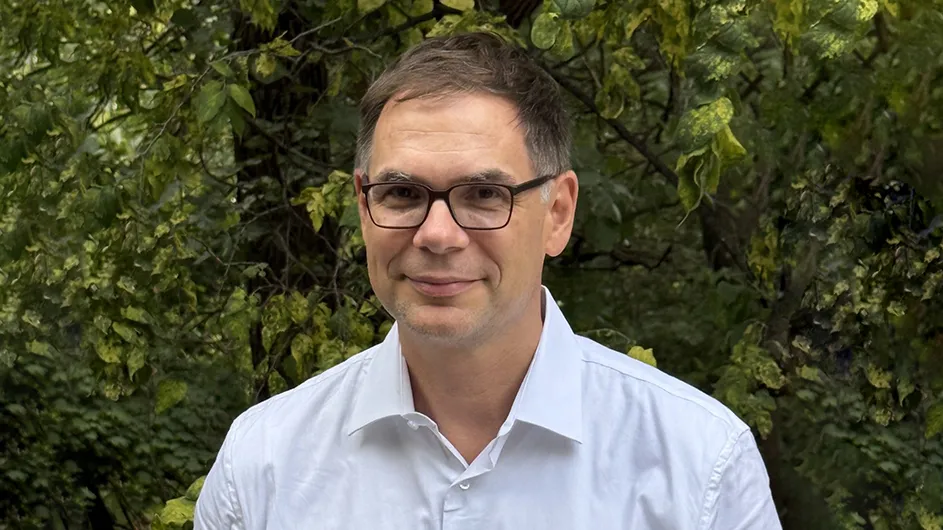
Columbia University’s Department of Germanic Languages has long been considered one of the strongest German departments in the country. It offers a rich, comprehensive curriculum on the history of German literature and culture from 1750 to the present. The focus is on literary theory, intellectual history, media history, film, performance studies, literature and science, and translation theory, as well as German-Jewish culture.
In the undergraduate program, German majors and concentrators acquire proficiency in examining literary, philosophical, and historical texts in the original, as well as critical understanding of German culture and society. Courses taught in translation build on the Core Curriculum, thereby allowing students to enroll in upper-level seminars before completing the language requirement. The department’s PhD students receive excellent training in language pedagogy.
Oliver Simons, the new chair of Germanic Languages, took time to speak with Columbia News about his ideas for the department, along with his own work, and why language study is crucial in today’s globalized world.
As the new chair of Germanic languages, what are your plans for the department?
First and foremost, we are committed to promoting the study of languages at all levels. We offer German, Yiddish, Dutch, Swedish, and Finnish, and this linguistic and cultural diversity is crucial to what we do. In a time when many believe we can replace language instruction with AI tools or rely on translation apps, we stand for multilingual competency and cultural literacy.
Related to this, in the current moment, study-abroad opportunities are particularly important. We offer a fantastic summer program in Berlin, where students can study for several weeks at no cost to them. Additionally, we are part of a consortium, Berlin Consortium for German Studies, with several universities, that allows students to spend a semester or a full year in Berlin.
We also want to promote a new minor in German Thought and Critical Theory, which we introduced a couple of years ago. It allows students to gain a deeper understanding of a critical intellectual and philosophical tradition, from Immanuel Kant through Hannah Arendt and the Frankfurt School. Students can build on what they’re already reading in Contemporary Civilization, and it’s a minor in partnership with the Philosophy departments at Barnard and Columbia.
Strengthening our multidisciplinary connections will also be crucial. Germanic studies have always been inherently interdisciplinary, and we want to make those connections more visible and accessible. Finally, we are fortunate to have Deutsches Haus as an event space for lectures, workshops, and conferences.
While chair, will you continue to teach? If so, what are you teaching this semester, and in the spring?
Yes, teaching remains a priority for me. This semester, I’m teaching a lecture course, Marx, Nietzsche, Freud, which I always immensely enjoy. Although I’ve taught it several times before, the discussions are always fresh and unique with each group of students.
In the spring, I’ll be teaching a course on literary theories, open to both undergraduates and graduate students. It provides a thorough overview of the main theoretical frameworks that have influenced literary and cultural criticism. German materials and thinkers are central to both courses, but they are open to students across the University, which is what we want as a department.
What sort of programming is planned for the department this year?
As I said earlier, Deutsches Haus is our venue for lectures and other public activities, including Kaffeestunden (coffee hours) in German, conversation hours in Yiddish and Dutch. We bring in scholars, but also writers and cultural figures to Columbia. This fall, for example, on October 29, at 6 pm, we have Adam Gidwitz,an award-winning children’s book author and podcaster, who will talk about adapting dark and bloody Grimm fairy tales. It’s an event in conjunction with Professor Annie Pfeifer’s successful lecture on fairy tales. Gidwitz will speak right before Halloween, which is perfect timing.
In the spring, we’re hosting the annual Mosse Lecture for the fourth time. The Mosse lectures were originally founded in Berlin at Humboldt University. I remember hearing the very first ones when I was a student there. For us, they provide another opportunity to show that German literary and cultural traditions still connect with today’s issues. We’re especially excited because Daniel Kehlmann, one of Germany’s most celebrated contemporary writers, will be speaking. His latest novel, The Director, has attracted much attention. It is about the Austrian film director G.W. Pabst and his controversial choice to make films for the Nazi regime during World War II.
We also have a lecture on Nazi films scheduled, a colleague will organize a workshop on fascism, and another is leading a colloquium on sociology and literature. Plus, we use Deutsches Haus for our own departmental events—for example, our regular colloquium lunches where faculty and graduate students share their current research.
Why is the study of languages and literature so important?
Learning a new language offers something truly irreplaceable—the ability to understand cultural differences, to immerse yourself in a different world and culture, and to see how other languages shape our experiences and realities in different ways. This isn’t just academic curiosity. In our globalized world, the skill to think across linguistic and cultural boundaries is more important than ever.
The same is true for the study of literature, culture, and theory. Especially now, when AI seems to give us answers to almost every problem, and we seem surrounded by answers and solutions everywhere, I believe it’s really about learning to find the right questions. I think this is what the humanities are about—finding questions—and what studying literature can help us achieve.
And, of course, there are many other skills that literature departments teach. Reading critically, reading closely, and learning how to do research—these are essential skills. However, what exactly they mean isn't clear without the classroom, without those discussions that help develop these skills. These critical thinking and research skills transfer to many other fields and forms of communication. Especially today, in our current algorithm-driven information environment, these skills are not luxuries, but necessities: The ability to analyze rhetoric, understand how arguments work, and recognize bias and propaganda. I don’t believe you can fully understand the complexities of Europe today without understanding its literary and cultural history.
Finally, studying literature develops our ability for sophisticated communication and expression—allowing us to convey ourselves with precision and nuance. We’re facing so many uncertain futures right now, but I believe these humanistic skills—critical thinking, cultural sensitivity, and communicative competence—will remain essential, and they are transferable.
What was your path to a career as an educator and writer?
I studied German literature, philosophy, and cultural studies at Humboldt University in Berlin. It was an exciting time in Berlin, both politically and academically—a few years after the fall of the Berlin Wall. After my MA, I continued there for my doctoral studies and started teaching in German studies.
After defending my dissertation, I joined Harvard’s German department. I initially thought it would be temporary, a couple of years in the United States, but temporary became permanent. In 2012, I came to Columbia. I feel very fortunate to have always been in a teaching position, and to have gained so much from my classroom experiences at these institutions.
What are you working on now?
I’ve just finished a book, Reading as Method, that’ll come out in early spring. It examines different reading practices—from close reading to symptomatic reading to digital humanities approaches—but it also aims to define what makes reading truly methodological. I’m also finalizing a second book, Towards a Genealogy of Theory, which attempts to offer a systematic understanding of how the many different theories of the 20th century can be viewed genealogically.
Building on my lecture course, I’m beginning a new book project, Marx, Nietzsche, Freud: Writing Modernity. This trio has become a common subject in university curricula across the country, and I’m interested in how concepts like labor or value have been adopted, altered, and sometimes distorted in their work—from Marx’s labor theory to what Freud called dreamwork. My second major long-term project is a comparative study on Literature and Money, which explores the history of financial crises and currencies through literary texts. I’m less interested in economic themes in literature and more in how literary forms respond to economic structures. Since my other projects are so theory-focused, I look forward to spending more time on literary texts again.
Advice for anyone interested in pursuing a trajectory similar to yours?
I never took a gap year or left the academy myself, but I strongly recommend anyone thinking about a career in academia to actively seek experiences outside the university. I’ve always felt I missed out by not having that kind of perspective.
And I cannot overstate the importance of language learning at all stages of your training. There is never enough time to read all the books you want, but there is an ideal time to learn languages. Related to language learning, I highly recommend gaining extended international experience—whether through formal study-abroad programs, research fellowships, or just spending time abroad. These opportunities don’t come back, or they won’t have the same impact and depth later.
I believe those experiences also help you stay realistic about the challenges of an academic career. Finally, you need to find out if you’re passionate about teaching. Regardless of research interests or administrative roles, the academic workspace is the classroom.
What’s special about teaching at Columbia and in New York?
Both the classroom environment and the diverse student body stand out. Compared to other institutions where I’ve taught, Columbia students are much more heterogenous—economically, culturally, and intellectually. They also have this edge I like very much. When I first arrived at Columbia and was asked to teach Contemporary Civilization, I was honestly skeptical about the course. But it has become one of my favorite classes. It works and encourages critical and controversial discussions of great texts and issues. The interdisciplinary programs, like those run by the Institute for Comparative Literature and Society, are also special. The scholarship and knowledge generated in these programs are unique.
The city always plays a crucial role, not just because of its endless resources. The energy and dynamic of New York are always present in the background of classroom discussions. And it’s good to know you can cross a street or two and find yourself in a completely different world.