An Artist Who Engages with the City in All of Its Diversity
School of the Arts student Alejandro Valencia likes the intensity of New York—as well as occasionally leaving it.
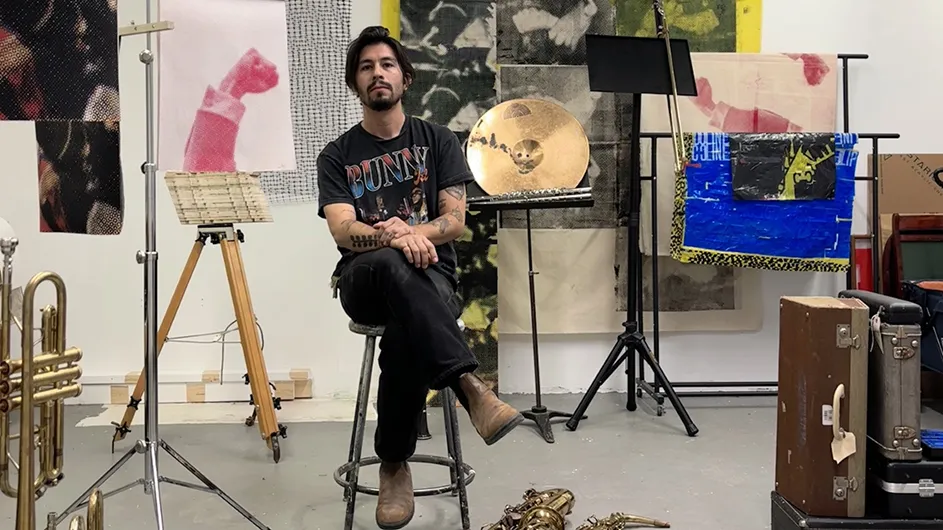
Alejandro Valencia recently organized a large exhibition at the Neiman Gallery in School of the Arts, featuring works by faculty, current and former students, and established artists beyond Columbia. When he isn’t curating shows or creating his own art, Valencia likes to explore the city, sampling the diversity of art, food, and music, or simply walking and getting lost.
When will you graduate from School of the Arts, and what is your degree in?
May 2026, with a master's of fine arts from the Visual Arts Program.
What was your path to pursuing graduate work at Columbia?
I felt it was necessary at this point in my career to be in a place where I could engage in constant critical dialogue with peers and mentors from diverse disciplines and backgrounds. The graduate MFA program at Columbia offered that space for engagement and conversations with artists and professors from different departments in the University. Columbia’s location in New York was also an asset I considered important.
Have there been special mentors/professors during your time here? Or a particular class that inspired you?
Tomas Vu-Daniel, Rirkrit Tiravanija, Jon Kessler, william cordova, Adama Delphine Fawundu, Shourideh Molavi, and Melanie Kress are some of the mentors/professors with whom I have had very fruitful and meaningful experiences and conversations during my time here. They have been central to the development of my work and work philosophy, and they have also given me insights regarding life outside of the academic bubble.
Borderlands, Surveillance, and Human Rights, taught by Shourideh Molavi, was a class that had a deep impact on me: How we view one another; how we contend with a world that is increasingly fearful of migrants and anyone different from the norm; how we construct borders around ourselves; and how we can engage proactively with all of these difficulties. It was a class that allowed space to openly and critically discuss the current state of the world, inside and outside the institution.
What was it like to organize the recent exhibition, After the Last Sky, at the Neiman Gallery? Is curating something you want to continue doing?
It was a challenge that came with a lot of learning. The exhibition hosted 40 artists from various stages of their careers, as well as School of the Arts MFA alumni and current SoA students, plus works from the LeRoy Neiman Center for Print Studies. So a lot of preparation came before curating the exhibition in the gallery. It was rewarding to see how the public engaged not only with the work, but also with the space, as they interacted with many of the elements in the show.
Yes, I see curatorial practice as an extension of my work. It is a great platform to bring people together.
How do you like studying in the city? What are your favorite urban pastimes?
The campus is far enough from the intensity of the city, yet it allows you to immerse yourself in the nonstop chaos of it. I enjoy being able to experience all the various aspects of a city like this one—from the diversity of culture, food, and music, to the ever-changing art shows and walking in the parks. Every street corner is another opportunity to experience something new.
Any specific recommendations for things to do beyond campus?
Walk and get lost in the city. Also, leave the city every so often.
What are some of your favorite spots on campus?
Prentis Hall, which is where the graduate MFA studios are, is the designated work space. I like the steps in front of Low Library to sit and wind down. There is a corner desk on the third floor of Butler Library where I like to sit and read. Silence is golden in a city of noise.
What are your plans post-graduation?
Spend some time by the sea, then resume operations in New York, Miami, and Colombia, where I am from.