Wafaa El-Sadr on Columbia Global and its Role in Collaborating to Have an Impact
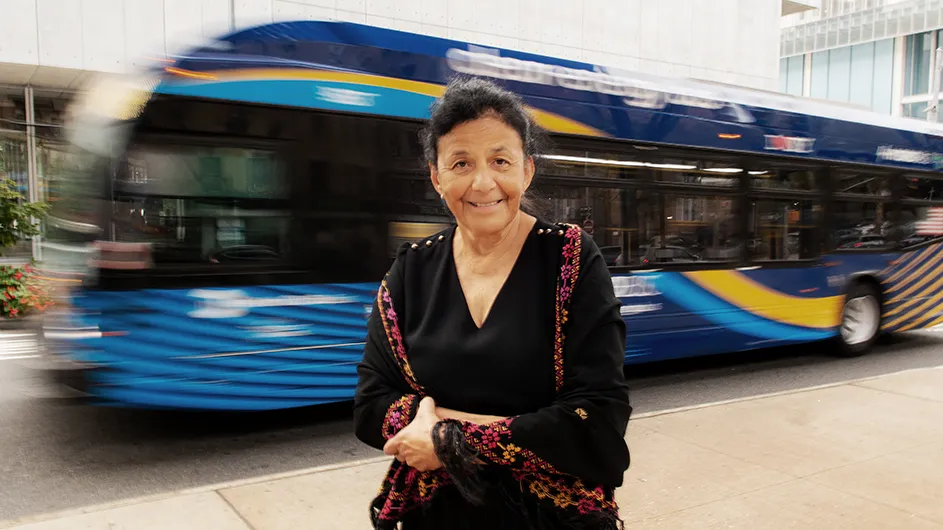
As COP30 gets underway in Belém, Brazil, this month, Columbia Global has been hosting virtual discussions at its Global Centers. To highlight this activity and more, Columbia News spoke to Wafaa El-Sadr, the executive vice president of Columbia Global, which includes the 11 Global Centers and four other international initiatives, to learn about the group’s mission and role within the University.
For a student or faculty member who is learning about Columbia Global for the first time, how do you explain what it is?
Columbia Global was born from a simple realization: We live in a deeply interconnected world. Our lives are linked through technology, culture, and shared challenges, from climate change and migration to threats to democracy. If we want to truly understand the world, we cannot stay apart from it. We must be in it.
That is what Columbia Global does. We connect Columbia’s people—faculty, students, and alumni—with the ideas, institutions, and communities shaping our shared future. Through our programs, we support both scholarship and action, what we call “where thinking meets doing.” For students, that can mean transformative experiences that expand how they see themselves in the world. For faculty, it means partnerships that bring their research to life in ways that have real impact.
Columbia Global was created in 2022. Four years in, what have you been able to accomplish?
We have spent these first years defining our priorities and putting them into practice. Columbia Global now serves as a single platform for the 11 Global Centers, Columbia World Projects, the Committee on Global Thought, the Institute for Ideas and Imagination, and now Undergraduate Global Engagement. This alignment has given us both coherence and reach.
Programmatically, we have launched several new initiatives. The Scholars-in-Residence program supports faculty research abroad. The Emerging Scholars in the Humanities program helps displaced and at-risk academics rebuild their careers. The Columbia Global Resilience Fund enables rapid faculty-led responses to crises. Most recently, we created a fellowship to nurture the next generation of climate leaders. These efforts show how Columbia’s global presence can generate new knowledge and drive positive change.
Some might question why focus on global issues when there are so many challenges that we face here in the U.S. How would you respond?
The local and the global are inseparable. Every major issue, whether public health, inequality, or climate, has both dimensions. Understanding the global context makes our local work stronger, and vice versa.
I have seen this again and again. For example, Vanessa Fiuza, who received her M.A. in Human Rights, worked through our Santiago Center to document Indigenous land rights in Chile, applying what she learned in New York to real-world challenges abroad. Or take Professor Rachel Cummings, whose work through our Early Career Faculty Impact Fellowship helped her to expand her research network and explore how her work could have greater societal impact.
These experiences feed directly back into the Columbia classroom. That cycle of exchange, ideas flowing out and insights flowing back, is what keeps the University vital.
You mentioned that collaborations are a key component of Columbia Global. Why is this so important to Columbia Global’s work?
Collaboration is at the heart of everything we do. Within Columbia, we bridge schools and institutes to help faculty pursue new research across disciplines. The Center for Political Economy at Columbia World Projects, for instance, brings together economists, historians, and legal scholars to tackle questions of inequality and growth. The Committee on Global Thought curates public dialogues that span philosophy, culture, and policy.
Beyond campus, our Global Centers make collaboration tangible. In the Dominican Republic, Columbia World Projects worked with faculty from the Mailman School of Public Health and the Graduate School of Architecture, Planning, and Preservation, alongside Dominican universities and city officials, to design a “blueprint” for community resilience in the face of natural disasters. The government is now using that blueprint to shape policy.
Our Global Centers also convene groups that might not otherwise meet. In Paris, we partnered with Le Monde and Columbia’s Maison Française for a symposium on ethics in conflict reporting. Our Amman Center hosted a dialogue on post-conflict journalism that produced recommendations now being shared across the Middle East. These are the kinds of collaborations that translate Columbia’s intellectual power into real-world impact.
How do you gauge progress in Columbia Global’s efforts?
We measure it in value to our community. Are we expanding opportunities for students to have meaningful global experiences? Are we helping faculty pursue their ideas in new settings? Those are our benchmarks.
Our long-term goal is simple: every Columbia student should graduate with a global experience, whether through study, research, or applied learning, that prepares them to navigate an interconnected world. And every faculty member should have access to partners and resources that amplify the reach and relevance of their research.
What’s one global issue where Columbia is uniquely positioned to help move ideas into action?
Climate change. It touches every discipline and every community. Our Road to COP30 series captures what Columbia Global does best, connecting global dialogue with local action. Starting in Beijing and culminating at our Center in Rio, each Global Center is hosting an event on how their region is confronting climate change in the lead-up to COP30 in Brazil. These events bring Columbia faculty together with local journalists, scientists, and advocates. It is a powerful reminder that universities are not ivory towers. They are living, breathing parts of the world, and that is where Columbia Global belongs.