From Subatomic Particles to Black Holes, and Back Again
Sebastian Mizera just joined the physics department as an assistant professor, researching quantum field theory.
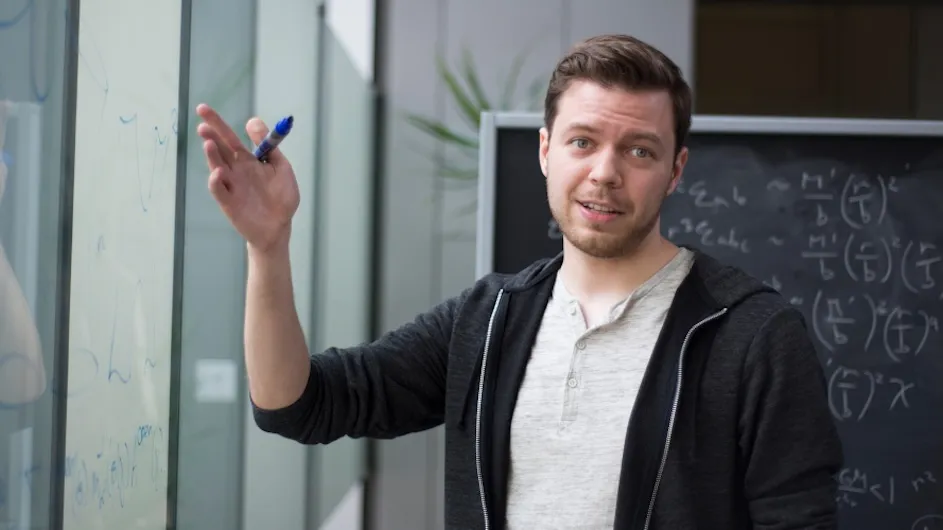
Sebastian Mizera grew up in Krakow, Poland, studied in the United Kingdom and Canada, and worked at the Institute for Advanced Study in Princeton, New Jersey, before making his way to New York City and to Columbia this past summer. Now an assistant professor of physics, Mizera studies quantum field theory, with a particular interest in predicting the outcomes of collisions between subatomic particles and comparing those computations to the data from particle physics experiments. Columbia News caught up with Mizera to discuss his research, his hobbies, and his favorite places for Polish food in New York City.
What does your research look at, broadly speaking?
Broadly speaking, I study the fundamental rules of particle interactions. My work focuses on calculating “scattering amplitudes,” which are essentially the quantum probabilities that predict what happens when subatomic particles collide.
You can think of experiments at the Large Hadron Collider in Switzerland, where particles are smashed together at incredible speeds. The rules of quantum theory tell us that we can’t predict the exact outcome of any single collision, but we can predict the statistical pattern of all collisions. My job is to calculate these patterns.
My day-to-day work involves calculating scattering amplitudes. This allows experimentalists to match their data against our theoretical predictions. The ultimate goal is to find out if the data reveals new forces, entirely new particles that we don’t yet know exist, or even to better understand the forces we already know, like the strong nuclear force, which holds subatomic particles together.
What’s especially exciting is that the mathematical techniques our field has developed for particles are now being applied to vastly different scales. For example, we’re using the same methods to understand what happens when two black holes or neutron stars spiral around each other and merge.
Just like in a particle collision, two objects interact, and something new flies out. In this case, a heavier black hole and gravitational waves. If we’re lucky, we can catch a glimpse of those waves on Earth.
So, my research is about using a single, unified framework—the language of scattering amplitudes—to understand both the smallest building blocks of matter and the most massive, energetic events in the cosmos.
One of the major questions in physics right now is whether the rules of gravity that govern very large-scale events like planet mergers are also taking place at the subatomic level, or if other forces are at work at tiny scales, and within the atom, right?
That’s exactly right, and my research sits at that intersection. From far away, a black hole looks just like a heavy, fundamental particle, allowing us to use the same techniques from particle physics. This is known as the “point-particle” approximation. The most exciting physics happens when we “zoom in” and this approximation starts breaking down. As the objects get closer, we need to take into account things like stretching forces that affect the shape and behavior of black holes. These are known as “finite-size effects.” Part of my research is to understand these corrections. This is what connects the abstract particle theory to the real-world gravitational wave signals we detect.
What else are you working on?
I’ve also been exploring a related question: why physics looks different at different scales. For example, you clearly don’t need to know particle physics to make pasta, even though pasta is ultimately made of those particles. There’s a framework called “renormalization” that explains which subatomic details can be safely forgotten as we “zoom out.” Together with three fantastic Columbia PhD students—Ameya Chavda, Dan McLoughlin, and John Staunton—I’m developing a new framework for this phenomenon, based on the core quantum principle of probability conservation. It suggests a potentially simpler and deeper foundation for understanding particle behavior, one that might let us bypass current computational bottlenecks.
What drew you to work at Columbia?
What drew me most was the incredible breadth of the expertise at Columbia’s Center for Theoretical Physics. We are based on the eighth and ninth floors of Pupin Hall. We have an amazing group of scientists working on everything from black holes and cosmology to quantum field theory—all kinds of theoretical questions. It’s so inspiring to be able to walk down the corridor, ask a colleague a detailed question about something like black hole observations, and get an immediate, deep insight. That kind of spontaneous, cross-disciplinary exchange is incredibly stimulating and a huge part of why I wanted to be here. Plus, of course, I love the energy of New York City.
What do you like to do outside of your day job?
My main hobby is running, which I really embraced after moving to New York. I discovered that the main loop around Central Park is almost exactly 10 kilometers, and I keep trying to push myself to beat my personal record. It’s my favorite thing to do on a weekend, when there’s so much energy in the park, but I also enjoy going after my last class of the week to clear my head.
Do you have any Polish food recommendations in the area?
I recommend Pierozek in Greenpoint. The name of the restaurant translates to “little dumpling,” and you can get savory or sweet ones. It’s very authentic and I had a great time there. It reminds me of home.