In Taiwan, Finding the Human Drama Beneath a Technological Triumph
Hsiao Chu-chen’s documentary A Chip Odyssey, a 50-year saga of grit and resilience, wins over a packed Columbia crowd.
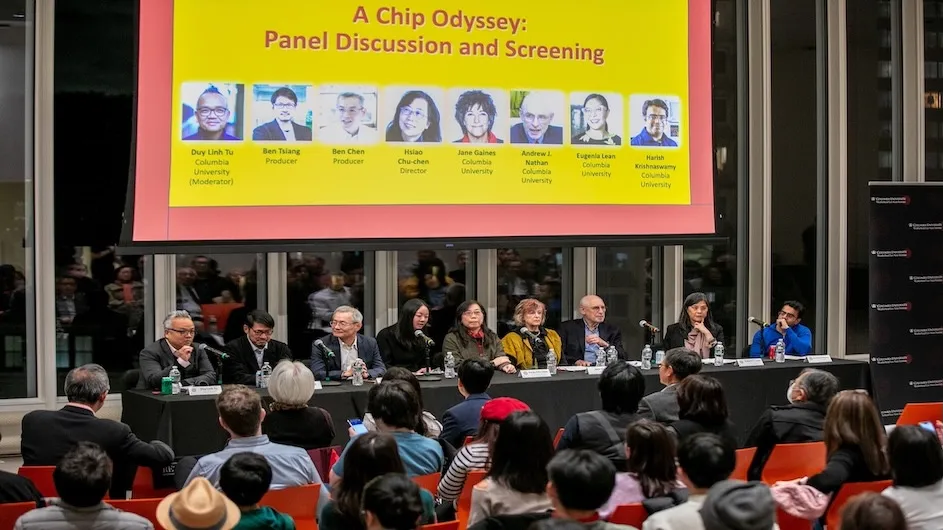
The intersection of geopolitics and cutting-edge technology made for a riveting recent night at Lenfest Center for the Arts, when the new Taiwanese documentary A Chip Odyssey played before a packed audience. Director Hsaio Chu-chen and producers Ben Chen and Ben Tsiang joined Columbia faculty for a lively panel discussion before the screening and an equally animated Q&A session afterward. The discussions demonstrated that the documentary resonated with viewers who were grateful for the story it brings to light.
The evening was a joint undertaking by three Columbia institutions—the Weatherhead East Asian Institute, the C.V. Starr East Asian Library, and the School of the Arts. The Columbia School of International and Public Affairs student group Taiwan Focus and the Taipei Economic and Cultural Office in New York City provided additional support.
Rooting for the Underdog
More than six years in the making, A Chip Odyssey is a lucid, absorbing account of the decades-long campaign behind Taiwan’s current dominance of the global market for semiconductors—the high-end computer chips that are indispensable to so much contemporary technology, from smartphones to the most sophisticated defense equipment.
That might sound like highly technical subject matter, but the filmmakers’ approach ensures that the movie should appeal to anyone who enjoys rooting for an underdog. As Hsaio said before the screening, “don’t worry if you don’t understand technology or semiconductors. This is a human story.”
A Chip Odyssey bears out that statement by focusing on the individuals who made Taiwan’s extraordinary success possible. The film foregrounds in particular the young engineers who were dispatched in 1976 to a plant run by the RCA Corporation in Ohio, where they immersed themselves in the most minute details of integrated circuit manufacturing so that they could later bring everything they’d learned back to their native country. A meeting with Taiwan’s Minister of Economic Affairs, Sun Yun-suan, before the team left for the U.S. made clear what was at stake: “Failure,” he told them, “is not an option.”
The documentary shows why a government official would cast the engineers’ mission in such stark terms. Taiwan was seized by a kind of existential anxiety in the 1970s after America restored ties with the People’s Republic of China under President Richard Nixon's administration. Increasingly friendless in the world and unseated from the United Nations, Taiwan, by 1979, was no longer even formally recognized by the U.S., its erstwhile patron. In response, Taiwanese senior officials bet big on advanced manufacturing as a means of not only raising the country’s living standards, but also securing a critical position in global supply chains—and thereby improving its prospects for survival.
That the government’s bet paid off is demonstrated by the fact that in the 21st century, Taiwan’s semiconductor industry, led by the Taiwan Semiconductor Manufacturing Company, became known as the Silicon Shield—a presumed safeguard against encroachment by its larger neighbor. In the words of one speaker in the film, the country’s technological prowess gave it “a seat at the Global North’s table.”
Nearly 30 Scripts and More Than 80 Interviews
A wide-ranging slate of Columbia faculty joined Hsaio, Tsiang, and Chen for the panel discussion before the screening: Eugenia Lean, vice provost for faculty affairs and professor of Chinese history; Andrew Nathan, Class of 1919 Professor of Political Science; Jane Gaines, professor of film at the School of the Arts; and Harish Krishnaswamy, professor of electrical engineering. Duy Linh Tu, dean of academic affairs and professor at Columbia Journalism School, moderated the panel.
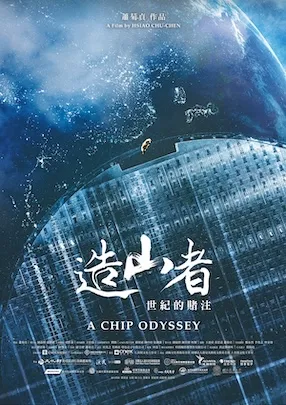
Tsiang explained that A Chip Odyssey took nearly 30 scripts and interviews with more than 80 people to complete. He emphasized that the film was never a commissioned project, and that the team declined funding from any source that might have expected them to adopt a partisan slant.
During the post-screening Q&A, several audience members mentioned how moved they were by the spirit of common purpose and shared sacrifice evident in the film. Thanking them, Hsaio said that part of her intent was to reveal “what human beings can do when their country, when their home, is in trouble. I think that’s something everyone can relate to.”
A Chip Odyssey ends on a note of foreboding as the People's Republic of China's rhetoric about Taiwan becomes increasingly assertive, America’s security guarantees are called into question, and the environmental costs associated with ever-accelerating demands for chip technology start to cast a pall on what has until recently been a virtually unqualified success story.
No one speaking at the event claimed to have the answers to these and other questions the film raises, but Tsiang said that he thought the ethos of constant innovation instilled at companies like the Taiwan Semiconductor Manufacturing Company might yield some breakthroughs in energy efficiency, perhaps sooner rather than later. Regarding other issues, he suggested that “there have got to be some paradigm shifts,” but that currently, no one knows what the new paradigm will look like. “Right now, it’s not in the textbook.”
One of the most hopeful notes of the evening, meanwhile, arrived earlier in the Q&A. Referring to Hsaio’s creative team, co-presenter Dr. Shen Yi-Ying told listeners: “The studio is very small, but we have many more stories to tell. We hope to keep telling these Taiwan stories, and share them with you in the future.”
The Weatherhead East Asian Institute (WEAI) would like to thank Vickie Wang for her interpreting at both of the evening’s public conversations.
Jeff Tompkins is the communications coordinator at WEAI.