New Book Explores Links Between Disasters and Development
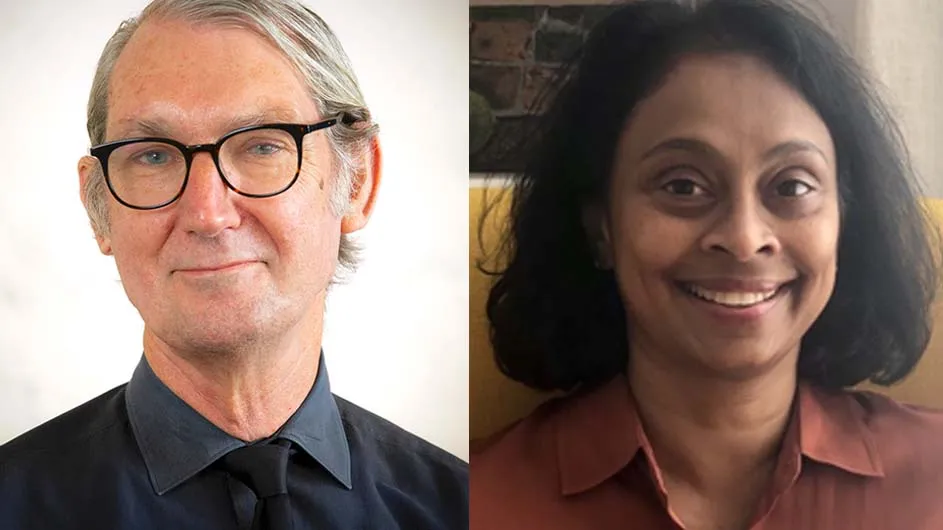
Co-authors John Mutter and Sonali Deraniyagala explain why an interdisciplinary approach is necessary to understand these connections.
Disasters arise from the convergence of natural and social forces. Earthquakes, cyclones, floods, droughts, and other catastrophic events disproportionately affect the most vulnerable people, whether the poor in wealthy countries or the inhabitants of less developed countries. In a warming world, climate-related disasters threaten to become even more hazardous.
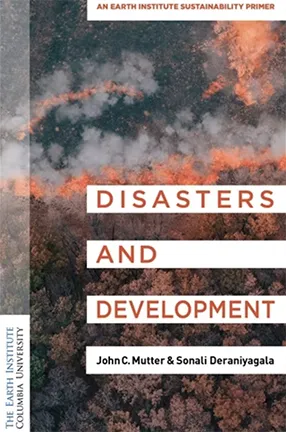
Disasters and Development by John Mutter, professor of earth and environmental sciences and of international and public affairs, and Sonali Deraniyagala, adjunct associate professor of international and public affairs, provides readers with a fundamental understanding of disasters and their consequences. Mutter and Deraniyagala—a natural scientist and an economist—share their expertise in straightforward language, showing why an interdisciplinary approach is necessary to understand the causes and effects of these multifaceted events. They first explain the natural science of why and how disasters occur, and then investigate their significance for economic development across communities and countries, focusing on growth, inequality, and reconstruction.
Why did you write this book?
Sonali Deraniyagala: The book emerged out of the course Disasters and Development, which we teach jointly at Columbia’s School of International and Public Affairs. The course is unique in that it combines the physical sciences and the social sciences in equal measure. We found that there is no one source that could be used as the basis for the course, so we wrote this book to fill that gap. But the book’s reach goes wider than our students: It is written very simply, and is accessible to any reader who wants to understand the causes and effects of destructive natural hazards that turn into disasters.
John Mutter: The book came about from our teaching the course, which is offered to undergraduates and masters students. Although there is literature on the subject, nothing is written in a way that supports teaching. As Sonali said, the writing is direct and accessible to a general audience.
Why is an interdisciplinary approach necessary to understanding the causes and effects of natural disasters?
SD: The term “natural disaster” is commonly used to describe destructive events that arise from naturally occurring phenomena—geological, climatological, meteorological, hydrological. But the word “natural” is misleading. These hazards become catastrophic disasters only when countries and communities are exposed to, and vulnerable to, them. This exposure is the result of economics, politics, and history—all of which combines to put people in harm’s way. So it is important that we understand both the physical science that explains these hazards, and the political economy contexts that turn them into disasters.
JM: We need to distinguish hazard from disaster. The former is an expression of natural processes in the earth, while the latter refers to the consequences of a natural extreme event—earthquake, cyclone, wildfire, flood, etc. Hazards and extreme events can be examined from the perspective of the natural sciences. The consequences for economic welfare depend on the state of development, governance, the make-up of an economy, and a variety of other social factors. These require study from the economic and political sciences. To obtain a comprehensive appreciation of the intersection between disaster events and development prospects requires both natural and social sciences.
What is your forecast for the future of such disasters?
SD: Human-caused warming may well increase the intensity of natural hazards such as tropical cyclones (hurricanes), and also extreme heat events. Recently, we have seen rare and ferocious cyclones in South Asia and Southeast Asia, which killed over one thousand people each in Sri Lanka and Indonesia. Cyclones so near to the equator are unusual—and could be a new phenomenon in a warming world.
JM: We need to separate hazard and disaster here as well. Some hazards, such as earthquakes, are not expected to increase. Cyclone strength and frequency may well increase, as will heat extremes. As populations increase globally, it is very likely that they will increase in hazardous areas, leading to more common disasters. Nevertheless, we are seeing a drop in the number of fatalities per disaster as societies become more robust.
What are you teaching in the spring?
SD: I will teach the Disasters and Development course again next fall.
JM: Possibly Disasters and Development, and a course on climate change and human rights.
What are you working on now?
SD: I am working on a project on economic rights as human rights.
JM: A book with the tentative title The Unbearable Choices of Climate Change. And a memoir about growing up in post-World War II Australia.