‘Inside the Situation Room’ Bridges the Gap Between Politics and Academia
Columbia SIPA Dean Keren Yarhi-Milo and Secretary Hillary Clinton co-edited a book that brings readers into the room where leaders make decisions in times of crisis.
For decades, people have sought to understand how and why decisions are made at critical times, but very few get the opportunity to witness leaders’ decision-making process. The result has been a persistent disconnect between the theory and the practice of decision-making.
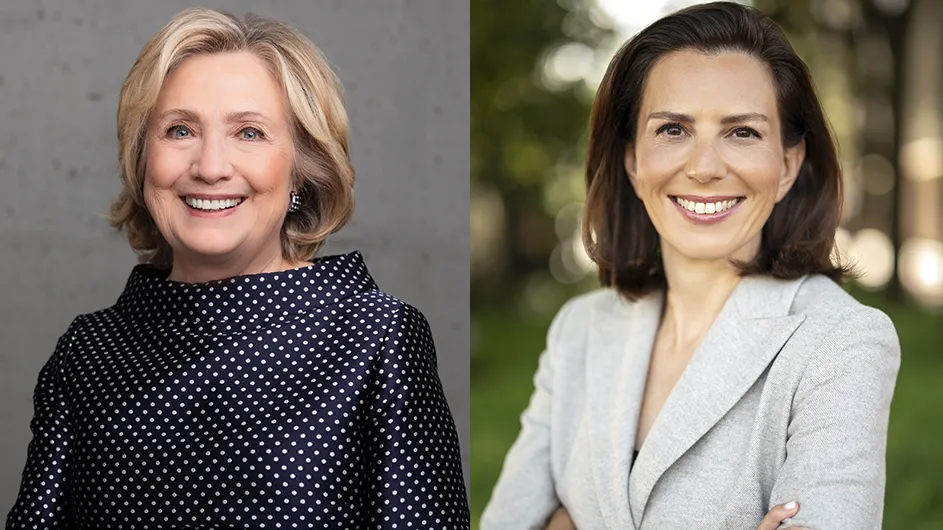
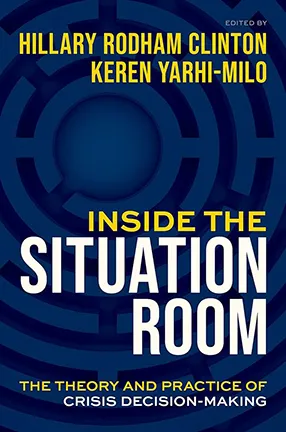
Hillary Clinton, former U.S. Secretary of State, joined forces with Keren Yarhi-Milo, Dean of Columbia’s School of International and Public Affairs, to bridge that gap—first, in their ground-breaking class at Columbia, and now in a book that came out this past fall. In Inside the Situation Room, Clinton and Yarhi-Milo bring together insights from more than a dozen leading policymakers and scholars so readers can experience a masterclass in global policy and crisis decision-making. The book includes everything from the psychology and mechanics of threat assessment; the role of advisers; the effects of group think and trust; real-life stories of diplomatic efforts and covert operations; how women have shaped decisions over peace and security; and the impact of public opinion.
The book offers an insider look at how decisions are actually made, what theoretical insights might be useful to current and future generations of leaders, and where research still needs to be done. Inside the Situation Room will serve as the first step toward a new standard engagement: more active, iterative collaboration among two communities—scholars and practitioners—who have a great deal to contribute and learn from one another.
Dean Yarhi-Milo discusses the book with Columbia News and the experience of co-teaching and co-editing with Secretary Clinton.
What was the impetus behind this book?
Well, it grew out of the popular Columbia SIPA course I’ve had the privilege to co-teach with Secretary Clinton each fall since 2023, which takes students inside real moments of American foreign-policy crisis decision-making. What struck us early on was the persistent disconnect between how scholars theorize decision-making, and how policymakers actually experience it—under pressure, with incomplete information, and enormous stakes. With Inside the Situation Room, we wanted to bridge that gap by putting cutting-edge scholarship in direct conversation with the lived experiences of senior practitioners from across the political spectrum, like Leon Panetta, Catherine Ashton, and Robert O’Brien, who have sat at the highest decision-making tables.
Can you give some examples from the book of key decisions made in times of crisis that bridge theory and practice?
Throughout the book, we examine cases where leaders faced profound uncertainty, from the hunt for Osama bin Laden, to the high-stakes negotiations over Iran’s nuclear program, to the decision to release sensitive intelligence ahead of Russia’s invasion of Ukraine. One clear pattern is how leaders interpret the same intelligence and threat environment differently depending on their psychology, prior beliefs, biases, and emotional state. Traditional theories often assume leaders make rational calculations, but the cases show how fear, loss aversion, or overconfidence can decisively shape outcomes, sometimes with catastrophic consequences.
In our course and in our book, we explore how human psychology so often trips up leaders and causes miscalculations and mistakes. This is something that was ingrained in me by my mentor, the late Columbia SIPA Professor Robert Jervis, whose post-mortems were instrumental in making intelligence officials and policymakers aware of their blind spots.
What are the most important qualities a political leader needs when making crucial decisions in a crisis?
Humility and self-awareness are essential. Leaders need to recognize their own cognitive biases, surround themselves with advisers who challenge them rather than flatter them, and remain open to revising assumptions as new information emerges. Leaders are almost always making decisions with imperfect or even poor information. What defines crisis leadership is how those in charge manage uncertainty and their ability to sift through all the noise. Effective leadership also requires an ability to communicate these decisions to the public. There’s a great chapter in the book on the role of public opinion and the important lesson that the public is always inside the Situation Room—not physically, of course, but metaphorically.
What do women bring to the table in these situations?
The research is clear that who gets a seat at the table matters, and inclusive decision-making processes tend to produce more legitimate outcomes. We see evidence of that in the durability of peace deals after wars, whether in Northern Ireland or Colombia or Liberia. Women bring exactly what effective crisis decision-making requires—a willingness to question group-think, and a greater sensitivity to second- and third-order consequences, among other useful qualities.
What has it been like co-teaching and co-editing with Secretary Clinton?
Immensely rewarding. As a scholar, I’m used to studying decisions with hindsight and archival distance. Working closely with Hillary constantly reminds me that policymakers don’t have that luxury. They must act in real time, under stress, and with human lives on the line. That perspective has deepened my respect for the human element of decision-making, and added an important sense of humility to my own scholarship on decision-making.
Is there anything that you would like to add?
At its core, this book is a call for better collaboration between scholars and practitioners, something sorely lacking in higher education. At a moment of extraordinary global instability, we simply can’t afford ivory-tower theorizing disconnected from practice, or for that matter, policymaking divorced from evidence. The future of effective statecraft depends on bridging those worlds and training the next generation to understand and appreciate both.
But this book is also written for students. Columbia graduates will be tomorrow’s diplomats, public servants, journalists, military officers, and civic leaders. They will inevitably face crises in a world that is more polarized, more unstable, and more information-saturated than ever before. Inside the Situation Room is meant to give them tools to navigate those moments with confidence. The book emphasizes that effective leadership is about understanding human behavior. Especially in polarizing times, we hope this book helps future leaders learn how to listen, deliberate, and make consequential decisions without losing sight of the human stakes involved.