How Do You See What Cannot Be Seen?
With the help of AI, Alexey Yurenev, an adjunct professor at Columbia’s School of the Arts, attempts to do just that in his new book.
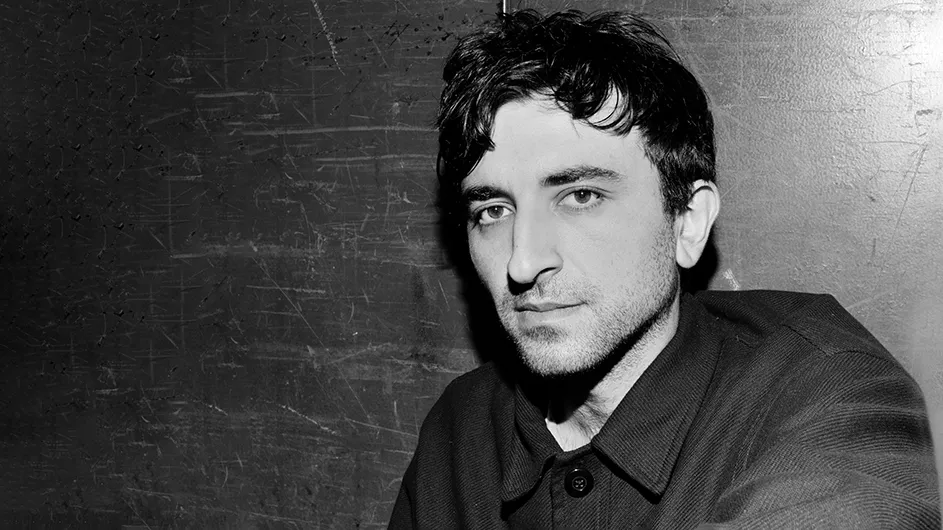
Seeing Against Seeing is an artist’s book by Alexey Yurenev, an adjunct professor in the Visual Arts Program at School of the Arts. The book is one of several outcomes of Silent Hero, a visual research project and historical investigation into Yurenev’s grandfather’s unspoken experience during World War II. Rooted in the documentary tradition, Yurenev’s work confronts the challenge of visualizing what cannot be seen—absences in family and state archives, repressed memories, and events without witnesses. If photojournalism shows what could not be observed firsthand, one of generative AI’s more provocative capacities is to imagine what never happened, but could have. Yurenev draws this speculative potential of artificial intelligence into collaboration with Seeing Against Seeing.
At the heart of the book is a dialogue with German author Ernst Friedrich’s 1924 anti-war manifesto War Against War!, which used graphic photographs to dismantle war’s heroic image. Yurenev responds by employing a bespoke AI generative model trained on portraits and landscapes from the World War II era. The resulting synthetic images resemble Friedrich’s photographs, echoing their visual grammar, yet they do not merely imitate historical evidence. Instead, they peel away the surface of photographic realism, exposing what lies beneath it—the flesh under the skin of the image.
Why did you create this book?
I created Seeing Against Seeing because I inherited something I could not see. The book is one of many outcomes of Silent Hero, a long-term visual research project that began with my grandfather, Grigoriy Lipkin, who fought from Moscow to Berlin during World War II, and never spoke about what he experienced. While remaining silent about the war, he used to tell me that, as his only grandson, I was in charge of carrying his medals and his memory. When he died in 2009, I received his medals, but I did not receive his memories.
In an effort to address the void left by his silence, I meticulously examined archives, both familial and state, seeking evidence of his experience. Family archives largely under-informed, depicting Grigoriy in a studio setting, as if his wartime experience had occurred within the confines of a photography atelier. Conversely, the state archives were excessively detailed, reinforcing a pervasive image of glory and heroism through iconic representation. My objective was to access an image beyond the camera’s reach—a site of repressed memory, the ineffable—that which resists articulation.
In 2019, I began researching generative AI, specifically, generative adversarial networks (GANs)—older models that don’t use prompts and require large datasets to learn from. Working with something as sensitive as my ancestor’s missing memories, I trained a model from scratch, using 35,000 photographs of World War II that I sourced from various public domain archives.
After weeks of training, the images the AI model produced, unlike the photographs used for training, appeared abstract and Rorschach-like. These images do not convince or persuade of a singular truth of a depicted event, but rather let the reader fill in the unimaginable. A model trained on images of soldiers similar to my grandfather, looking healthy, posing in a studio in quiet, graceful postures, generated monsters with disfigured faces. It was as if AI was able to peel away this layer of realism, and through glitch and imperfection, reveal the image that underlies the image, the memory concealed, showing the true face of war, which is grotesque. This is where the book began.
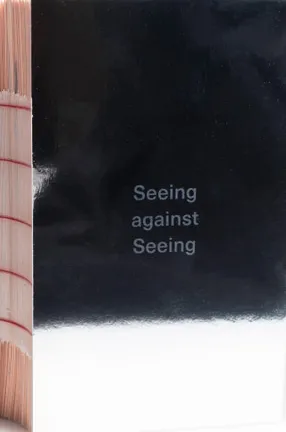
Ernst Friedrich argued for photography to be the ultimate form of evidence, which did not exist before, and that “can tear the mask off the field of honor and glory of the image of war.” The synthetic World War II images I generated eerily echo Friedrich’s visual grammar, yet they do not simply imitate historical evidence. This creates a dialectic of two technologies depicting war separated by a century. Seeing Against Seeing was developed in collaboration with designer Teun van der Heijden and the Anti-Kriegs (Anti-War) Museum in Berlin. At its core, the book is a dialogue with Friedrich’s 1924 War Against War!, a manifesto that used graphic photographs to dismantle the heroic image of conflict.
The book extends beyond the page. While working on Seeing Against Seeing, I showed the same AI-generated images to five Red Army centenarian veterans in Brighton Beach in Brooklyn, explaining the nature of these images being synthetic. These men encountered the images, and their reactions—identifying tank crews, wounded soldiers, battle formations—were immediate and emotional. Their words are recorded in the film No One is Forgotten, and interwoven into the book, printed in silver ink on translucent pages. Although AI is statistical, in this encounter, abstraction becomes psychological. The veterans read the images through lived memory, recalling and renegotiating their own accounts elicited by the synthetic images.
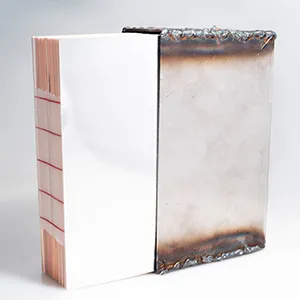
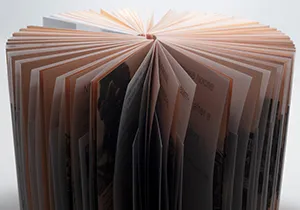
The book as an object carries tension. The book block is hand-bound like a brick; it combines a reproduction of a dissected 1980s pocket edition of War Against War!, synthetic images reproduced as polymer prints, and the veterans’ testimonies. The book is housed in a hand-welded iron case that rusts over time. The saw marks on the spine and the welding scars on the metal echo bodily wounds. When put on its spine, the book can be shaped as a circular drum, to speak about the cyclical cadence of histories. I created this book as a meditation on vision itself—how we see, what remains unseen, and how seeing might be turned against itself.
So the book is your answer to the challenge of photography?
I created Seeing Against Seeing out of a growing discomfort with how photography operates between over-informing and under-informing. On one hand, contemporary image culture overwhelms us with detail—iconicity, resolution, endless circulation—creating the impression that nothing escapes visibility. On the other hand, photography has always withheld as much as it reveals. Photography frames, isolates, aestheticizes. It persuades, and convinces us of a fixed truth, even when that truth is partial, constructed, or ideologically charged. The authority of the photographic image often rests on this tension: The image appears transparent while quietly shaping belief.
I wanted to interrupt that contract. Rather than producing another image that claims to clarify history, I was searching for an image that destabilizes certainty—an image that refuses to settle into evidence. The synthetic war photographs in the book operate as a kind of destructive fiction. They resemble documentary images closely enough to trigger recognition, yet they undermine the expectation that photography delivers stable truth. Instead of reinforcing realism, they corrode it from within. Instead of persuading the viewer of a fixed historical truth, they open a space to imagine and to feel. The encounter shifts from being convinced to being implicated. Seeing becomes less about confirmation and more about confrontation.
How do you negotiate being an artist and a teacher? Do the two overlap, or do you keep them separate?
For me, being an artist and a teacher are deeply connected, but not interchangeable. Both are forms of inquiry: In the studio, I test materials, structures, and ideas; in the classroom, I test language, frameworks, and ways of seeing. Teaching forces me to articulate positions that in my own practice might remain intuitive, and students often challenge assumptions in ways that sharpen my thinking.
What are you teaching this semester?
AI and Photography.
What are you working on now?
At the moment, I’m developing a series of exhibitions around Silent Hero, including installations of Seeing Against Seeing, where the book functions not only as a publication, but also as a sculptural and spatial object. In parallel, I’m continuing a long-term project on the visibility of labor, where I calculate the time it takes workers in different industries to earn one dollar, and use that duration as the length of a photographic exposure. The image becomes a direct index of economic time. I’m also mapping a project about language, interpretation, deceit, and obfuscation in human/machine interactions.
Which three artists/scholars, dead or alive, would you invite to a dinner party, and why?
Czech philosopher and writer Vilém Flusser, Danish artist and writer Mari Bastashevski, and German filmmaker Werner Herzog. I imagine the party spiraling quickly. Flusser would begin by calmly explaining that the dinner is not a dinner, but a program, and that we are merely executing the script of cutlery and appetite. He would diagram the salt shaker as an apparatus.
Herzog would then attribute a completely fabricated quote to Kant— something like, “As the Prussian sage once said, ‘The soup must stare back at you’”—and deliver it with such conviction that no one would dare question it. By the third course, Herzog would seamlessly transition to quoting Wittgenstein, who, he would claim, once mused, “The only true measure of a man’s character is the quality of the bread he chooses.”
Bastashevski would quietly smile, perhaps release a snail onto the table, and let us debate authorship while the creature advances at its own historically adequate pace. At some point, someone would bring up the Wikipedia rumor about her being Banksy, and Herzog would solemnly confirm it as “emotionally true.”