Columbia Makes the Case for Quantum on Capitol Hill
Universities will be critical to keeping America at the forefront of this rapidly advancing field, says research panel.
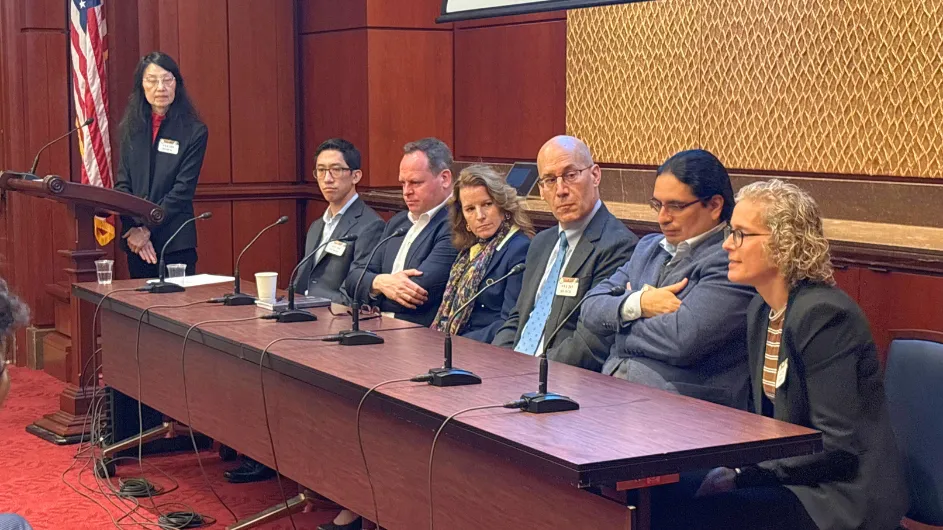
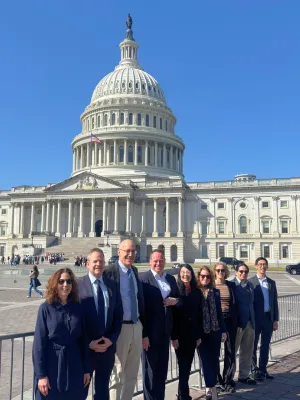
On March 10, a panel of researchers from Columbia University and Stony Brook University gave Congressional staffers a crash course in emerging quantum technologies—and the importance of federal support for the American universities driving the field forward.
“Today’s conversation is about quantum science and artificial intelligence. But more importantly, it’s about ensuring America’s capacity to lead in this next era of quantum and AI-driven innovation,” Jeannette Wing, executive vice president of research at Columbia, noted in her opening remarks. “AI is a technology already transforming every sector and our daily lives. Quantum information science is no longer a distant or abstract field. Both quantum and AI are rapidly becoming foundational technologies that will shape the global economy, our national security, and our scientific leadership.”
The discussion was hosted by Senator Kirsten Gillibrand’s office and convened as Congress begins consideration of the National Quantum Initiative (NQI) Reauthorization Bill, introduced in the Senate in January to build on the NQI’s work to advance basic research while establishing an ecosystem to develop practical quantum applications.
The panelists discussed two rapidly advancing technologies: quantum computers, which are poised to perform complex calculations beyond the capacities of even today’s supercomputers; and quantum networks, which, akin to the classical internet, will someday link those devices and others into a quantum internet.
Early versions of quantum computers and quantum networks both exist today, but research is still needed to bring them to their full potential. “There are impressive commercial demonstrations of quantum technologies, but they are nascent,” said Alexander Gaeta, David M. Rickey Professor of Applied Physics and Materials Science and professor of electrical engineering at Columbia. In many cases, “universities are still at the state of the art.”
Companies are building ever-bigger, more powerful quantum computing hardware that is beginning to perform meaningful calculations, noted Henry Yuen, Srivani Professor of Computer Science at Columbia, but there is still a long road ahead. Not only are more qubits—the quantum equivalent of classical computer bits—needed, but researchers are still grappling with finding ways to correct errors that accumulate in them.
Quantum networks are also expanding worldwide and already provide secure quantum key distribution. The longest in North America spans more than 170 miles across Long Island into New York City and connects research labs at Stony Brook, Columbia, and Yale universities, as well as Brookhaven National Lab. Called SCY-QNet, it, in principle, demonstrates a technology platform for connecting quantum computers.
Quantum information, encoded in light traveling along these networks, cannot be intercepted; the information is teleported from one node to another using a quantum phenomenon called entanglement—Einstein’s “spooky action at a distance.” “It’s secured by physics, not computational complexity,” said Eden Figueroa, professor of physics at Stony Brook and lead investigator of the National Science Foundation–funded SCY-Qnet project.
The technologies for creating and teleporting entangled photons are now mature and ready to scale, noted Sebastian Will, professor of physics at Columbia, but the necessary interfaces that enable those photons to interact with qubits in quantum computers are still under development. The United States has an opportunity to push that frontier and pioneer the technologies needed to link quantum devices in a quantum way, he stressed.
Light is also an important link between the quantum world and that of artificial intelligence. “There has been a tsunami of AI, with companies buying compute in gigawatts, not buildings or servers,” said Keren Bergman, Charles Batchelor Professor of Electrical Engineering at Columbia. “Energy is the unit of currency.” Shifting the field toward moving photons around chips, rather than electrons, could greatly reduce energy consumption in AI data centers while improving their performance. “The next phase of AI systems will build on the same systems as quantum,” she said. “Quantum will be an accelerator.”
Engineering chip-based photonic devices, qubit interfaces, and quantum error-corrected quantum devices will require substantial federal investment, the panelists stressed. As will developing the workforce needed as quantum technologies continue to move from research labs to commercial industries. “We need to be developing and recruiting talent across the entire academic continuum,” said Angela Kelly, professor of physics and STEM education at Stony Brook. That includes, she said, students at the K-12 level, which inspires initial interests in science; undergraduates at both 2- and 4-year universities to fill diverse entry points; and graduate students advancing research in rapidly moving fields.
Even as applications emerge, it remains hard to predict just how transformative they may be. Not unlike the internet, as it was forming with heavy federal research and infrastructure investment from the 1960s into the 1990s. “We're probably just scratching the surface in terms of what is possible,” said Yuen.