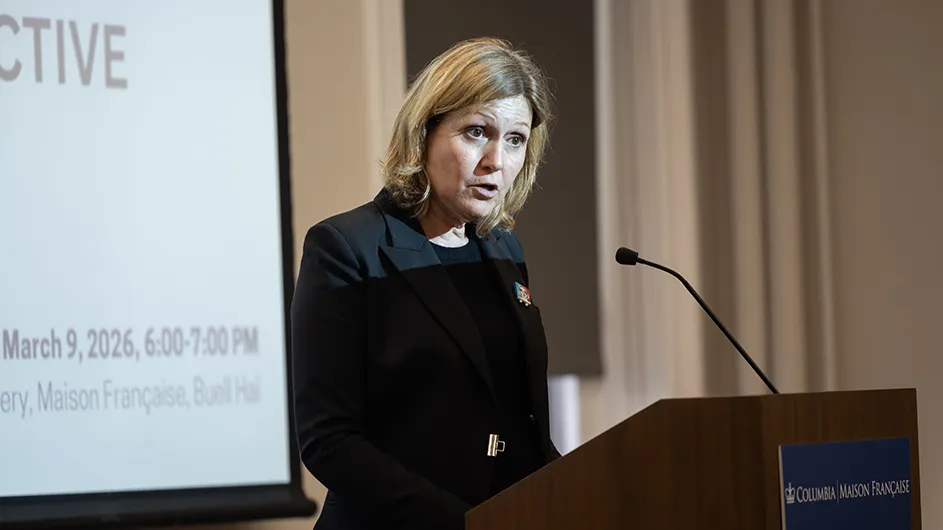
On an evening in March, the Maison Française welcomed Yaël Braun-Pivet, president of the French National Assembly and the first woman to hold that position. She was first elected to the National Assembly in 2022, and reelected in 2024. Braun-Pivet was invited to Columbia to give a talk titled “Effective Multilateralism: A Common Perspective.”
Braun-Pivet spoke about diplomacy, democracy, and the protection of international law to an audience comprised of students, staff, and faculty, as well as members of a prestigious delegation of diplomats, including Mohamed Bouabdallah, director of the Villa Albertine in New York, and Jerome Bonnafont, France’s ambassador to the United Nations. The talk, delivered in French, was translated live by an interpreter, which allowed for a diverse audience of French and English speakers to follow the discussion.
Sister Republics
Braun-Pivet’s speech at Maison Française was part of the Maison’s cultural programming this year, which includes several events marking 250 years of French-American friendship between the two “sister republics,” said Braun-Pivet. She emphasized this long-standing friendship and “sisterhood” between the two nations in her speech, using as an example George Washington and his ally, the Marquis de Lafayette.
In her talk, as well as in her exchanges with the audience, Braun-Pivet stressed the importance of “multilateralism that concerns all of us and is evolving. Nations must work together to address the challenges and conflicts that are rife in our times.” In this period of geopolitical unrest—and specifically speaking of the Iranian people’s struggle for freedom—Braun-Pivet spoke of her support for self-determination and France’s dedication to protecting civilians in the face of global conflict.
She acknowledged, however, that this effective multilateralism France and its allies have historically championed may need to change shape in the current context. “Even between old Western allies, cooperation is replaced by competition. Or even by commercial, technological, or ideological coercion,” Braun-Pivet said. She also highlighted the roadblocks to effective collaboration, given that multilateralism is an old concept that relies on the United Nations’ charter.
Advocating for Reform
As president of the National Assembly in France, Braun-Pivet thus advocated for a reform of the United Nations’ charter to broaden the U.N. Security Council to allow for better collaboration. While coalitions have formed over time through affinities, Braun-Pivet painted the picture of a United Nations that moves past current institutional blockages.
A running theme of Braun-Pivet’s talk was her commitment to championing women’s rights. She advocated for a feminist approach to multilateralism, spoke of the first-ever female assembly presidents’ summit that she hosted at the United Nations, and lamented the lack of a female U.N. Secretary General. She humorously yet candidly urged the women in the room—especially students—to think about roles in diplomacy and possibly even aim for this ambitious leadership role.
Emmanuelle Boucher is the 2025-2026 intern/cultural programming assistant at Columbia’s Maison Française.