The Science of Growing Up
Natalie Brito, a professor of psychology, researches how both the families we’re raised in and the societies we live in, shape us.
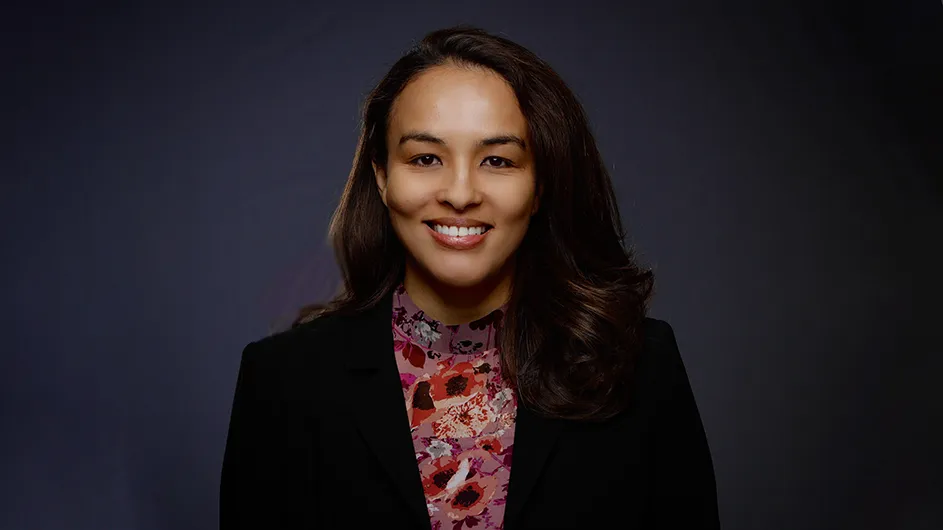
Natalie Brito first came to Columbia as a postdoctoral researcher in 2013. She spent four years at the medical center before joining New York University (NYU) as an assistant professor. Last summer, after almost eight years at NYU, Brito rejoined Columbia as an associate professor of psychology. Unlike her last stint at Columbia, which she spent uptown at the medical center, this time Brito is stationed on the Morningside campus, in the department of psychology. Brito spoke to Columbia News about what shaped her interest in her field—early childhood development—and what brought her back to Columbia.
How would you describe your research broadly?
I’m really interested in how infants grow and learn about the world around them. I focus a lot on caregivers and the baby’s home environment, but I also look at societal factors like family leave policies. Overall, I’m interested in understanding how social and cultural contexts influence early brain and behavior in the first three years of life.
Some things we’ve looked at in my lab include auditory input in the home, factors like multiple languages or patterning of noise, and how those affect infants. We also examine how babies and caregivers interact with each other. Some of our work has looked at caregiver well-being—particularly moms, and how a mom’s mental health might have an impact on the child’s physiology and development. On a more society-wide level, a couple of studies that I did a few years ago looked at the impact of paid family leave on infant and toddler development.
In addition to surveys and behavioral tasks, we use non-invasive tools like electroencephalography, or EEG, to measure early brain activity and see how these elements of the home environment may influence the developing brain.
What first got you interested in this line of research?
In undergrad at the University of Virginia, I was a research assistant in Judy DeLoache’s lab. She was a famous psychologist and expert in early cognitive development. From her lab I learned the importance of observation and using creative methods to “get inside a child’s mind.”
After college, I worked at a private tutoring company as an assistant director of education. This was during the No Child Left Behind era of former President George W. Bush. As tutors, we were tasked with going into what were termed “failing schools” to provide after-school tutoring to students. I would meet all these students who were bright, motivated, and curious. They shared stories about violence in their neighborhoods or how they hadn’t had breakfast that morning, or sometimes even dinner the night before. It was clear that just a couple of hours of tutoring wasn’t going to help them fully catch up in school.
These experiences got me really interested in adaptation, the idea that kids’ behaviors may make more sense when you look at the environments they’re growing up in. So instead of seeing certain behaviors as “bad,” I think about how they might actually be strategic responses to stress or unpredictability. For example, a child who seems easily distracted in the classroom might be highly tuned in to what’s happening around them because that awareness has been useful at home. That perspective really shapes my work, pushing me to understand development in context.
Prior to my postdoc at the medical center, I attended Georgetown University for my PhD, getting a concentration in Human Development and Public Policy. That got me motivated to understand how experiences shape brain development and what kind of structural factors or policies can really ensure that children thrive.
Do you mostly look at kids from underserved backgrounds?
A lot of the most seminal theories of developmental psychology are based on studies conducted with children from middle to upper income families. And it’s skewed because the studies are done in cities or towns where there’s a large university or hospital system nearby. My lab really tried to expand the kinds of families who participate, across lines of income, race, ethnicity, and geography. We have one study that’s fully remote and that participants can complete on their smartphone, tablet, or laptop, which helps us reach people who might not otherwise be able to participate. I’m really excited about the data we’re gathering on rural families in particular.
What are you teaching this semester?
I teach Science of Psychology, which is an introductory psychology course for undergraduates. I love teaching it. I like interacting with non-psychology students and being the first person that gets to introduce students to what psychology is, because I think most of them come in thinking it's psychiatry, or counseling. It’s cool to be able to expand their worldview and show them what psychology research looks like.
I’m also teaching an upper-level undergraduate seminar class called Cognitive Development in Context. That’s a course where we look at different cognitive processes, but really try to think about how environmental contexts, social policies and norms—those macro level factors that I am very interested in—play a role in how early cognitive processes come about. The students are awesome. They're really, really engaged with the material.
What brought you back to Columbia?
I had been thinking about ways my research could expand, and I was really excited about the faculty in the department. Nim Tottenham and Dima Amso, both professors in the psychology department, also work on child development in slightly different ways from me, and it’s great to have them as resources for myself and my students. We’ve talked about the idea of possibility tag-teaming our research at some point in the future: Studying a cohort of kids, and each of us looking at them at a slightly different stage of development and across different domains. My other colleagues in the psych department have been wonderful. There’s a lot of opportunity here at Columbia, and I’m excited to see where it takes me next.
Do you have any hobbies outside of work?
I don’t know if you’d really call it a hobby, but I’m the board chair of a nonprofit called Social Creatures that focuses on improving social connection and reducing loneliness through innovation, education, and advocacy. One of our key programs is “Bonded by Baby,” which is a postpartum group counseling program. We bring together new parents—often low-income parents who live near each other and have babies around the same age. They meet regularly with a social worker to share experiences, get support, and build community.
The program has been wildly successful in part because of that intentional structure, and also because we’ve worked with hospital systems to make it reimbursable through insurance. That makes the program sustainable, which is a major challenge for many nonprofit initiatives.
I also have two kids, who are eight and four years old, so most of my hobby time goes to playing with them.
Any favorite places to eat in the neighborhood?
Not yet! I feel like when I’ve gone out, I’ve stuck to some of my favorite spots downtown. I still need to get out more to explore.