The Ancient Sardinian City of Tharros Is Revealed
A new book, co-edited by Barbara Faedda, focuses on this strategic Mediterranean port city.

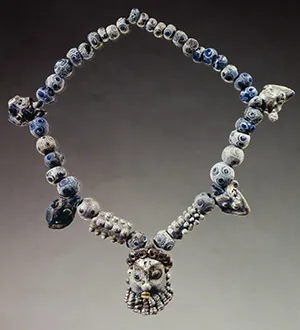
For nearly a thousand years, the city of Tharros in western Sardinia was central to trade routes and cultural exchange, a hub connecting North Africa, the Balearic Islands, and the Eastern Mediterranean. This strategic port’s earliest ruins, dating from the seventh century BCE, were likely constructed by Punic settlers from North Africa. The Carthaginians built temples and tombs; the Romans, who arrived in the third century BCE, erected their own infrastructure, such as public baths and aqueducts. Tharros was eventually abandoned around 1000 CE. The site was plundered over the centuries, and treasures from its tombs were widely trafficked.
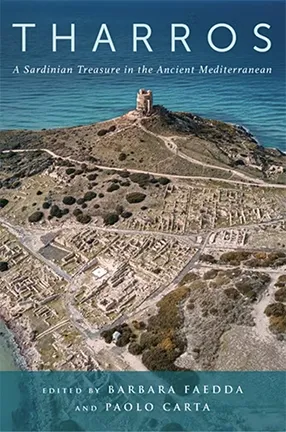
Tharros: A Sardinian Treasure in the Ancient Mediterranean, co-edited by Barbara Faedda, executive director of the Italian Academy and adjunct professor in the Italian Department, and Paolo Carta, a professor at the University of Trento, is the first English-language book to explore this rich archaeological site. Scholars of Sardinian and Mediterranean archaeology examine the history of excavations and the many significant discoveries that have been made at the site. Essays consider the religious beliefs, burial practices, material culture, and daily life of the inhabitants of ancient Tharros. Also showcased are the city’s architecture and artifacts—buildings and roads from the Bronze Age, the Punic era, ancient Roman times, and Christian centuries, along with treasured and everyday objects.
Faedda discusses the book with Columbia News, as well as what’s happening at the Italian Academy this fall, her research projects, and the classes she’s teaching.
What was the impetus behind this book?
This book is part of the Italian Academy’s Sardinia Cultural Heritage Project, a multiyear program dedicated to examining the island’s exceptional legacy—a unique Mediterranean location distinguished by its rich historical traditions and natural environment. The project illuminates little-known aspects of Sardinia, and spreads awareness of the important role it played in Mediterranean history.
In 2023, Paolo Carta and I published our first book about Sardinia with Columbia University Press. It’s about the Mont’e Prama Giants—colossal, 3,000-year-old limestone statues painstakingly reconstructed from thousands of shattered fragments discovered in western Sardinia in 1974. These remarkable sculptures are seen as one of the most significant archaeological discoveries of recent decades—and I was proud to facilitate the loan of one of them to the Metropolitan Museum of Art in New York.
This second book tells the story of Tharros, another Sardinian site of historical and cultural significance. Séan Hemingway, the John A. and Carole O. Moran Curator in Charge of Greek and Roman Art at the Metropolitan Museum, describes Tharros as “a breathtaking archaeological site with an amazing history.”
Are there other connections between Tharros and Mont’e Prama?
It is worth emphasizing that, like Mont’e Prama, Tharros demonstrates how islands shaped the ancient Mediterranean world, revealing the beliefs, values, and practices of communities during periods of cultural encounters and social transformation. Sardinia offers endless opportunities for discovery: Its cultural, artistic, and archaeological heritage is vast and, for the most part, little known to the American public.
The good news is that, given the Sardinia Cultural Heritage Project’s success, the Region of Sardinia is considering an extension of the program. In that case, we will have a new funding stream, and will continue to offer new initiatives, the first and foremost one on the necropolis sites called Domus de Janas (“houses of the fairies”), which were added to the UNESCO World Heritage List in July 2025. Created during the Neolithic and Copper Ages, these rock carvings illustrate fresh insights about the rituals and society of ancient Sardinian peoples.
Will the Italian Academy host an exhibition of the Tharros findings?
In 2023-24, we had a long-running show in our gallery lobby; the opening day coincided with our international conference, The Ancient City of Tharros: Rich Tombs and Extensive Ruins From Punic and Roman Times. The exhibition proved so popular that we developed a digital version.
What else is going on at the Italian Academy now?
With the arrival of our new director, Elena Aprile, the Centennial Professor of Physics, the academy is pleased to announce an exciting development: For the first time, we will open our Fellows’ Seminars to the broader Columbia community. These seminars will join our regular program of events, which this year includes several compelling offerings.
There was recently a conversation, On Rome and Writing, between Jhumpa Lahiri, Millicent C. McIntosh Professor of English and director of Creative Writing, Barnard College, and Alessandro Giammei, assistant professor of Italian Studies at Yale University.
November featured a symposium, Universal Rights in Practice: International Frameworks and Domestic Legal Systems, part of the academy’s ongoing Rule of Law initiative, as well as a lecture by Massimo Osanna, director general of museums at Italy's Ministry of Culture.
Additional fall programming includes an initiative celebrating the 50th anniversary of Primo Levi's short story collection, The Periodic Table, as well as an event featuring Teodolinda Barolini, a professor of Italian, and me on Lorenzo Da Ponte and Dante, connected to the World Week of Italian Language.
What are you working on now?
I’ve embarked on several new projects. One is a book exploring the cultural and academic exchanges between the United States and Italy, with Columbia as a focus. My goal is to complete this work in time for the Italian Academy’s centenary celebration in 2027, creating a volume that will complement the book I wrote in 2017 about the history of Italian studies at Columbia.
I am also working with Paolo Carta on the third volume of essays in our series on Sardinian and Mediterranean archaeology. This book will focus on the UNESCO site at Barumini and Nuragic culture; it will grow out of our 2024 initiatives on the discoveries at that site.
Next year will mark the 10th anniversary of the academy’s International Observatory for Cultural Heritage, and we are developing a program of conferences and exhibitions to celebrate this milestone. Italy’s internationally recognized leadership in cultural heritage preservation provides the foundation for our planning. In spring 2026, we will feature three major events—one on the recovery efforts following the devastating 2009 earthquake of L'Aquila, in central Italy; another on the evolving landscape of fashion as cultural heritage; and the final one on the Domus de Janas necropolis sites that I mentioned earlier.
What are you teaching this semester and in the spring?
This fall, I am teaching Italian Food in a Globalized World, which interrogates the multifaceted cultural meanings of food in Italian society, analyzing the mechanisms through which values and traditions are transmitted, preserved, and reconceptualized within the framework known as Made in Italy. Using an anthropological, interdisciplinary approach, students examine how Italian food culture mediates tensions between tradition and innovation, locality and globalization, and authenticity and commercialization within broader European and global contexts, and with particular attention to New York.
In the spring, I am considering teaching Introduction to Fashion Studies, which follows a similar structure to the food seminar, exploring the cultural dimensions of clothing and appearance in relation to the Made in Italy label.