The Anthropology Department at Columbia Has a New Chair
Rosalind Morris wants to build on the department’s impressive history by preparing its students for the future.
Columbia University’s Department of Anthropology, established by Franz Boas in 1902, is the oldest in the United States, and remains a center of disciplinary innovation and theoretical leadership. The department’s faculty members are actively engaged in research and writing about issues of both pressing contemporary relevance and historical significance. Columbia’s anthropology scholars work in regions and language traditions around the globe and in the U.S., as do its students.
The department operates doctoral degree programs in both sociocultural anthropology and archaeology, and hosts two distinct MA programs, one in sociocultural anthropology and the other in museum anthropology. In addition, the department offers rigorous undergraduate training toward both the major and the concentration, and welcomes students from other disciplines into its classes.
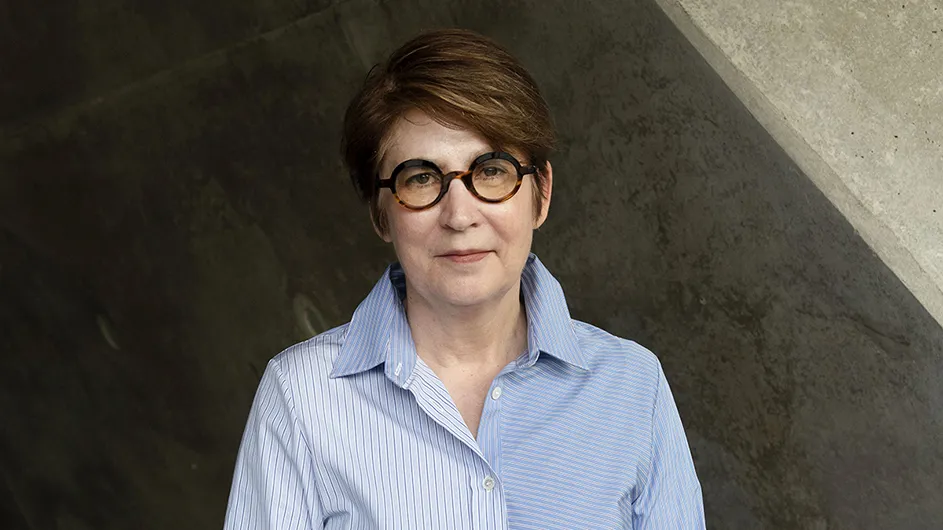
Rosalind Morris, the new chair of Anthropology, shares her plans for the department with Columbia News.
What are your plans for the department?
I hope to build on our extraordinary history; we were the first anthropology department in the United States, and we’ve been crucially involved in the reimagination of the discipline at several critical moments—often in response to major geopolitical and technological shifts in the world. We’re facing comparable pressures today—as the idea of intelligence, of the human, and our relation to the earth are being remade. These are fundamentally anthropological questions, so I hope to help the department demonstrate what it can offer now by way of critical analysis and creative response. We’re welcoming a new colleague to campus this fall, Professor Radhika Govindrajan; I hope we’ll be able to welcome others during my tenure.
While chair, will you continue to teach? If so, what are you teaching this semester, and in the spring?
Yes, indeed. Teaching is extremely important to me and part of my own learning how to think, anew. I am teaching a course called Reading, Writing, Ethnography this fall. It’s an exploration of the forms and genres of the discipline. Next semester, I’ll teach one of our core undergraduate courses—the Ethnographic Imagination, and a new seminar, Unsettlement, which is related to my research project of the same name.
What sort of programming is planned for the department this year?
We have a marvelous seminar series, the Franz Boas Lectures, on a nearly weekly basis. The lectures bring scholars at the cutting edge of the discipline to speak about their research. We’ll also be hosting book talks, and we will have a series of occasional lectures concerned with the critical anthropology of AI. These are open to the public, and are announced on our departmental website.
We also actively cosponsor events with other Columbia departments and institutions. For example, we will be cosponsoring a theatrical event (part music, part science, part visual art, part care and outreach), UnRavelled, on October 23 and 24, at 7:30 pm, at Miller Theatre. The production explores the parallel lives of scientist-turned-painter Anne Adams and composer Maurice Ravel, both affected by frontotemporal dementia. Many of our colleagues are engaged in different media—publishing, visual art, performance, film, and theater—and this is a work that similarly crosses boundaries.
This time, we’re partnering with the Department of Psychology, Mortimer B. Zuckerman Mind Brain Behavior Institute, School of the Arts, Program in Medical Humanities at the Institute for Comparative Literature and Society, the Doctoral Program in Theatre and Performance, the Doctoral Program in Neurobiology and Behavior, as well as the Division of Narrative Medicine, Department of Medical Humanities and Ethics.
Why is the study of anthropology so important?
You know, The Wall Street Journal published an article recently arguing that, if people want to "succeed in an AI world," they should study anthropology. I certainly believe that anthropology is more important than ever today. Its mode of learning and thinking on the basis of embodied experience—in conversation with others and in historically particular circumstances—is necessary if we are to avoid the temptation to believe that everything is, or should be, the same, and that it should resemble us. This empirically grounded way of thinking about other ways of being can be a wonderfully creative resource. If things have been and are different elsewhere, they can be different here—in both positive and negative ways.
These days, our colleagues are engaged with the most crucial issues of our time: From climate change and toxic environments to the organization of political power, from migration to the place of mass media in social movements, from the legacies of colonialism to the different trajectories that feminism has taken in the world. We anthropologists take the world as it is, and ask how it came to be so, learning to learn with others.
What was your path to a career as an educator and a writer?
I’m not sure that I can coherently narrate that path; it was circuitous. I’ve always written, and I was lucky in my life to have been the beneficiary of great teachers—formally and informally. Perhaps that is the most important fact of my biography. I certainly did not grow up in an academic milieu, and being a scholar-writer-teacher was not something I aspired to early in life. But I am happy if I have been able to join the relay by which one generation, teaching by example, can help another learn and think critically, but also generously.
What are you working on now?
I have just commenced a new research initiative, hosted at Incite at Columbia, called the Unsettlement Project, which aims to engage the major anthropologically transformative forces of our time: AI (as an epistemic event and as part of an extractivist economy), climate change, and mass migration (as geopolitical events also linked to extractivist economies). I work mainly in Africa, but this project is more global in ambition. I’m interested not only in the convergence of these forces, but in the ways in which they become visible and available for engagement via various cultural practices and arts of the imagination. That will be central to the publication platform, which will be part of the project.
Advice for anyone interested in pursuing a trajectory similar to yours?
A trajectory such as mine is not necessarily what I would advise anyone to pursue. The world has changed radically since I was a young person (traveling before cell phones, starting a professional academic life before the widespread use of email, coming of age when sex and gender were thought of in very different ways, and so forth). I did not grow up in the United States, and the country to which I arrived many decades ago is not the one we live in now. Many forces are arraigned against the university and against critical thinking today. It has always been necessary to struggle against these tendencies, but the pressure is even greater now. I can only suggest that students think of their education as something more than the route to a job. It is a way of preparing for life.
What’s special about teaching at Columbia and in New York?
The students, of course. And a city that is home to people from everywhere in the world. Last semester, I taught a terrific graduate seminar that made me especially conscious of what I love about Columbia and teaching in New York. There were students from many places—Malaysia and India, Ireland and China, Latin America, and the U.S., of course. There were also students from partner universities in New York, and visitors from elsewhere. There is something truly exceptional about the classroom at Columbia, which the great wealth of a private university can enable (and which we can share with others)—the coming together of people of different means, with radically different experiences and perspectives, to learn to think together. These seminars are spaces of rehearsal for life lived together.
Anything you want to add?
I think it has to be said that a research university isn’t only about teaching, as important as that is—to me and to our collective mission. It has to be oriented by research—in whatever form that takes. One of my aspirations as chair is to help us recover, strengthen, and defend this central pillar of our mission against the forces that would inhibit it, both political and economic. Think of that as service to our institution, to our colleagues, and to our students.