A Book About the Complexities of Care and Caregivers
In Love, Money, Duty, Rachel Adams explores care as a form of work, a feeling, an ethic, and an art.
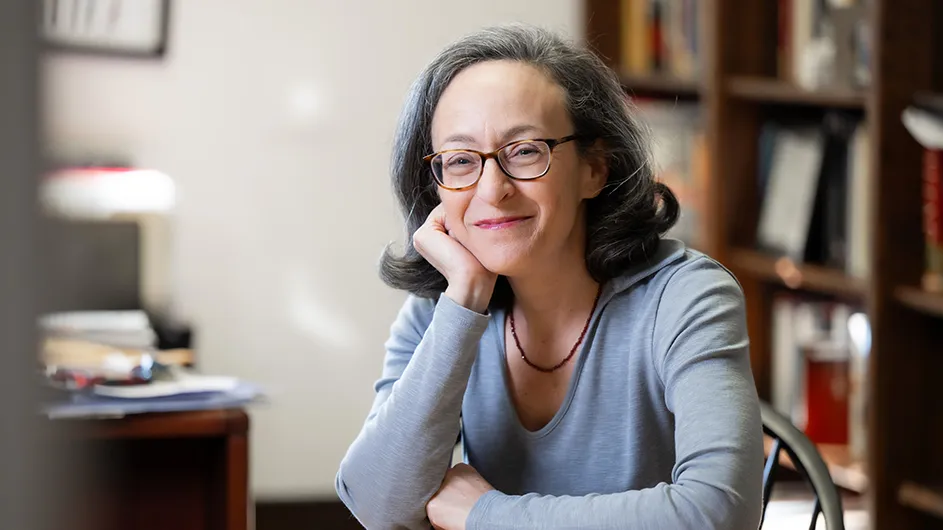
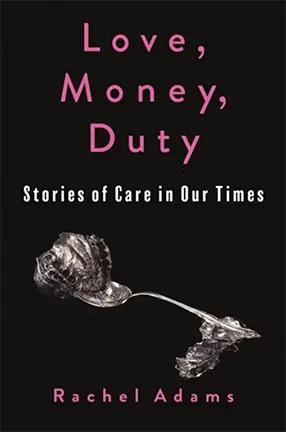
From birth to death, we care and are cared for by others. In Love, Money, Duty, Rachel Adams, a professor in the Department of English and Comparative Literature, examines the stories we tell about care, those who do the work, and those who depend on it. These narratives, she argues, help us better understand our feelings about care and the obligations that come with it.
Combining readings of writers and artists—among them, Toni Morrison, Susan Sontag, Roz Chast, Sally Mann, and Jamaica Kincaid—with stories of her own experiences, Adams analyzes the work, feelings, and ethical dilemmas associated with care, including unwelcome emotions such as boredom, resentment, exhaustion, and disgust. From the universal dependence of infancy to elder care, and from the intimacy of home and family to institutions like hospitals, nursing facilities, and asylums, Love, Money, Duty considers our ambivalence about vulnerability and need, and how it is shaped by capitalism, race, and gender.
Drawing from moral philosophy, gender and queer theory, critical race and disability studies, and health humanities, Adams treats care as a form of work, a feeling, an ethic, and an art. She invites readers to appreciate care that works, recognizing the creativity and resourcefulness of dependent people and their caregivers.
Adams talks about the book with Columbia News, along with the sorts of books she likes to read and why she reads, her current projects, and her ideal dinner guests.
Why did you write this book?
This book grew out of my experiences as a caregiver for two young children, one with significant disabilities. I love my children dearly, but also often felt angry, frustrated, or resistant. Why did I love them most tenderly when they were asleep? Why did care feel so unnatural and obligatory? Why didn’t other women seem to share my frustrations?
I found literary and visual narratives that expressed the complexity of my feelings—say, the writing of Kate Chopin, Adrienne Rich, or Toni Morrison, or the photography of Sally Mann—but did not find my experiences echoed in the social worlds I inhabit. I wanted to explore the personal and social forces that generate our complicated feelings about care giving and receiving, and write frankly about the realities of human frailty we often deny or repress until they are forced upon us.
Can you give some examples from the book of negative feelings—ambivalence, resentment—about care?
Oh yes, absolutely! I was especially drawn to moments of negativity because they tend to elicit our most searching, honest, and potentially transformational insights about care. There is Amy Hoffman’s wonderful memoir, Hospital Time, which is about caring for her dear friend Mike, who is dying of AIDS and wants only to be left alone. She confesses, “I wanted to run away. I wanted it to be over.”
Wendy Mitchell, who wrote of her experiences with early-onset Alzheimer’s in a memoir, Somebody I Used to Know, and a blog, Which Me Am I Today?, wished she had the resources to end her life at a clinic in Switzerland to avoid burdening her adult daughters. Gerda Saunders, another memoirist with dementia, imagines herself becoming “a self-centered bundle of need.” And in Toni Morrison’s novel Beloved, the escaped slave Sethe would rather kill her baby daughter than allow her to be taken into bondage.
I think bad feelings—resistance, resentment, frustration—are an inevitable part of caring relations that we should acknowledge. But it is also true that these feelings are more pronounced in a society like ours, where care is unevenly distributed and undercompensated, and we lack resources to properly support caregivers and the dependents who rely on them.
What sort of reader were you as a child?
Voracious and escapist. I grew up in a care vacuum and have few happy memories of childhood. Books were a way for me to retreat from my surroundings into other worlds, usually the darker and more conflicted, the better.
What's the best book you ever received as a gift?
My friend and colleague Scott Herring gave me the novel, Nothing to Look at Here by Kevin Wilson. I found its plot about children who spontaneously burst into flames absurd, moving, and deeply real, since it gets at the complex stew of love, joy, danger, and rage of caring relations.
Do you read fiction or nonfiction? Do you read to relax and escape, or to learn and be intellectually challenged?
I am usually reading multiple books for all of the reasons you mention. I am always reading something related to my research and writing, with the intention of learning, deepening, or honing my knowledge. If I’m in the midst of a semester, I will be reading the books I’ve assigned to my students. I try to reread every book I teach about a week ahead of them, so I can come into class with advice about how to manage upcoming reading assignments. And I’m always reading something for pleasure, which I keep by my bed to relax or offer myself a break. I am often also reading work in progress for students, colleagues, or friends, with the intention of offering them suggestions and feedback.
What did you teach this semester?
I was in charge of our department’s curriculum this year, so I gave myself an ideal teaching assignment. I taught two undergraduate seminars: One was Comics, Health, and Embodiment, where we read graphic narratives (aka comics) about experiences of illness, disability, and other conditions that draw attention to the body. We discussed and wrote about what we read, and students also produced comics of their own.
The other seminar was Lab Lit, Weird Science, and Speculative Fiction, in which we read literary narratives about science, scientists, and scientific innovations in many different genres, including sci-fi (Mary Shelley’s Frankenstein and N.K. Jemisen’s The Fifth Season), realism (Sinclair Lewis’s Arrowsmith and Richard Powers’ The Overstory), and films like Blade Runner, Gattaca, and Dr. Strangelove.
What are you working on now?
For the past 10 years, alongside my teaching and writing, I’ve been taking undergraduate science courses at Columbia, and am enrolled in the second-degree BA program in the School of General Studies. Now that I’ve finished this book on care, I’ll start to write a book about those experiences. It will combine multiple stories—trying to learn about science after growing up in an environment where girls were not encouraged to pursue STEM, how being a student myself later in life has transformed my teaching and given me new perspectives on my students, and about why it is valuable and important to cross the deep disciplinary divides between science and the humanities.
Which three writers/scholars, dead or alive, would you invite to a dinner party, and why?
Writers Merlin Sheldrake and Kazuo Ishiguro, and chemist Rosalind Franklin. I would use this dinner party to launch my new research project on humanities-biosciences intersections. I hope that conversation could flow, and I could just sit back and listen. Sheldrake and Ishiguro are two of the most talented contemporary writers I’ve read, and their work transformed my thinking in powerful ways. I imagine that the scientist and the novelists would each be open and deeply attentive to conversing and learning from one another.
How would Franklin enter the conversation? I’m not sure because there is so much mystery around her short life, and the accounts of her personality and social skills are contradictory. I think she was forced to do a lot of code switching, and I would love to see what she would do in a safe and sociable environment. I also have a lot of questions I’d like to ask her, hearing her side of a story that has been told almost exclusively by men.