BridgeColumbia Aims to Help Students Overcome Divides
The group offers structured opportunities for students to engage in constructive dialogue and disagreement.
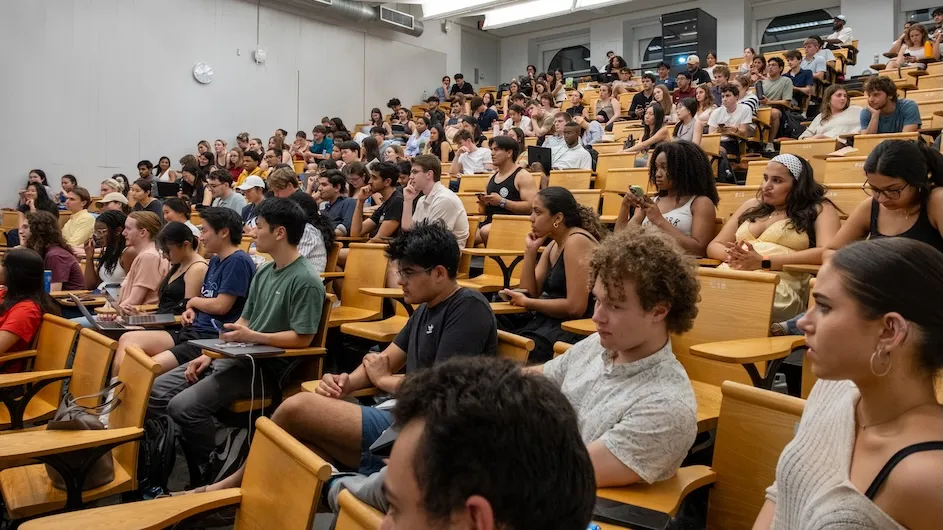
Extracurriculars is a series within Columbia News dedicated to showcasing the many clubs and organizations that exist at Columbia University.
BridgeUSA was founded in 2017, on the campus of the University of California, Berkeley, when protests over a conservative speaker coming to campus turned violent. The group wanted to create a space to foster dialogue where both sides could speak to each other.
Columbia’s chapter—BridgeColumbia—held its first meeting in September 2024, after Harvey Pennington (GS/JTS ’27) reached out to BridgeUSA about the idea of launching a Columbia chapter, in the wake of ongoing campus protests over Israel and Palestine. The national team connected Harvey to TJ Gill (Law ’27), who had independently contacted the national group about establishing a Columbia group. Together, they created Columbia’s chapter.
“I wanted to create a space on campus where structured, consistent space for productive dialogue was possible on a campus where political conversations are often polarized or avoided altogether,” Pennington said.
BridgeColumbia does that by holding moderated discussions on contentious topics that give people with differing viewpoints structured amounts of time to argue their viewpoint, listen to differing views, and offer counter-arguments to what they’ve heard.
The Club’s Mission
BridgeColumbia seeks to reduce political polarization within the wider Columbia community, emphasizing the need to respectfully engage with and listen to ideas from across the political spectrum. The group tackles the most pressing political challenges of our time—from upcoming elections to global events—through constructive disagreement and honest engagement. They host speaker events, town hall meetings, and other organized assemblies in the hopes of fostering collective empathy and cooperation within the Columbia student body. The group’s strategic faculty adviser is Peter Coleman, a leading scholar in conflict resolution and constructive dialogue.
Club Meetings
BridgeColumbia meets weekly, usually in Hamilton Hall. Meetings run one hour. A typical meeting is moderated by a member of the board, and proceeds under a set of established discussion norms: Listen to understand, not to respond; no interruptions or side conversations; address the statement, not the person; avoid generalizations, and only speak for yourself.
Each meeting focuses on one topic. The format is conversational, typically combining larger group discussions with breakout groups.
At the end of the meeting, members vote on topics for the following week via a group chat survey.
Recent Club Events
- A CU Democrats vs. CU Republicans debate with more than 200 attendees
- An Israel-Palestine debate with around 100 attendees
- An intercollegiate, multi-day summit (“Bridge the Northeast”) with seven BridgeUSA chapters (Columbia University, New York University, St. John’s University, Rutgers University, Stony Brook University, Dartmouth College, and University of New Hampshire) and more than 150 participants
Why You Should Sign Up
“When I spoke to the CEO of BridgeUSA, Manu Meel, something he told me particularly resonated with me,” Pennington said: “‘BridgeUSA is not about learning how to agree with one another, rather, it’s about learning how to disagree with one another.’”
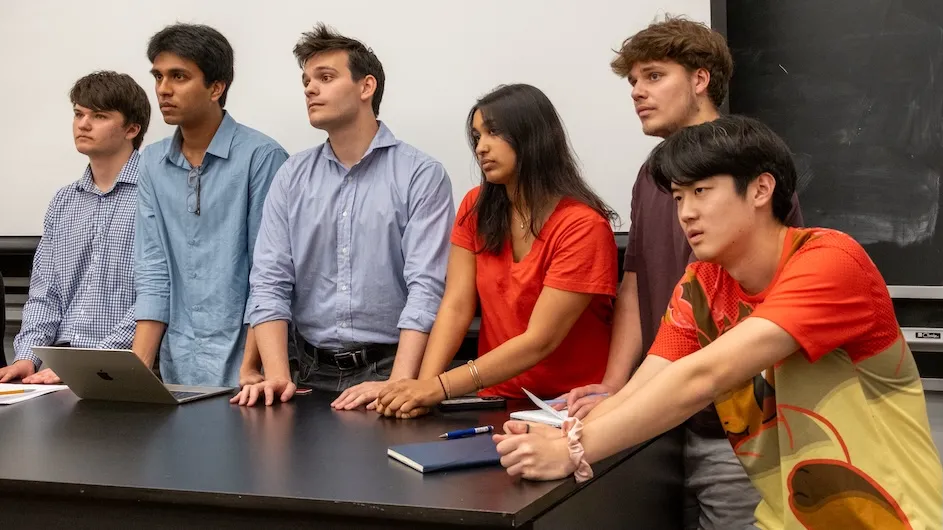
Pennington said that the lessons he’s learned from the group have enriched him, and even helped him in his post-college job search: “So many interview questions are like, ‘tell me about a time you disagreed with someone,’ or ‘tell me about a time you worked on a team.’ I end up using examples from Bridge for almost all of those. It’s made me a much better communicator.”
Who Can Attend and Join
Any Columbia student can attend BridgeColumbia’s large-scale, campus-wide events, and is eligible to apply for membership.
How to Join
Starting in the fall, there will be a formal membership recruiting process. Any student at the University will be eligible to apply to become a member. Prospective members will be required to attend all meetings, and some members will be elevated to the role of Bridge Discussion Lead throughout the year through an application process. The group will also be launching a selective committee application cycle for interested incoming freshmen and sophomores who want to participate in outreach and communications work. (All Columbia students will still be allowed to attend the group’s large, campus-wide events).
To stay up to date, look out for membership and committee applications in the fall via the group’s Instagram and at the Columbia Club Fair.